• I think Korean Elementary school lunches might be one of the best in the world. I worked for a short period in an American elementary school and I was shocked at the garbage they were being served. There was only one “lunch lady” who just got a bunch of plastic packages every morning and heated them in a bunch of microwaves before the kids came to lunch.

    The problem of course was not her but the lack of support the American schools got in terms of school lunch. In my school, there were 5 lunch ladies who cooked everything in the school kitchen the same day, and one nutritionist who was hired to decide the menu.

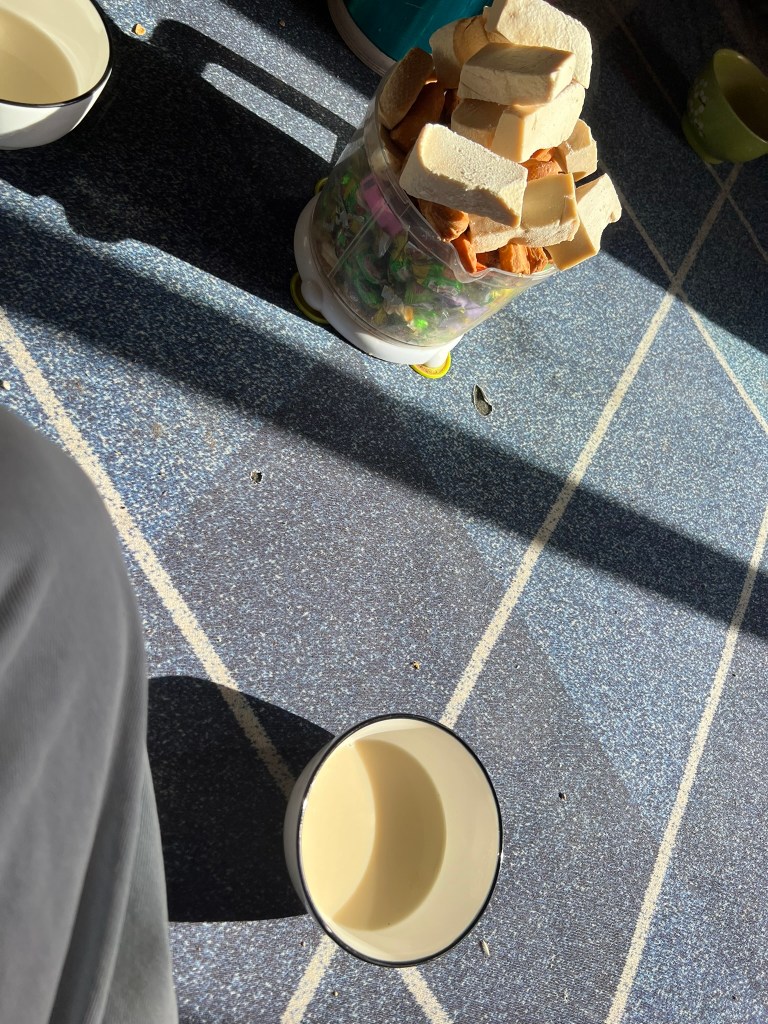
    Anyways, here is an example of what is served in 1 week at a Korean elementary school!

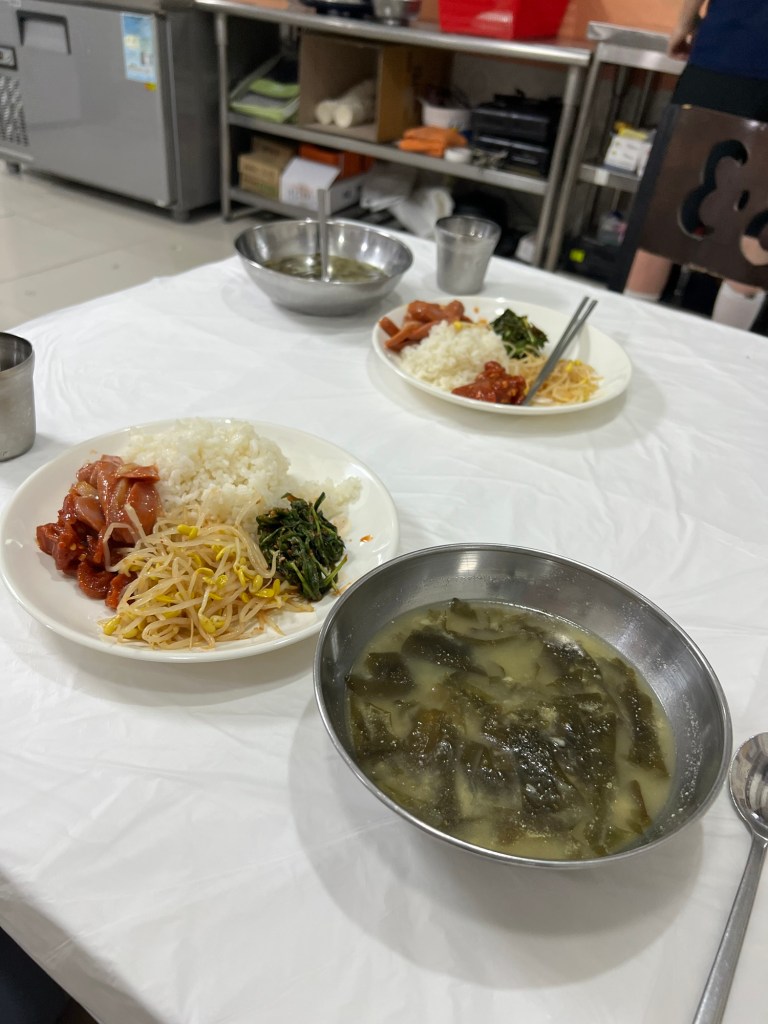
    Day 1 (647Kcal)
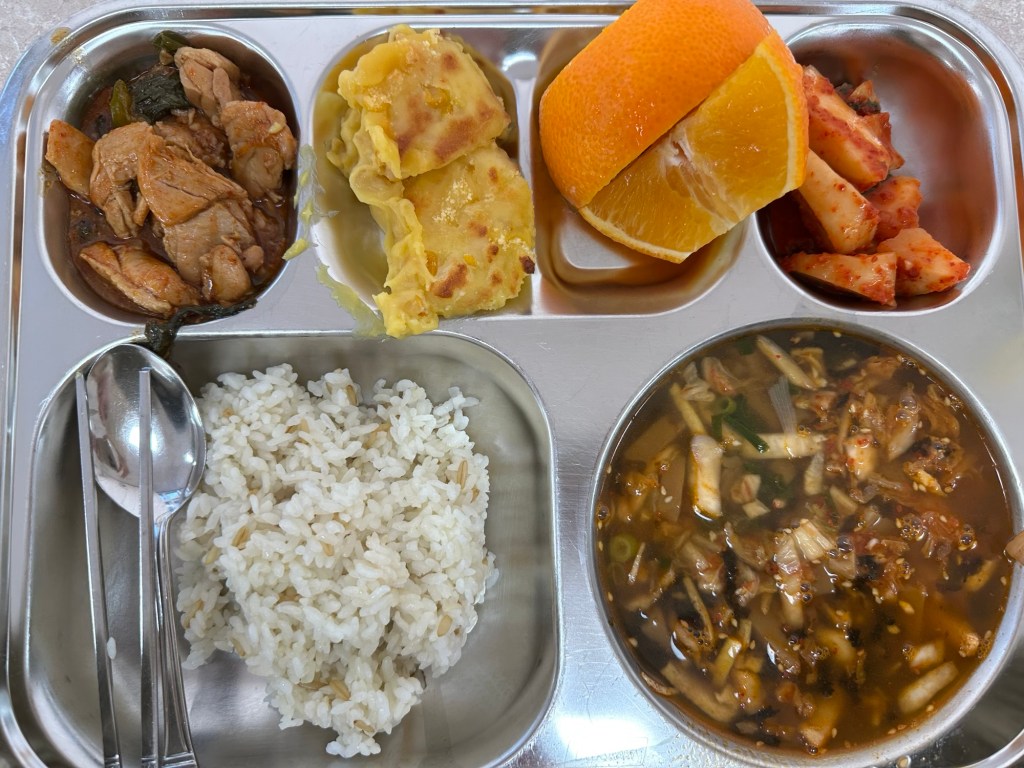
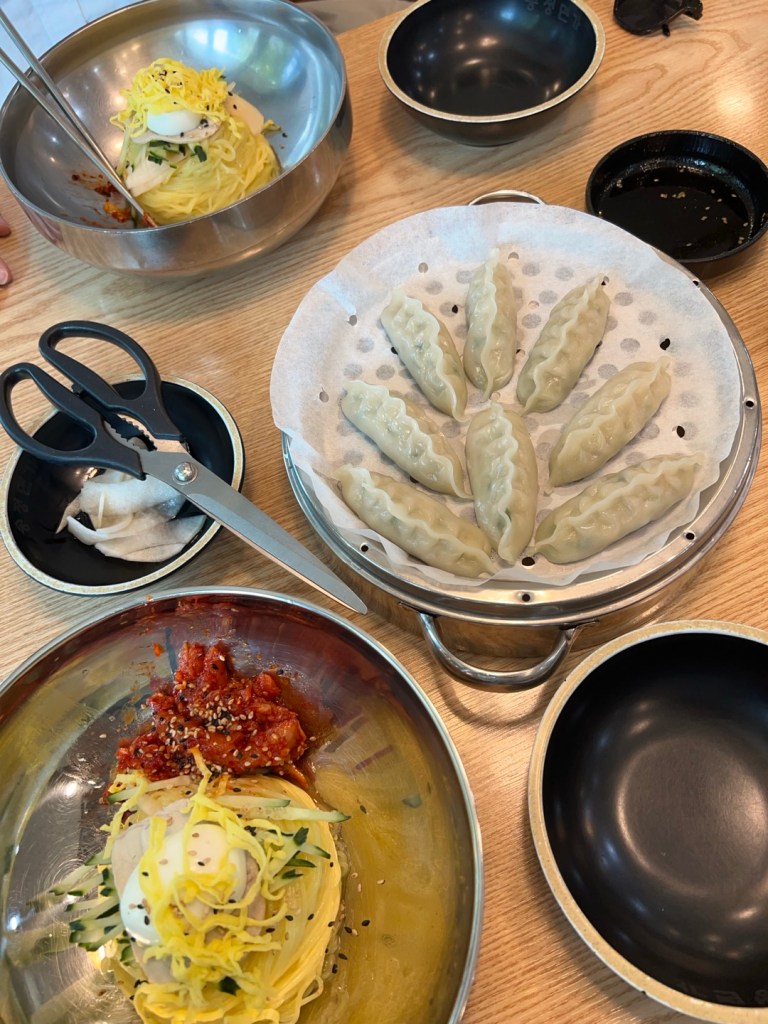
    Soup: Acorn Jelly Soup (bottom left)

    A cold soup with kimchi, Muk (like a squishy gelatin-like food made from acorns), sesame seeds, seaweed, green onions, and a sour and savory broth made from anchovies.

    Rice: Oatmeal rice

    Rice with oatmeal oats mixed in

    Kimchi: Chonggak Kimchi (Top right)

    A kimchi made from radishes.

    Meat: Spicy Braised Chicken

    This chicken comes a lot in school lunches here, it’s kind of soft and sweet.

    Sides: Sweet Potato Corn Cheese, Korean Orange

    Day 2 (764Kcal)
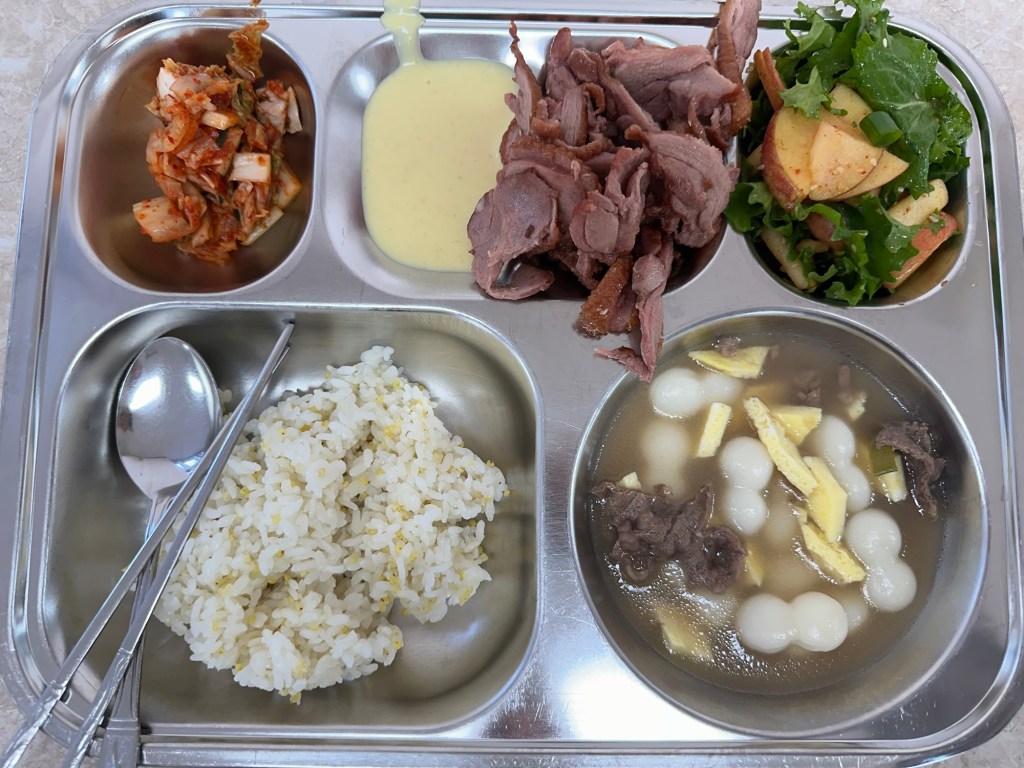
    Soup: Rice cake soup

    Ddeokguk is often eaten for the new years or birthdays. It’s rice cakes with a bone broth, beef, and eggs.

    Rice: Millet rice

    Rice with millet mixed in.
    Kimchi: Napa cabbage kimchi

    This is the most common kind of kimchi in Korea.

    Meat: Smoked duck with mustard sauce

    I thought this was ham but when I look now it’s duck! Duck is a pretty expensive meat in Asia.

    Sides: Apple and Chicory Fresh Salad

    Day 3 (718Kcal)
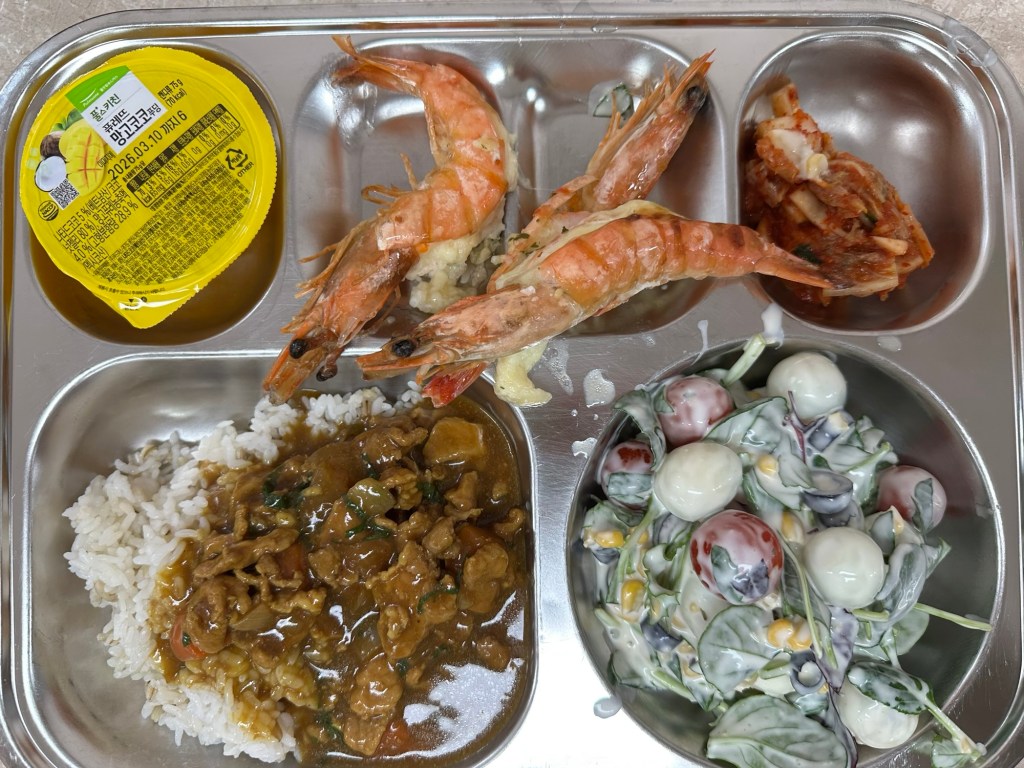
    Salad: Quail egg, spinach, olive, tomato and corn salad

    This would be right up my alley if it weren’t for the olives. It’s very rare for there to be no soup, but I think it’s because the rice came with curry today.

    Rice: Beef curry and white rice

    Has beef, carrots, and onions. It’s a common comfort food.

    Kimchi: Napa Kimchi

    Just normal kimchi!

    Meat: Cheese-baked shrimp

    I like shrimp, but any food where I have to get out some gloves to eat it is a minus for me.

    Sides: Mango pudding

    Just like mango jell-o! Wednesdays are “no leftovers” days in Korea, meaning that the menu served appeals to the palate of kids, so it’s not as healthy as the other days.

    Day 4 (574Kcal)
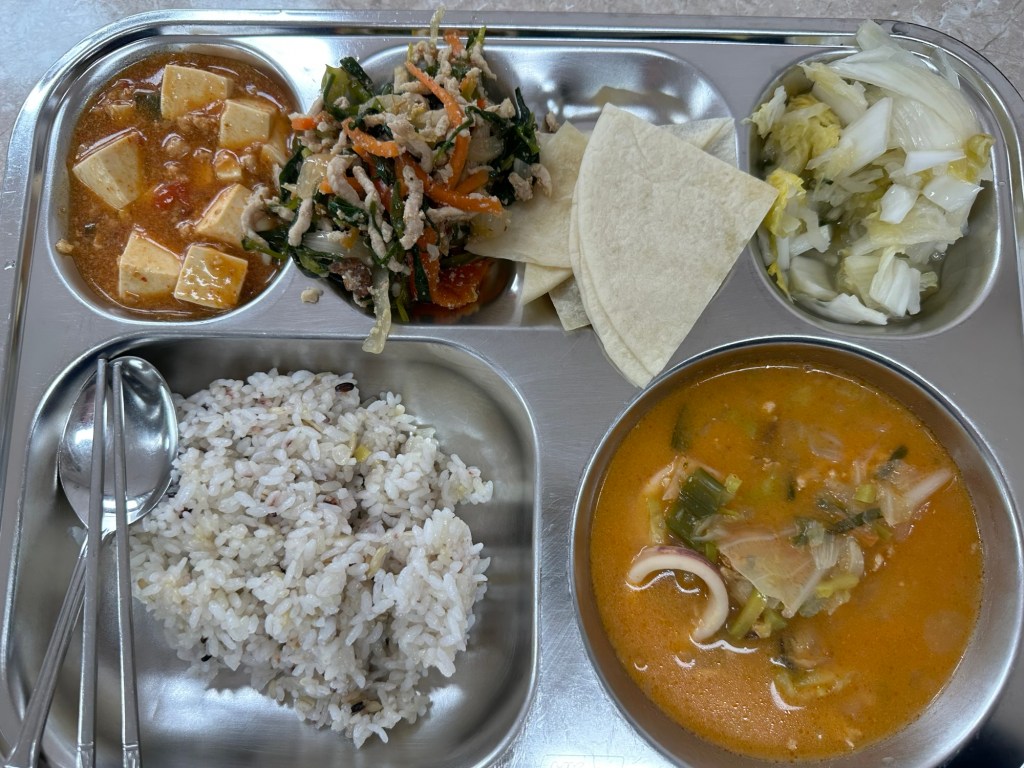
    Soup: Creamy Jjamppong

    Jjamppong is a Korean style Chinese food, like a spicy seafood soup, but because it’s an elementary school they don’t really do spicy foods. It has some vegetables and seafood like clams or squid.

    Rice: Multi-grain Rice

    It has a mix of different grains, so I’m not sure what’s in it.

    Kimchi: White Kimchi

    It’s fermented Napa cabbage, but not spicy (they don’t put in gochugaru)

    Other: Mapo Tofu

    It’s Chinese food, tofu in a sauce made from fermented chili beans, soy sauce, and a bunch of other stuff. It’s supposed to be spicy, but school lunches are never really spicy.

    Tacos?

    This Korean taco does not hold a candle to the American tacos. Why do they always cut the tortilla into fourths?

    Day 5 (676 Kcal)
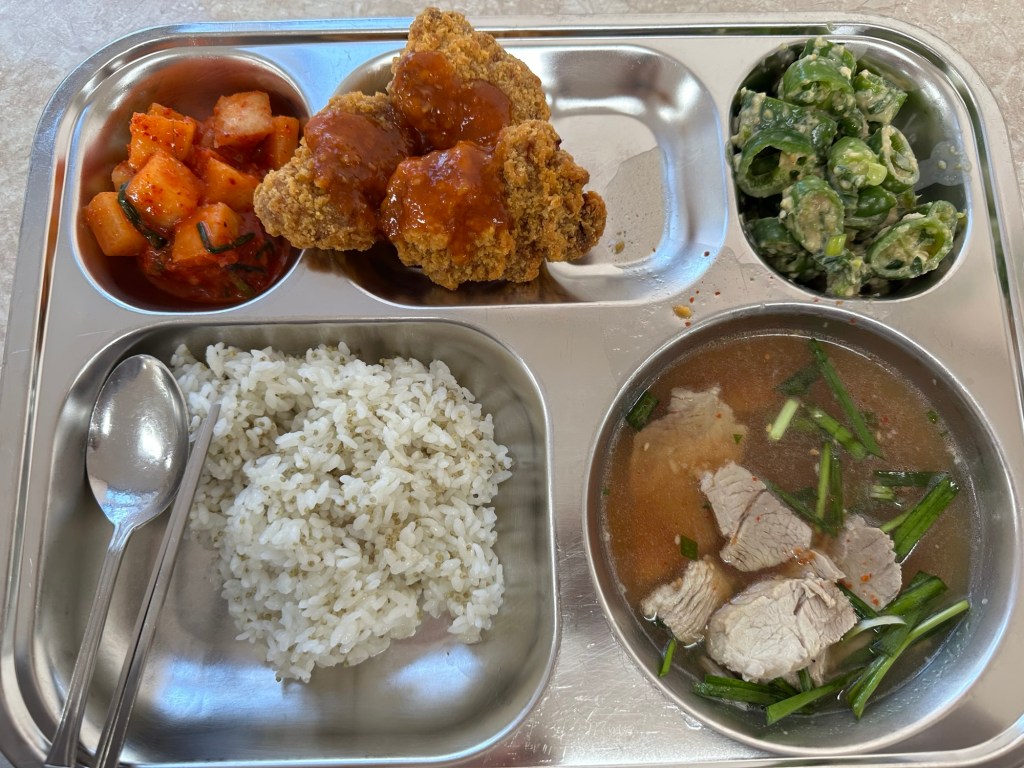
    Soup: Dweji-gukbap / Pork Soup

    A soup popular in southern Korea.

    Rice: Perilla rice

    Rice containing perilla grains

    Kimchi: Radish Kimchi

    Another day of radish kimchi.

    Meat: Fried chicken and chili sauce

    I don’t think it’s very good for you, but the kids went crazy.

    Side: Green pepper seasoned with Doenjang

    This is called Gochu Doenjang in Korean and it’s one of my favorite side dishes ever. Doenjang is kind of like miso, fermented soybeans in a paste, though it has a stronger taste and different purpose than Japanese miso.

    The best part of these lunches is they are either free or very cheap for staff! I think it costed me about 2,500 won per day which is like 2 dollars, just deducted from my paycheck each month.

    Thanks for reading until the end. Bye!
  • The next day we left the hostel early in the morning. Well, I thought it was early but we were actually the last ones to leave at 8 am?

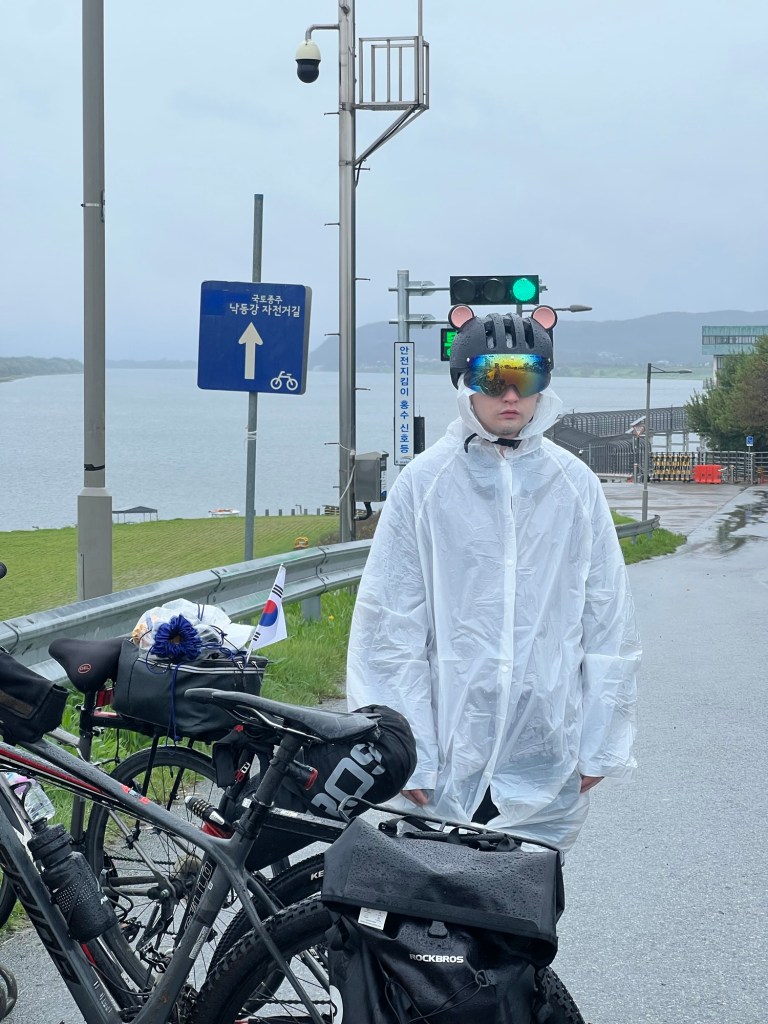
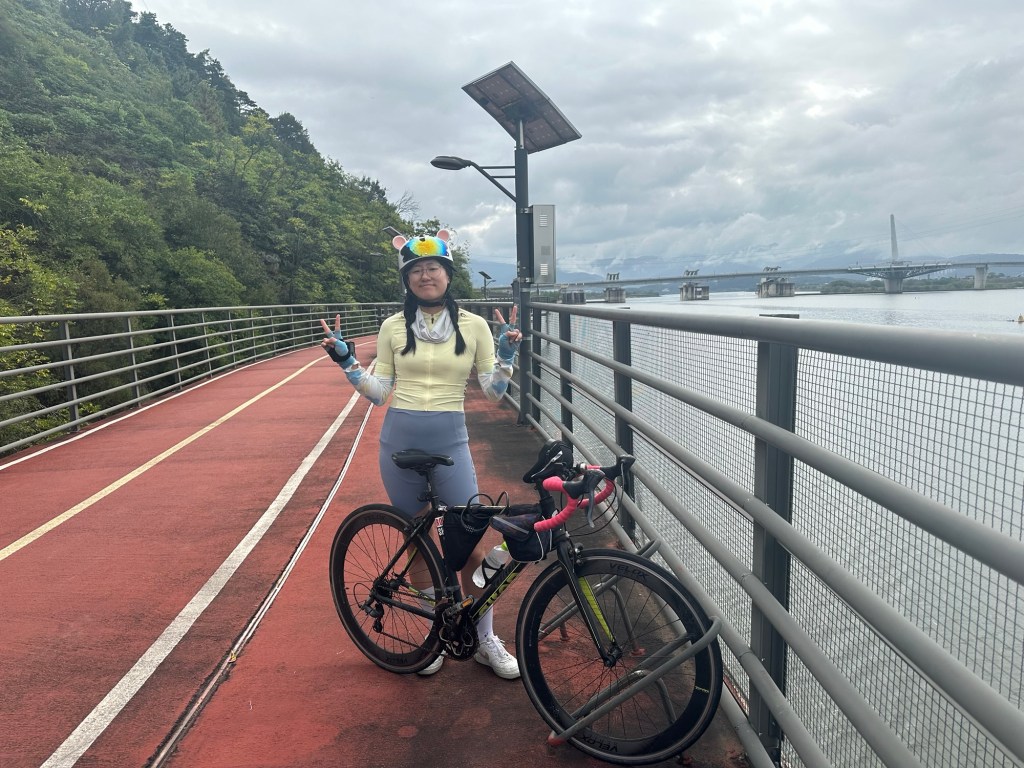
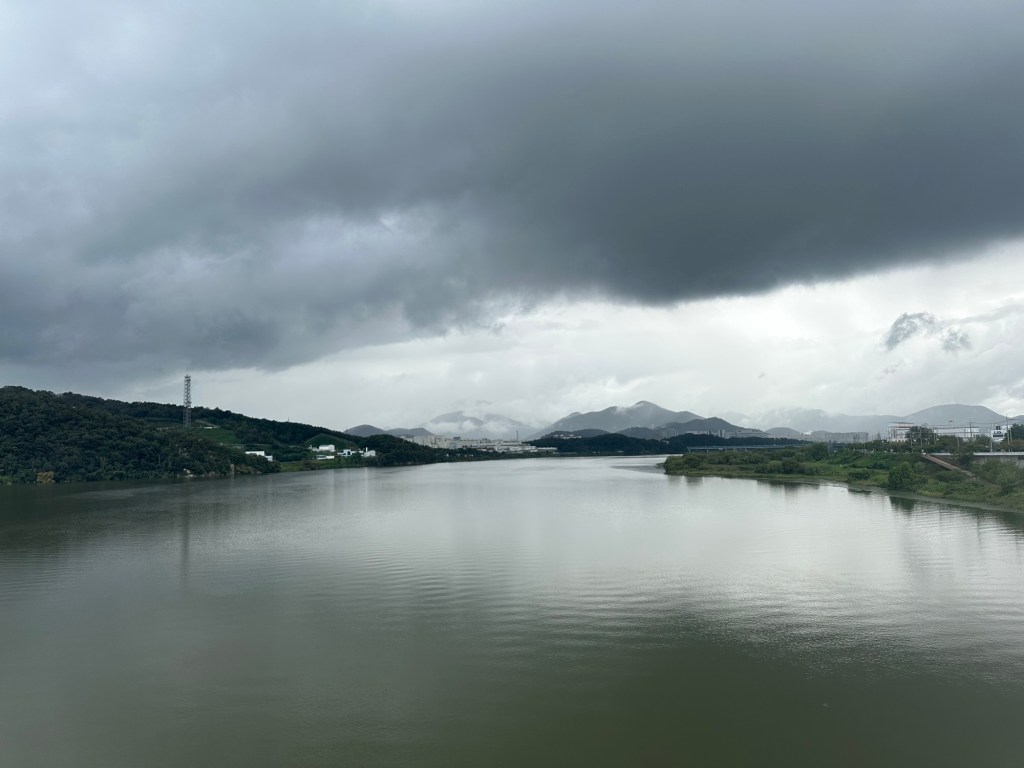
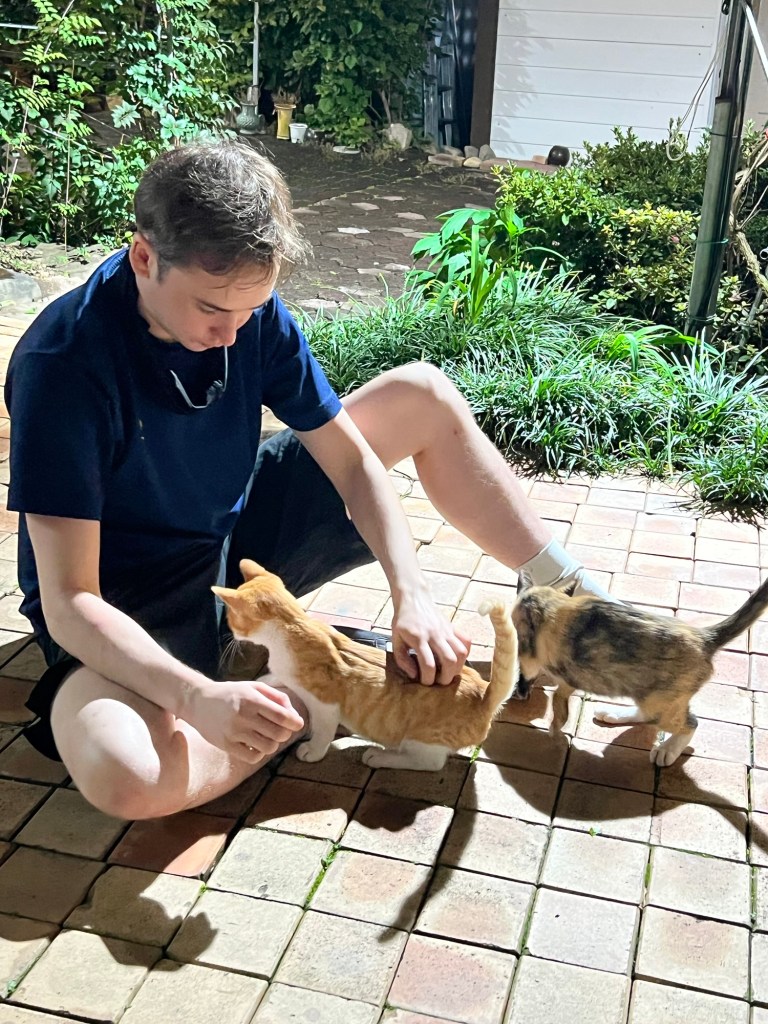
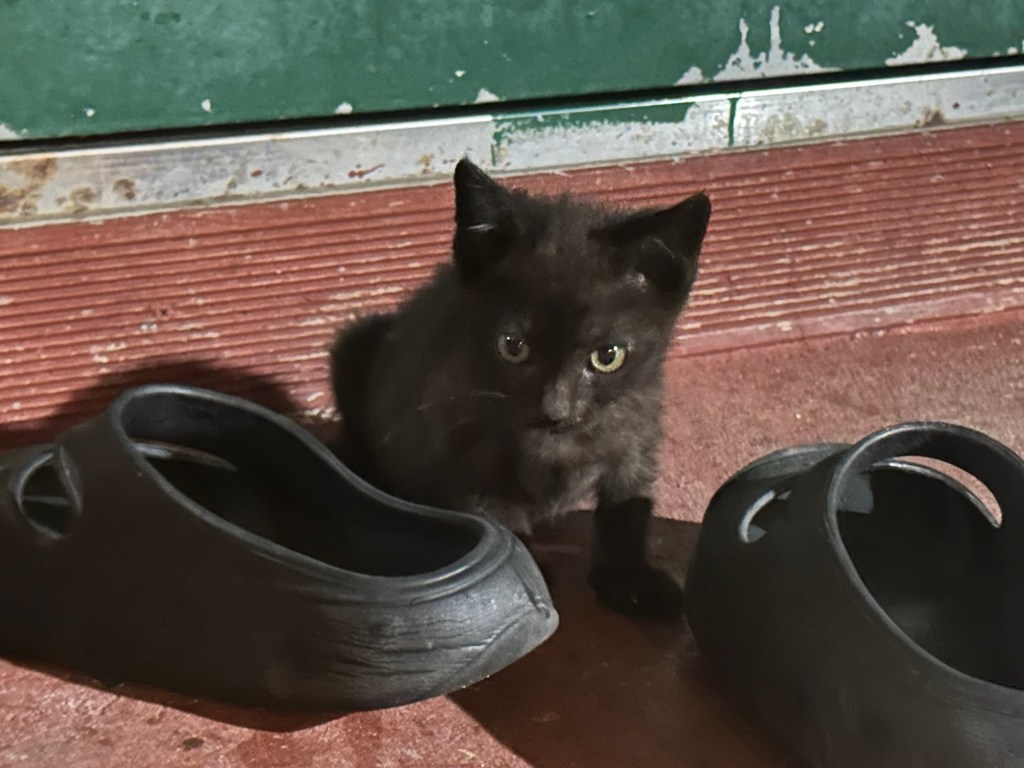
    Today we were again menaced by overcast skies, but given the healing strength of the 15 or so kittens at the hostel my morale was high.

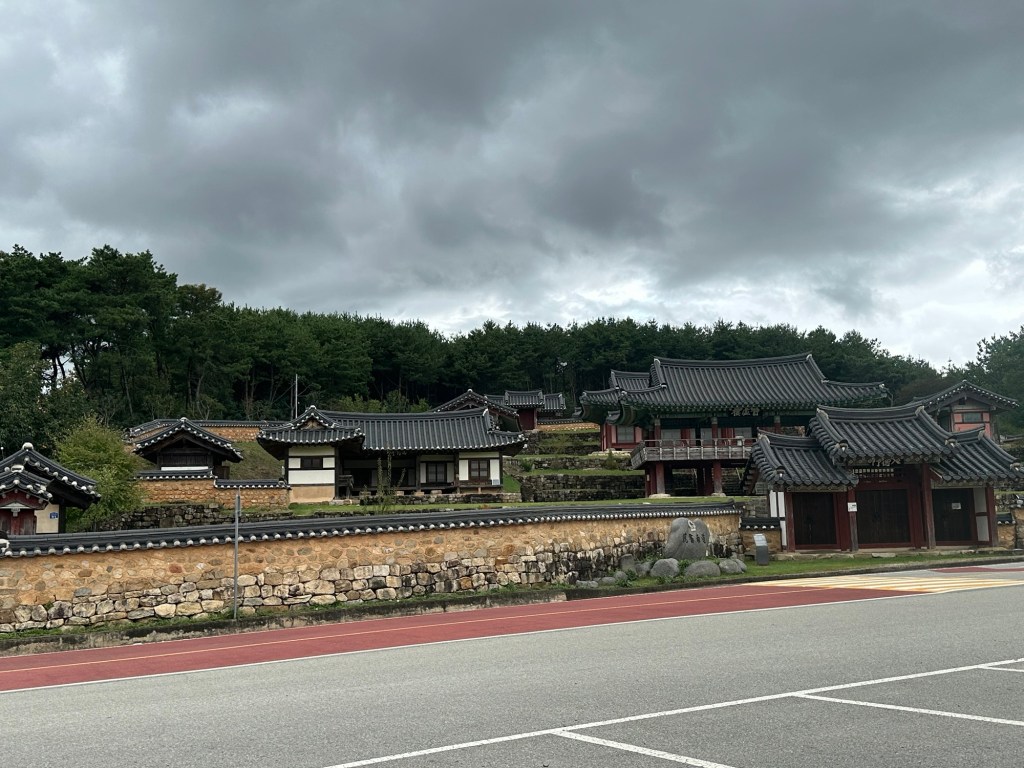
    Apparently this is a world heritage site, but it was so overcast it didn’t look all that pretty.

    And the first climb of the day! At this point it didn’t feel too hard.

    And some beautiful mountains on the way.

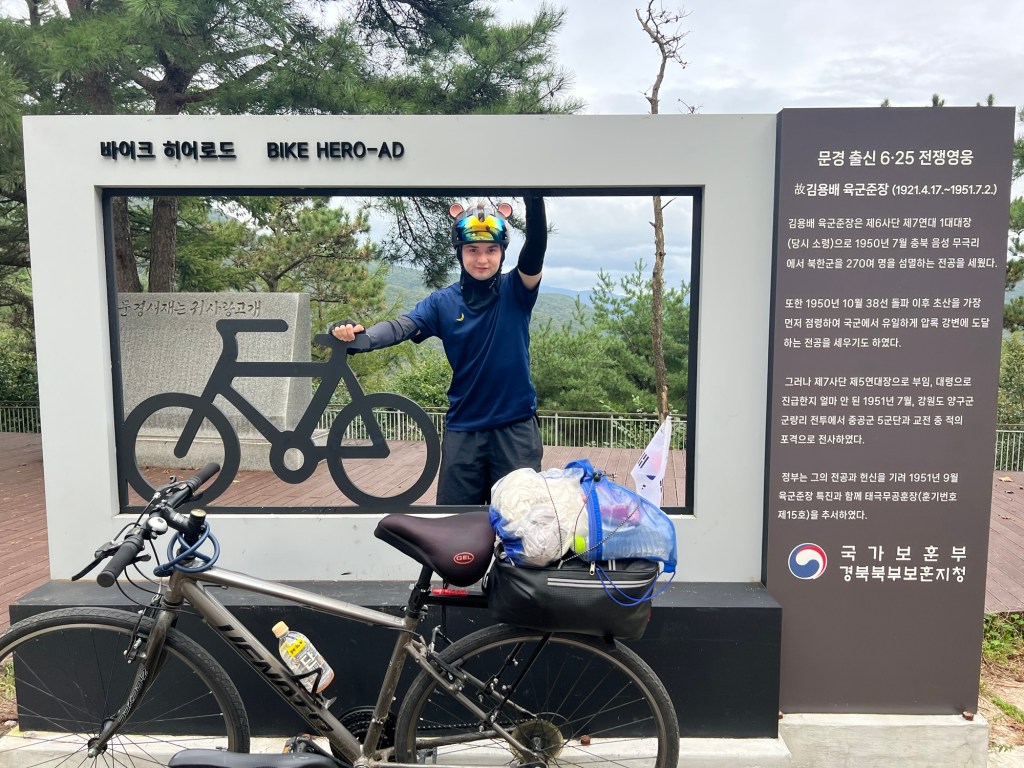
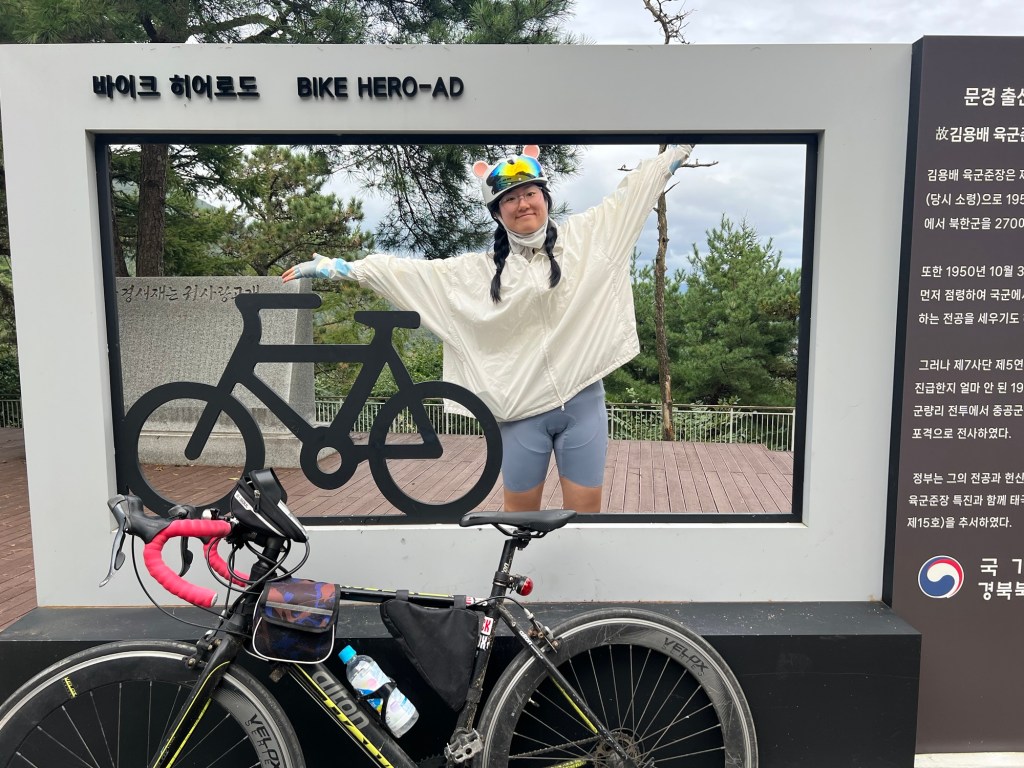
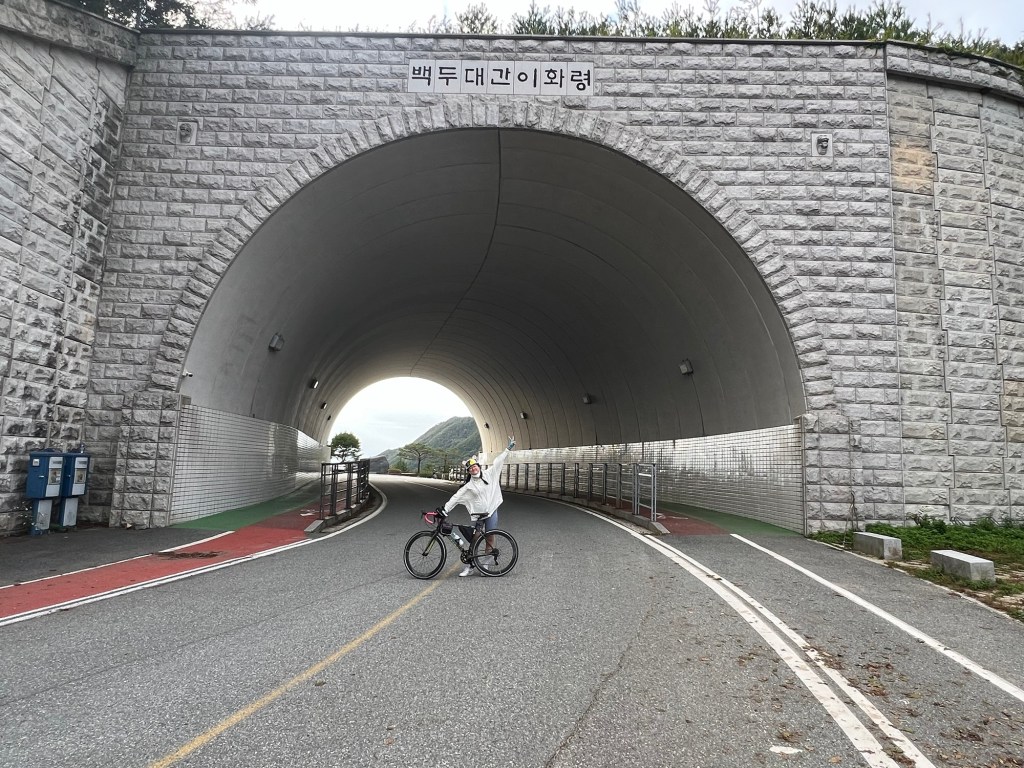
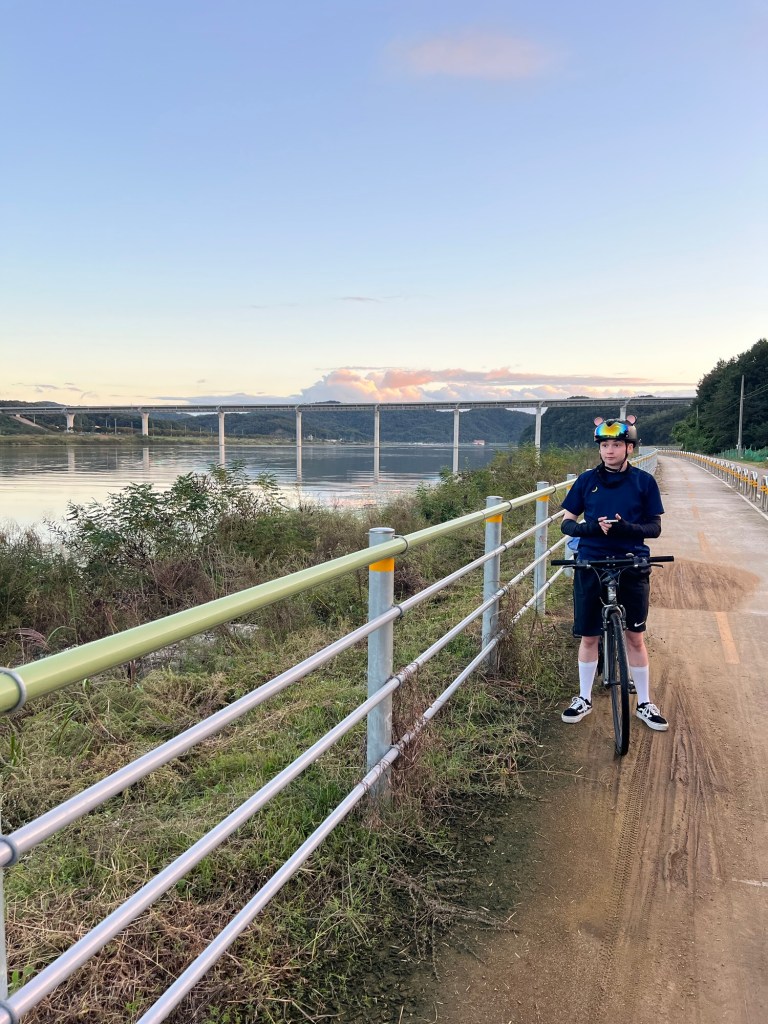
    Actually today has the most famous and difficult climb of the route. But despite being a little cloudy the weather was good! Hyeonjeong went up the entire climb without stopping.

    But I was faster, so I could stop at the rest stops and wait for her.

    It’s really high up.

    Anyways, we ended this day in Suan. It’s a very small town famous for hot springs.

    We didn’t have much time left, we decided to try to return to our house in Yangpyeong the following day. I don’t have many pictures today, I think it’s because I was trying so hard to get home before the sun set.

    I remember that it was cold and raining, and that I was bitter about all the scenery and fun things that would have been great if it was not so wet and cold.

    Anyways, we made it home and stayed in our house for the night. The weekend was already almost over and I had to go to work on Monday, so we decided to finish the last part some weekends later when the weather was better.

    And this is about how far we made it this day.

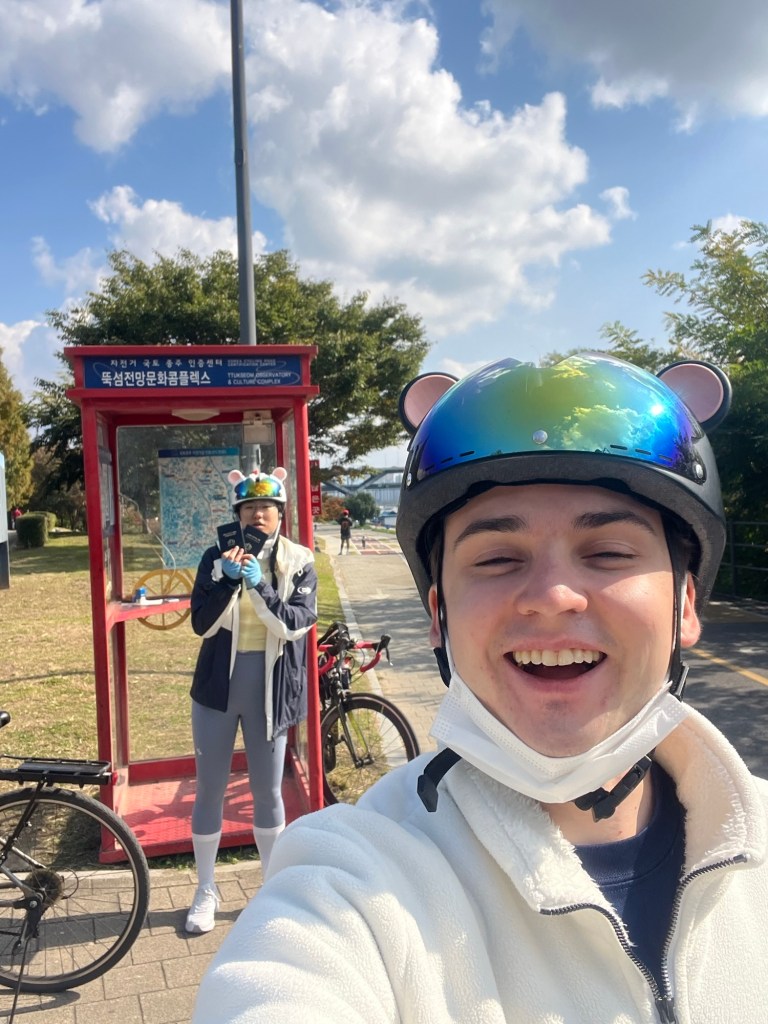
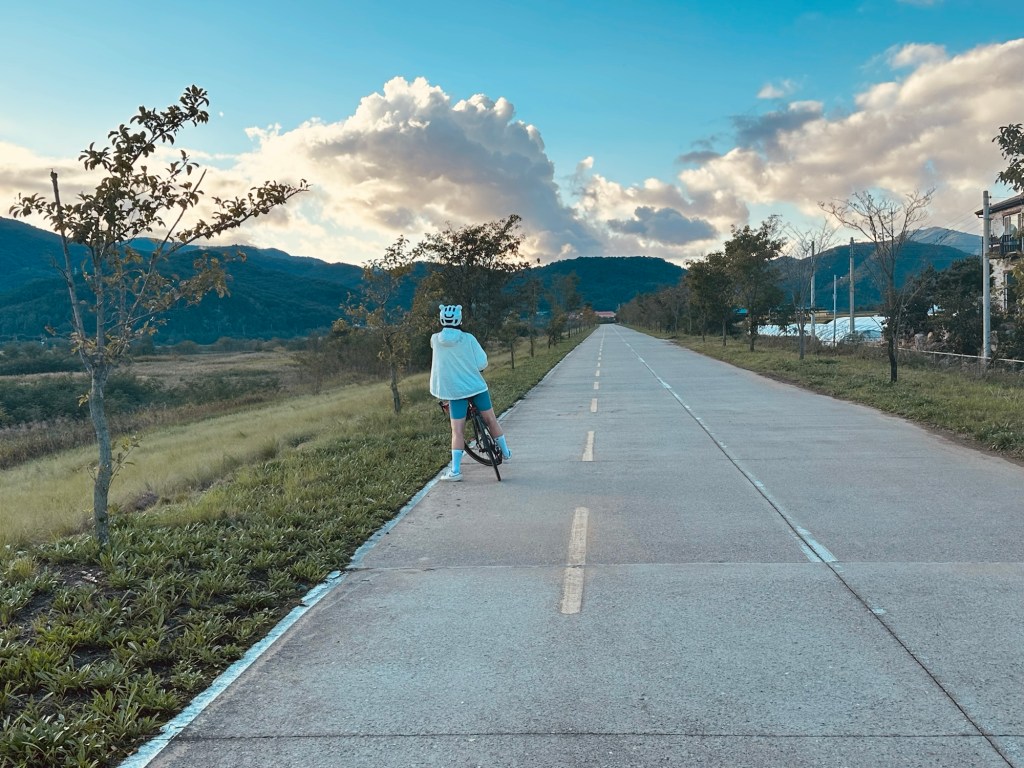
    And finally the last day! I was worried it would be slowed because we would have to use the normal roads sometimes like Busan, but it wasn’t a problem at all. The bike path was great the whole way.

    But I had some kind of coughing virus.

    I also had a small worm ride on me for a large part of the journey.

    Anyways, some other pictures.

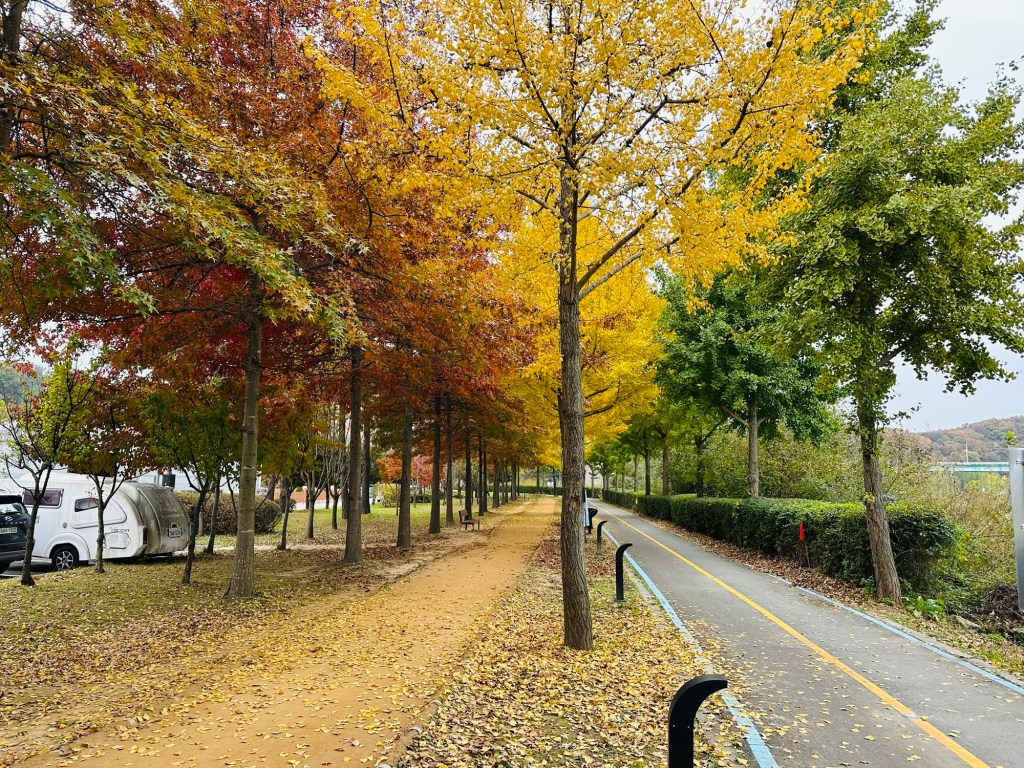
    And the fall colors were great as well.

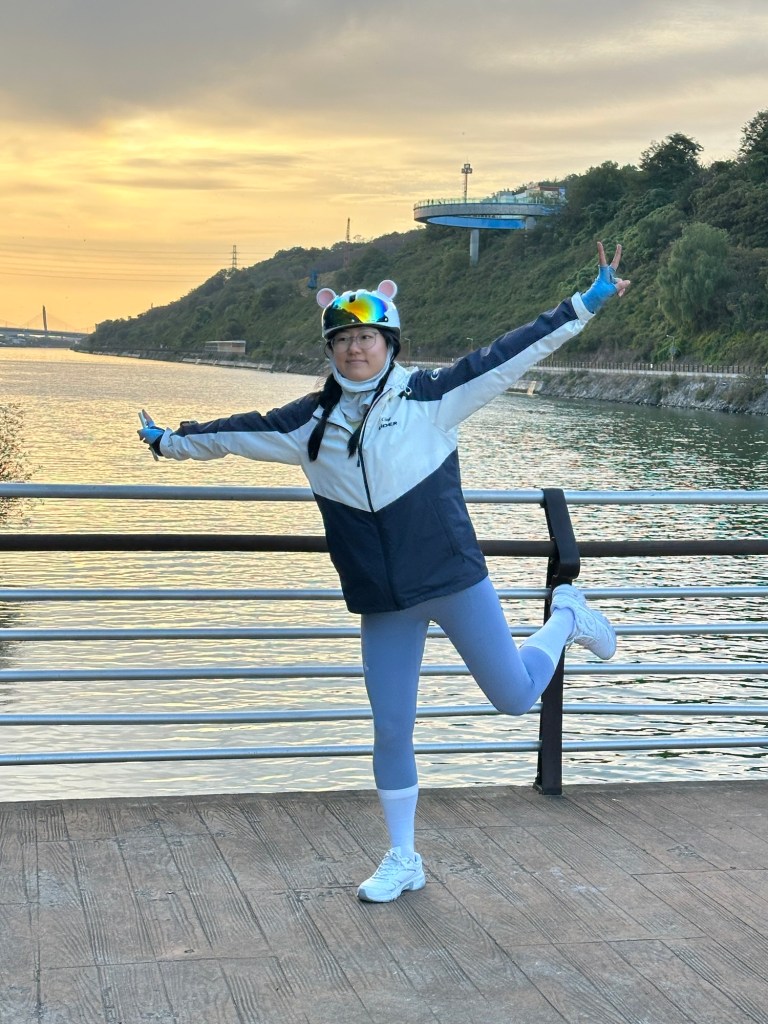
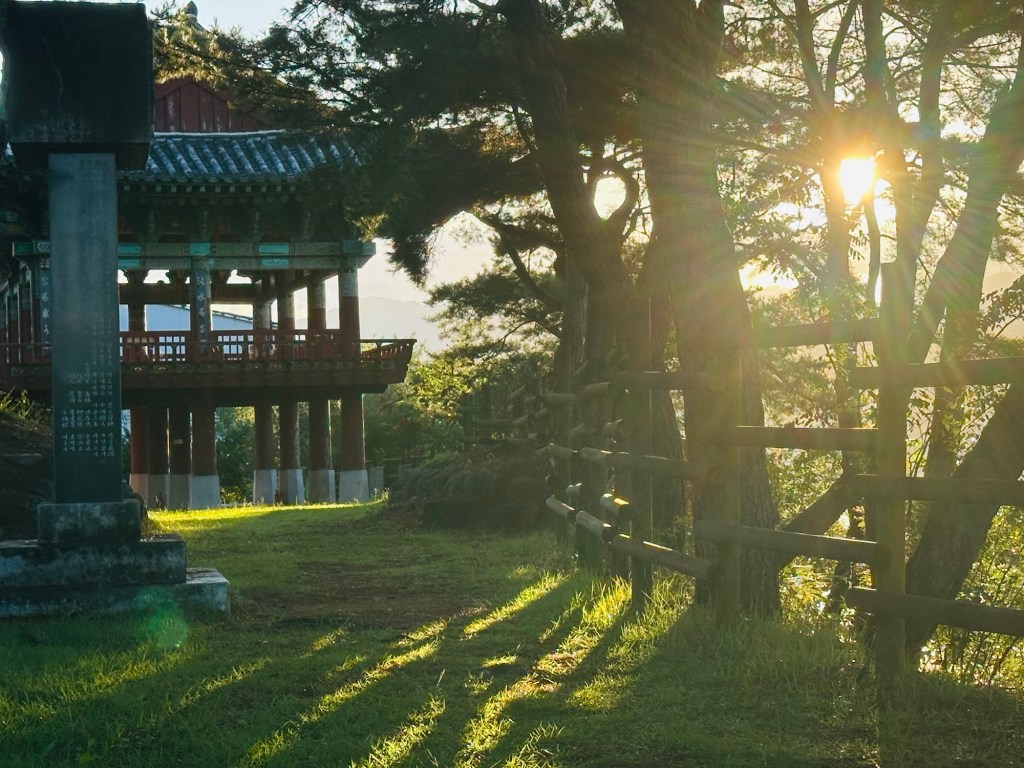
    I like this picture

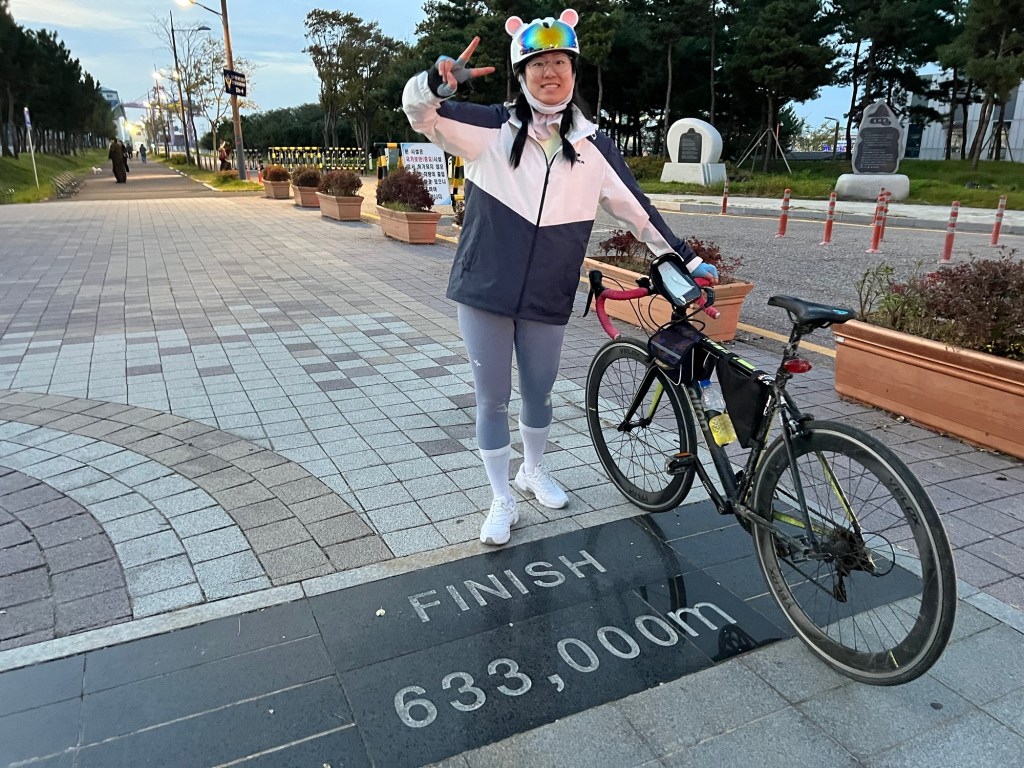
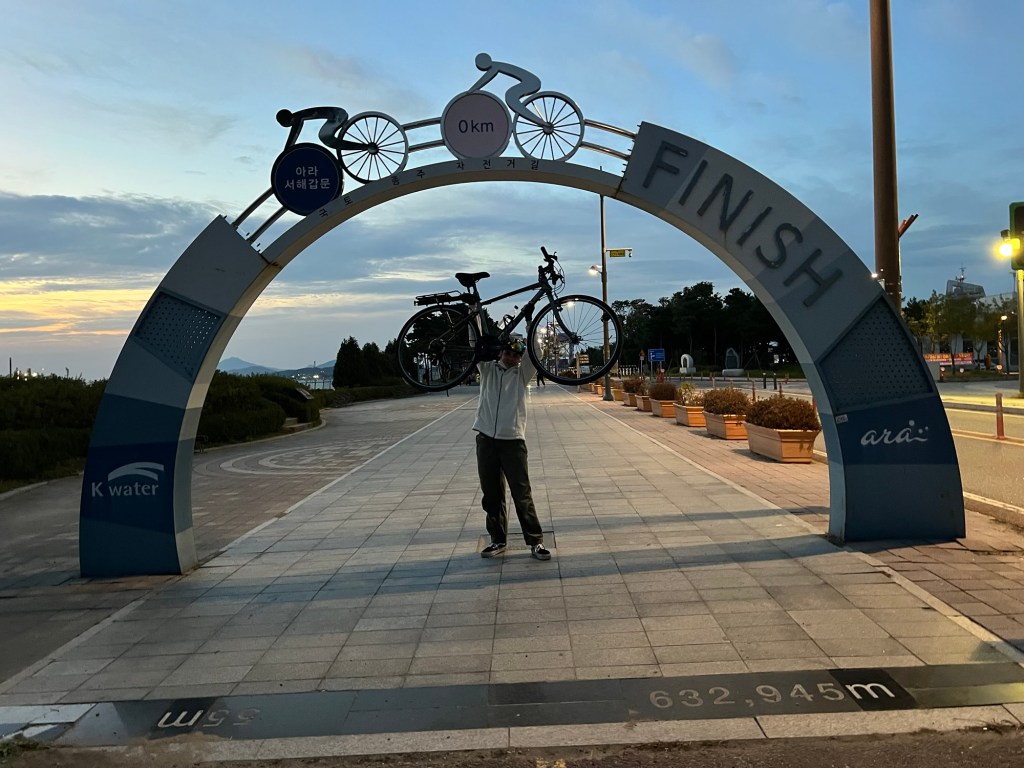
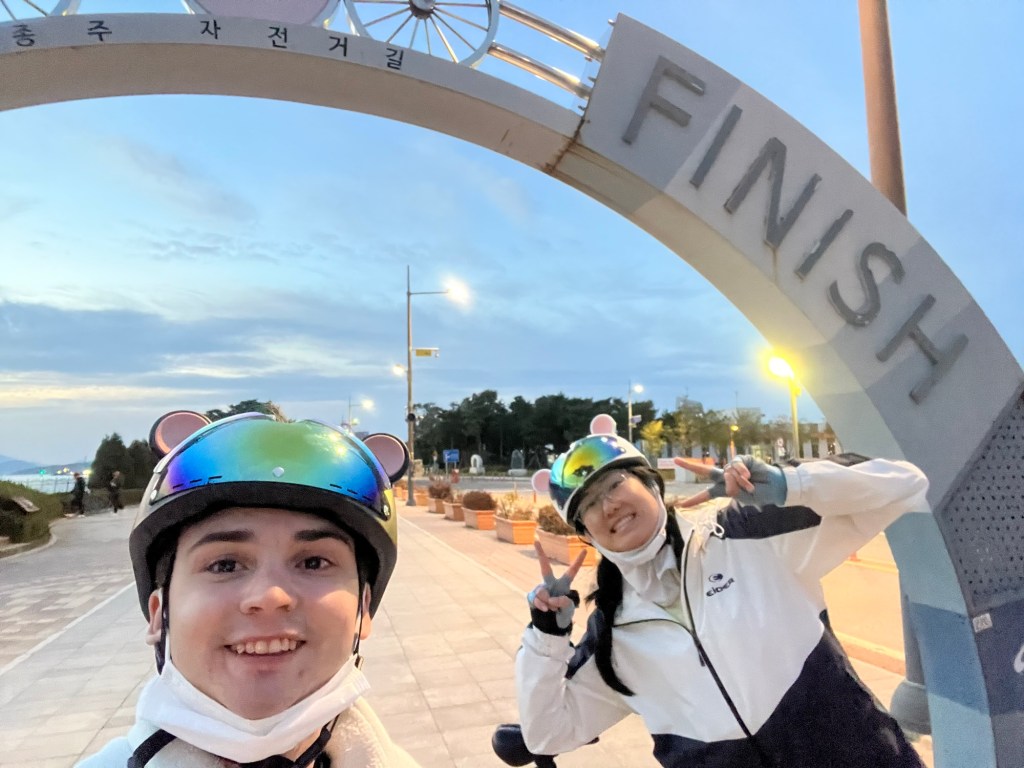
    We reached the finish line just before the sun set.

    Korea is a great country for bike touring. The bicycle road was completely separate from cars for most of the way and there are a lot of convenience stores and restaurants along the way.

    This was something I had wanted to do before I left Korea, though because of the rain circumstances I felt a little unsatisfied. Of course, you can’t expect the weather to be good the whole way, but it was raining every single day. I promised that I would do it one more time later on.

  • It’s been a while since I uploaded anything… Even though I have a lot to write. My personal computer broke, and shortly after WordPress was blocked at my workplace, so it’s been difficult to upload anything.

    Anyways, this fall I finished biking across Korea! I learned a lot. First, if you have no car or no support person to bring you to the start of the trail, you should use a folding bicycle. The only way to get to the start point is by the bullet train, which technically doesn’t allow bicycles.

    I had to take it apart.

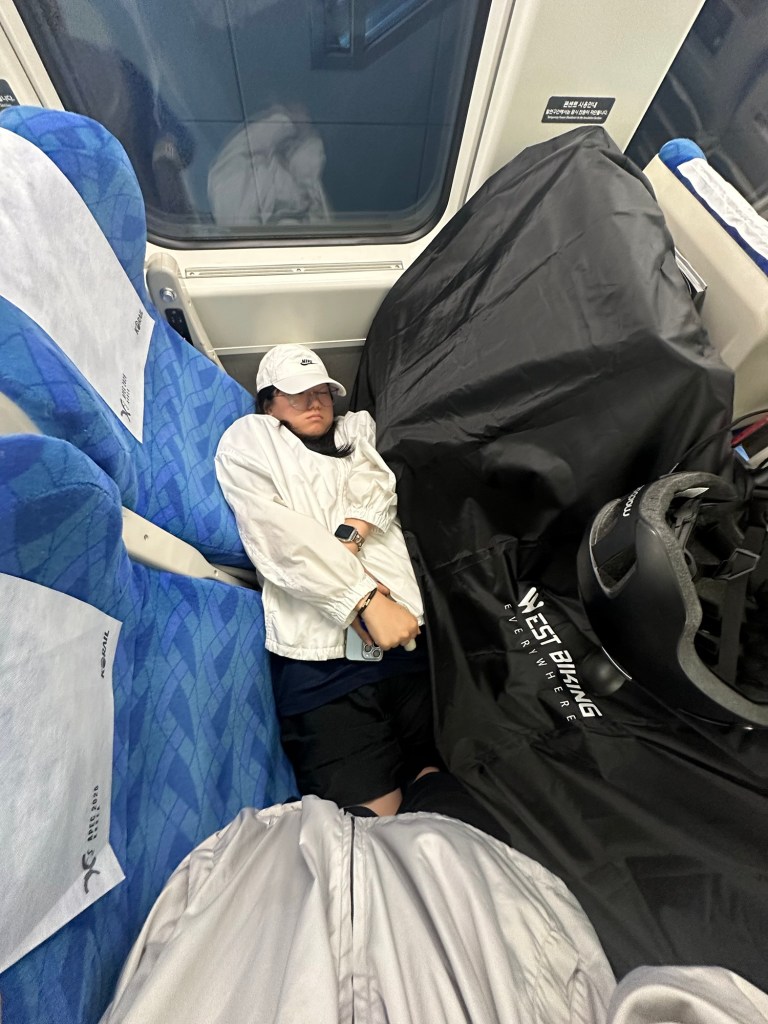
    So even after taking my bicycle apart, it was still very large. I felt like I was doing something wrong. It couldn’t fit in any of the storage so we put them in the seats.

    So I had to stand the whole way, worried about what people think.

    You need a folding bicycle. I was worried we were going to get kicked off the train in the middle of nowhere, but they let us go all the way to Busan.

    But it was already raining like crazy when we get off the train. Actually, the week we planned was forecasted to rain the entire time…

    Anyways, we stayed at a motel and started the next morning!

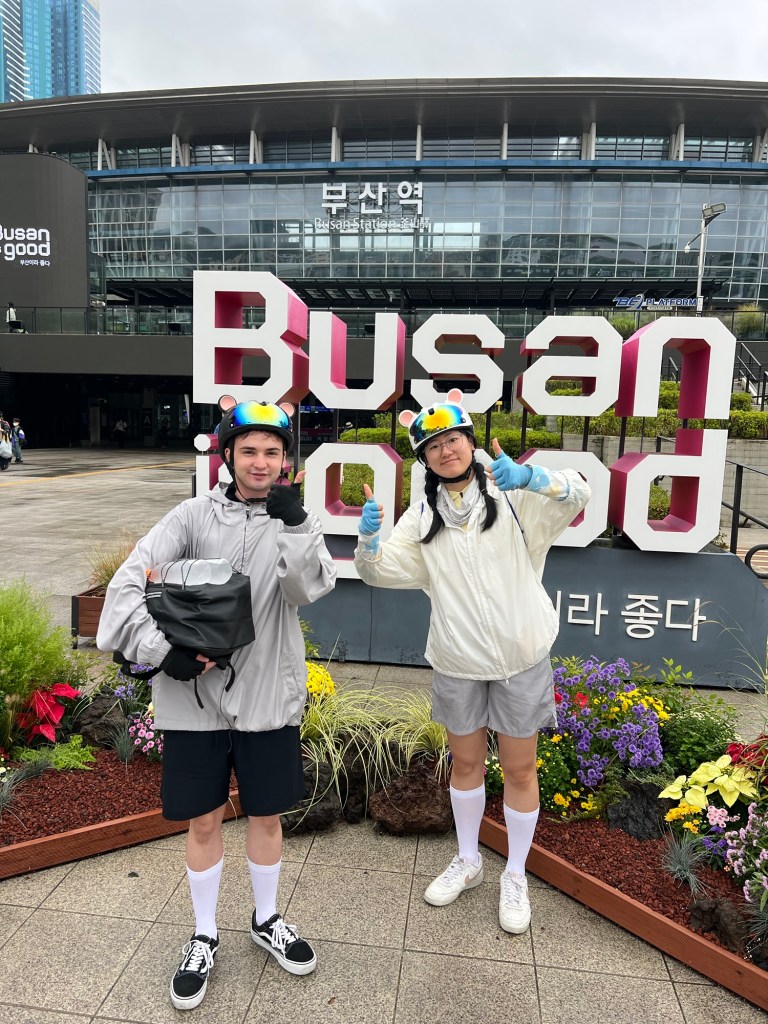
    Busan is good

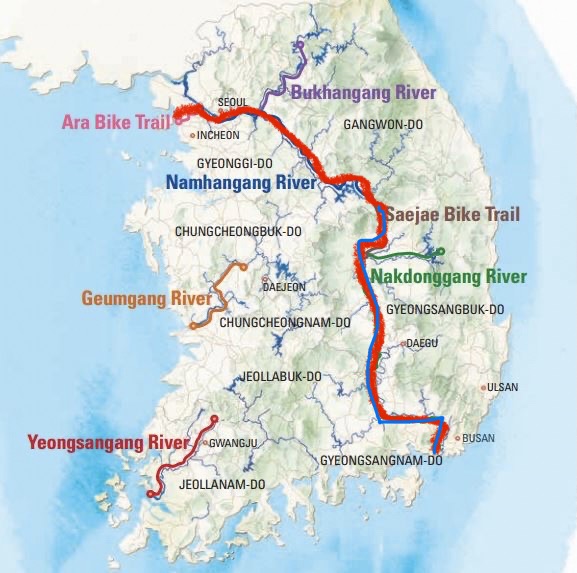
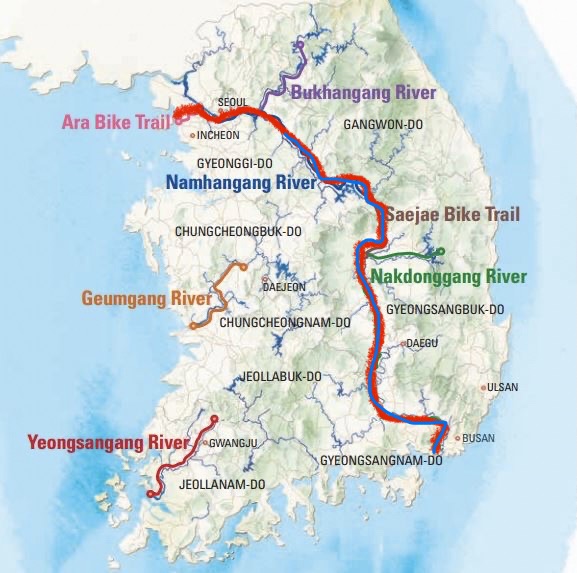
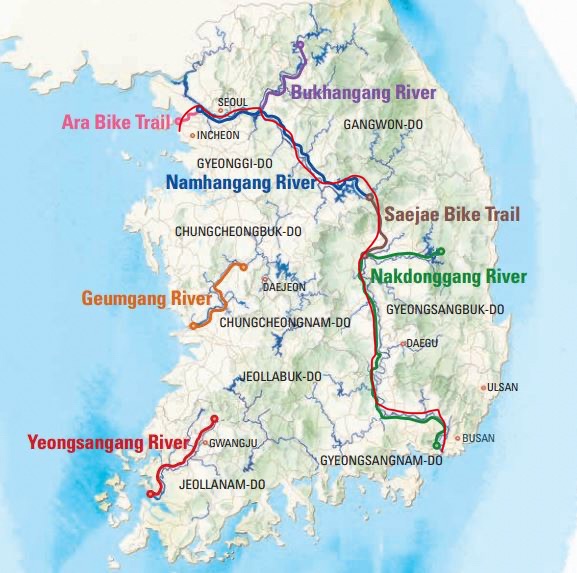
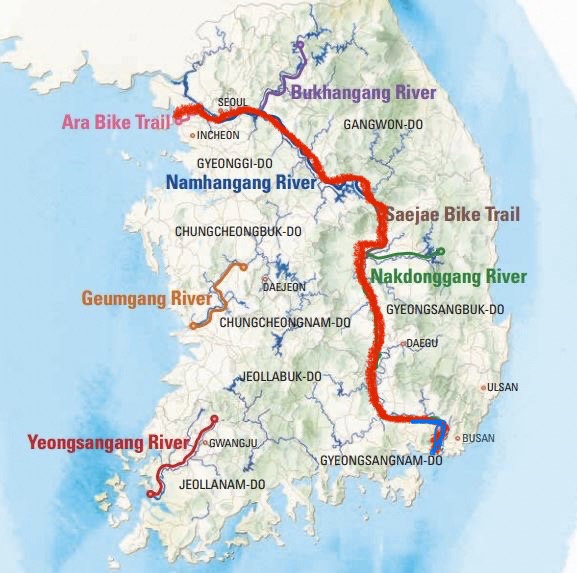
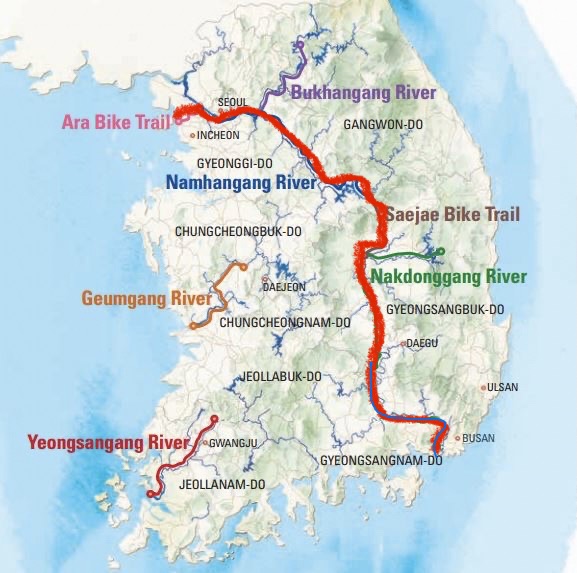
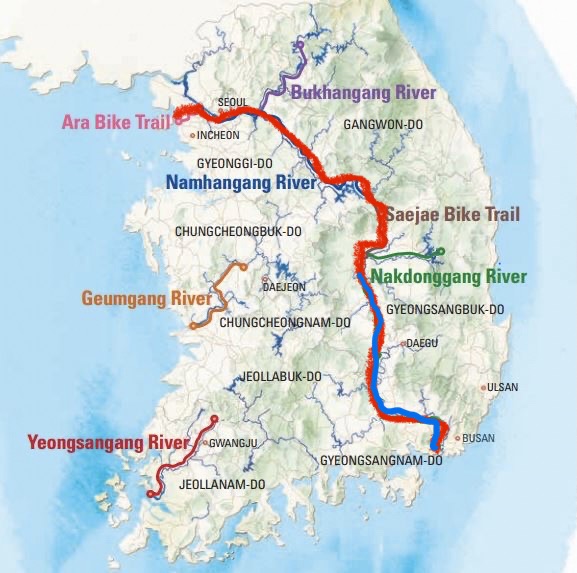
    And the trail marked in red is our route! It can be finished in 5 days, but it’s more fun if you have some extra days for rest or poor weather.
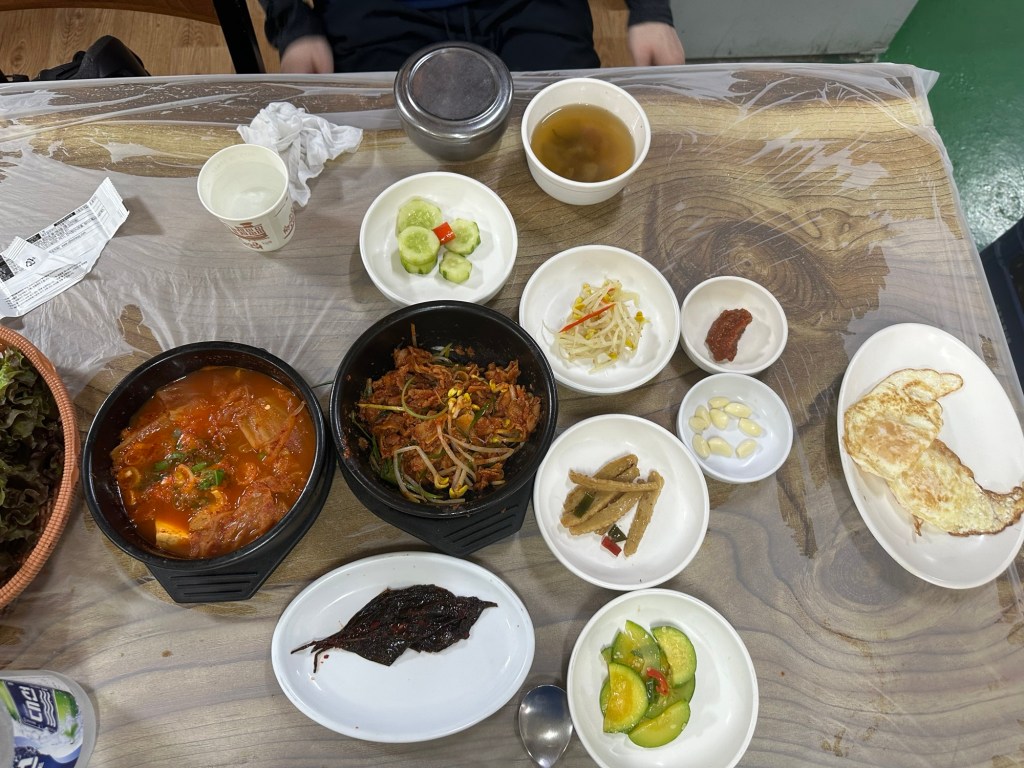
    First, some breakfast.

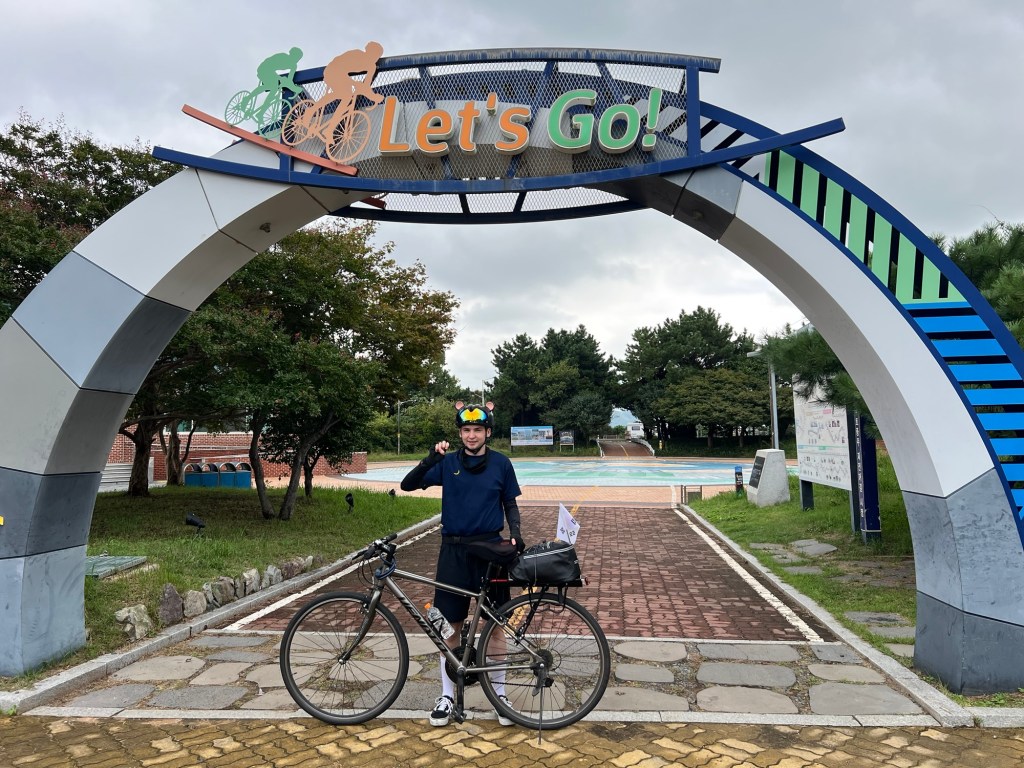
    And let’s start! Most people start from Incheon, but we started from Busan because I don’t want to deal with transportation on the way back.
    And it’s very overcast

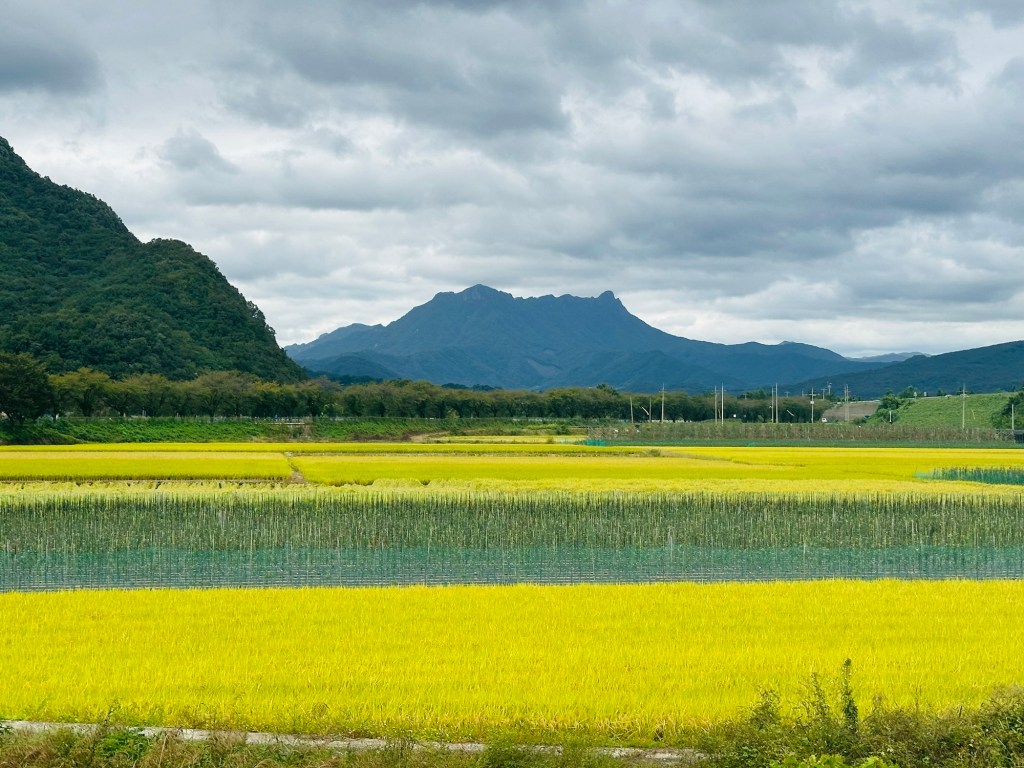
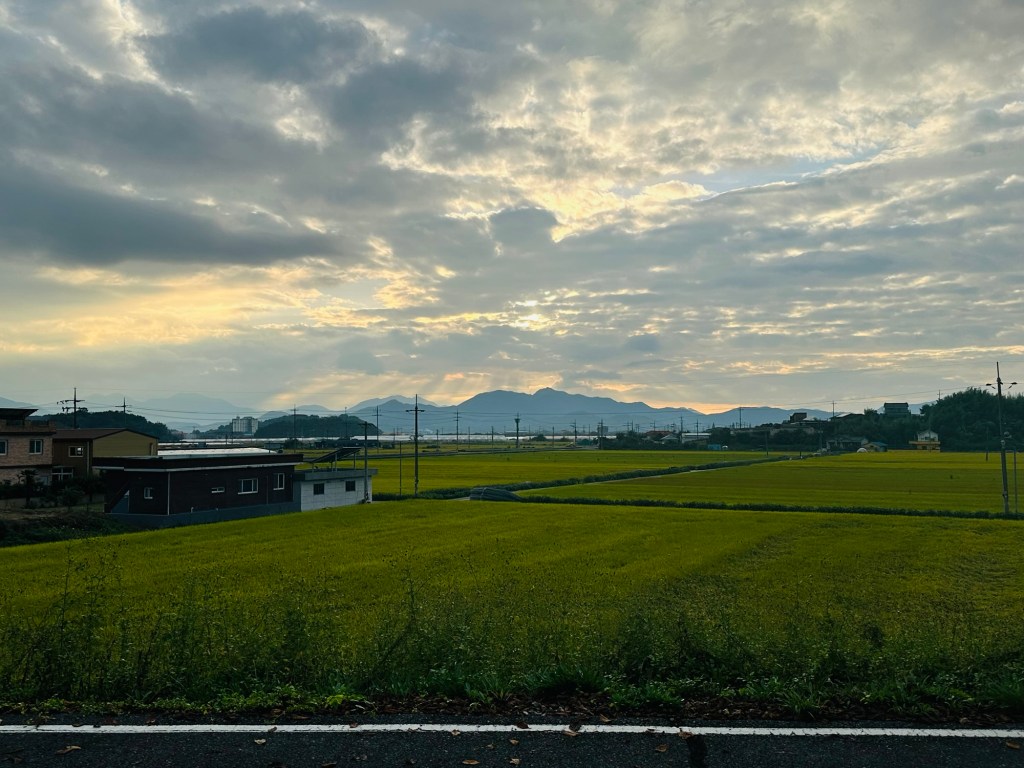
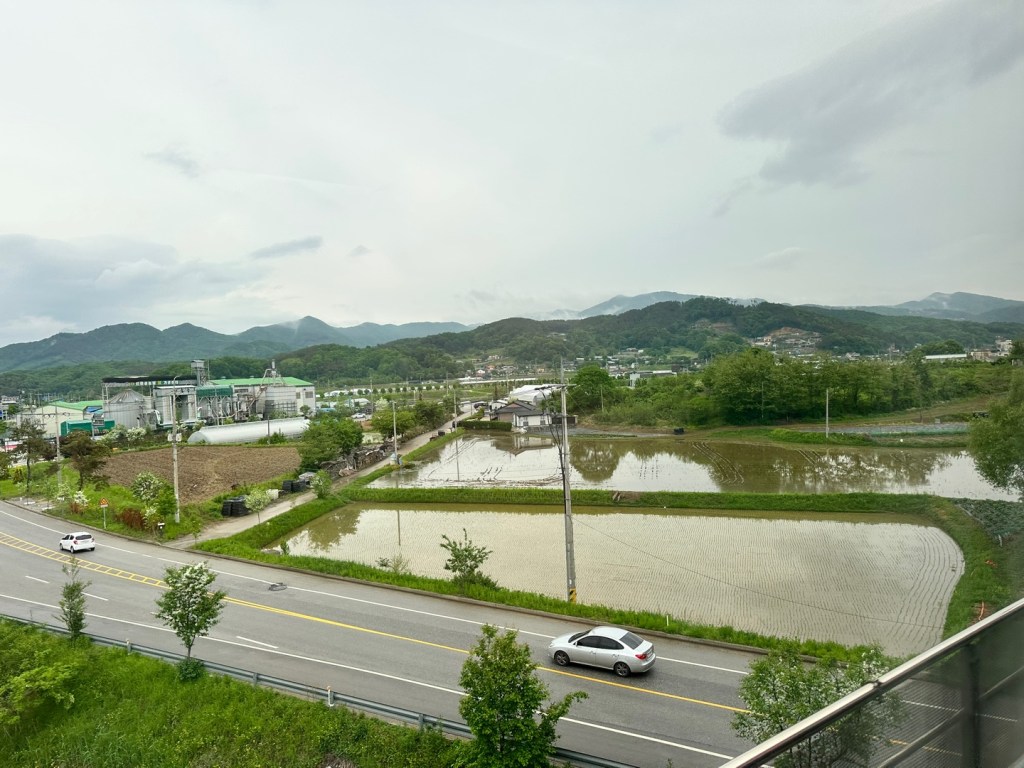
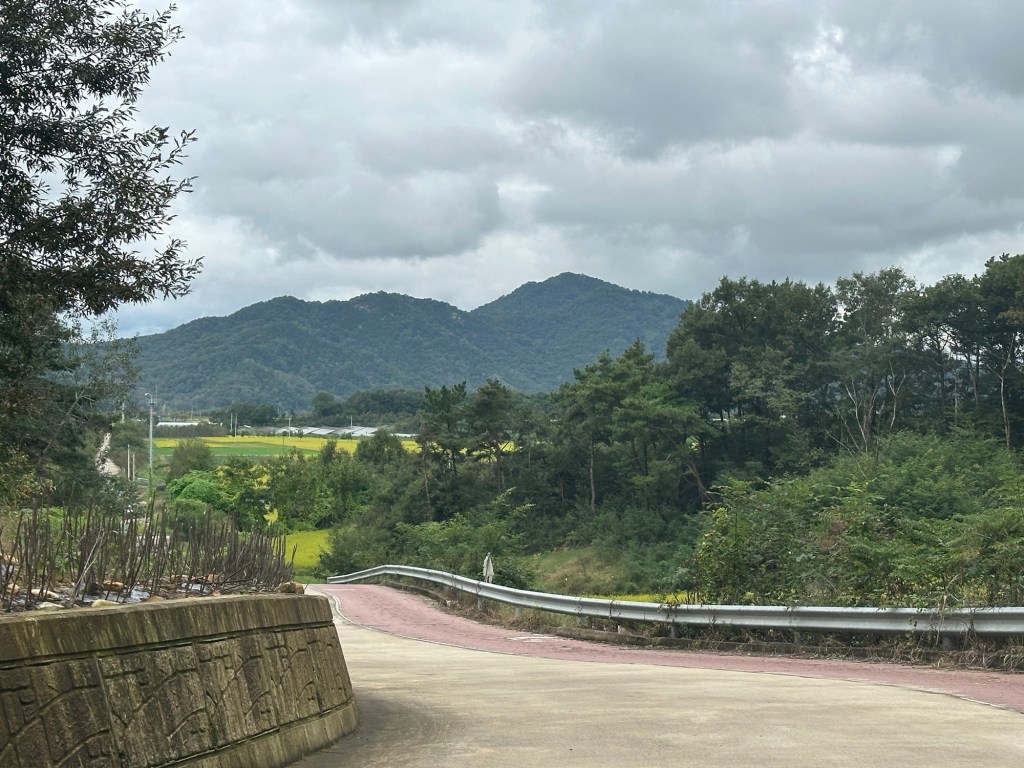
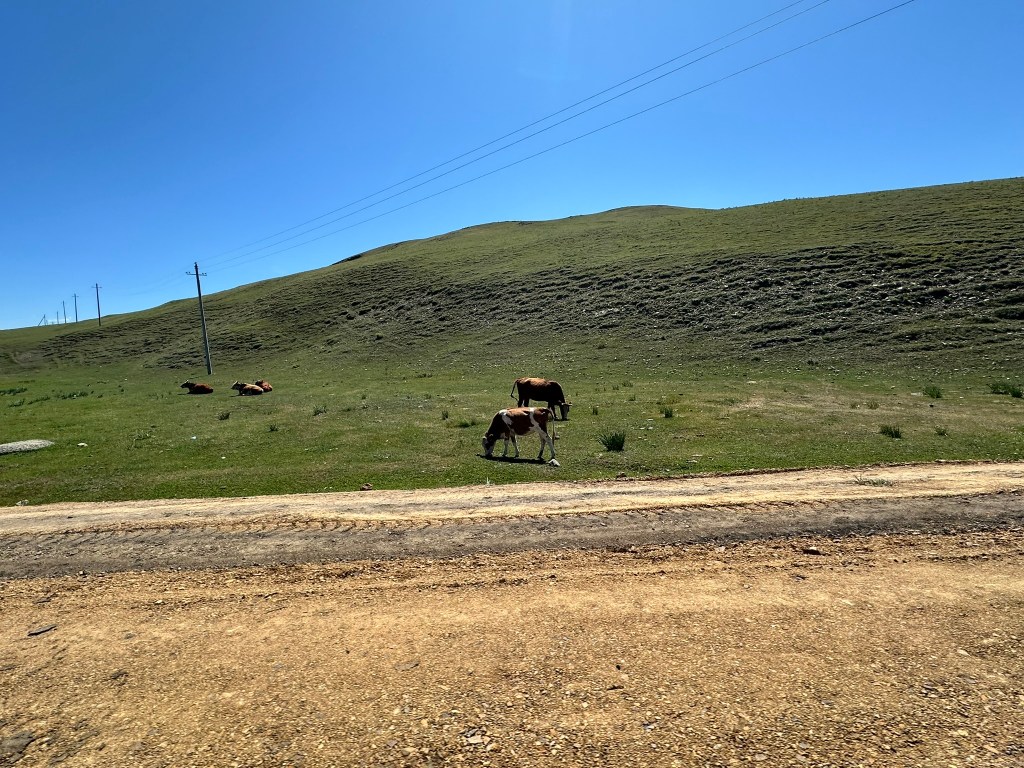
    We didn’t get very far on the first day, but that’s ok. We quickly escaped the urban areas. This is what the countryside of Korea looks like!
    We spent so much time trying to get out of the city that we were already delayed, so we only were able to get to a town called Susan. (Soo-San)

    The blue part!
    If you can see, the city of Busan is not where the actual start of the trail is, so we had to go from the city center, south and west to the start of the trail with stop-and-go crosswalks. It took forever. I would recommend taking the subway instead!!

    Anyways, I start the next day with relatively high morale. It was forecasted to rain but there wasn’t much. Would this luck continue…?

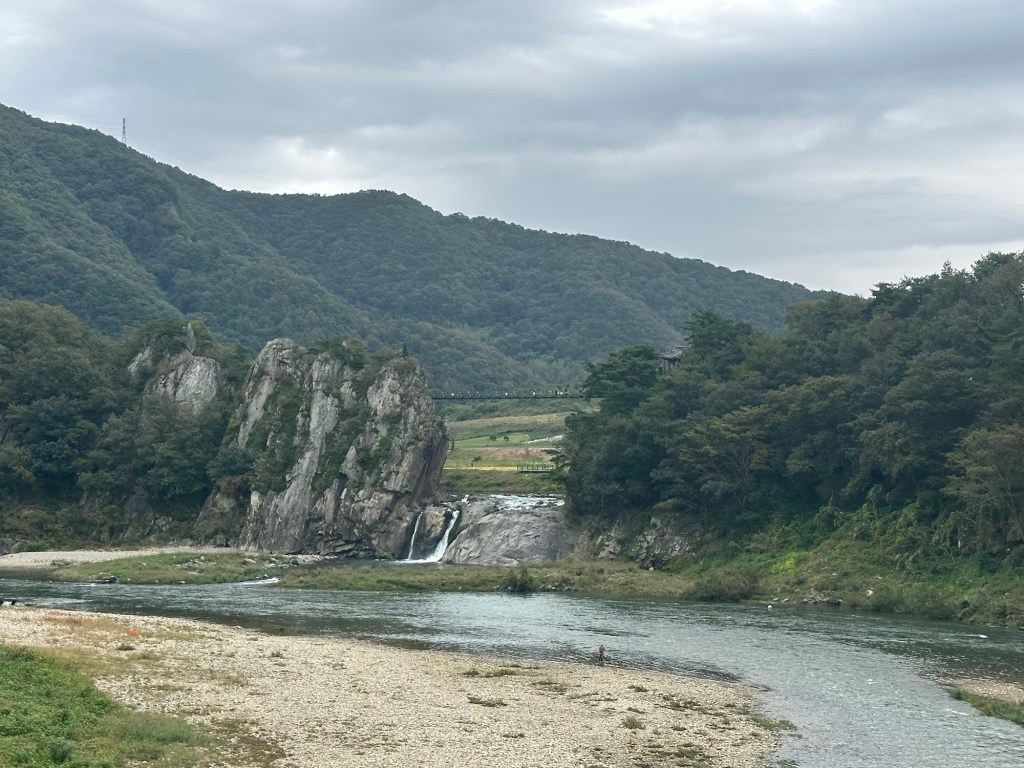
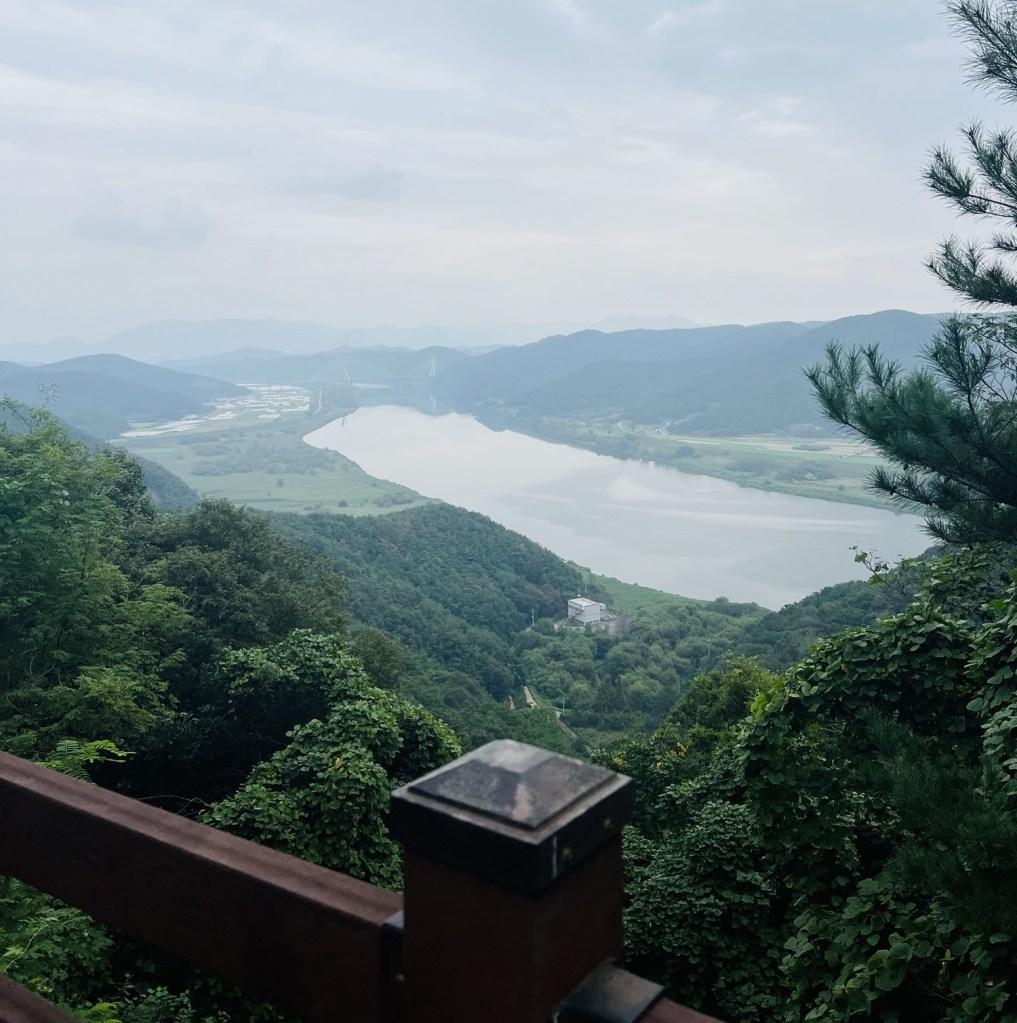
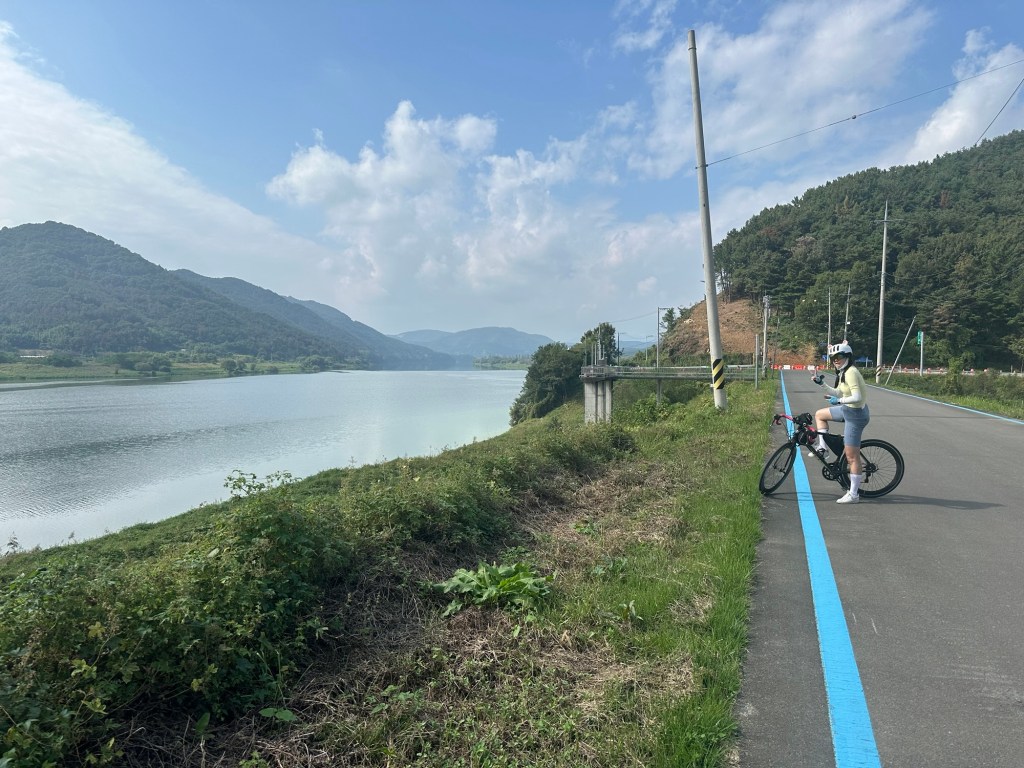
    Some great views of the Han river all along the trail!

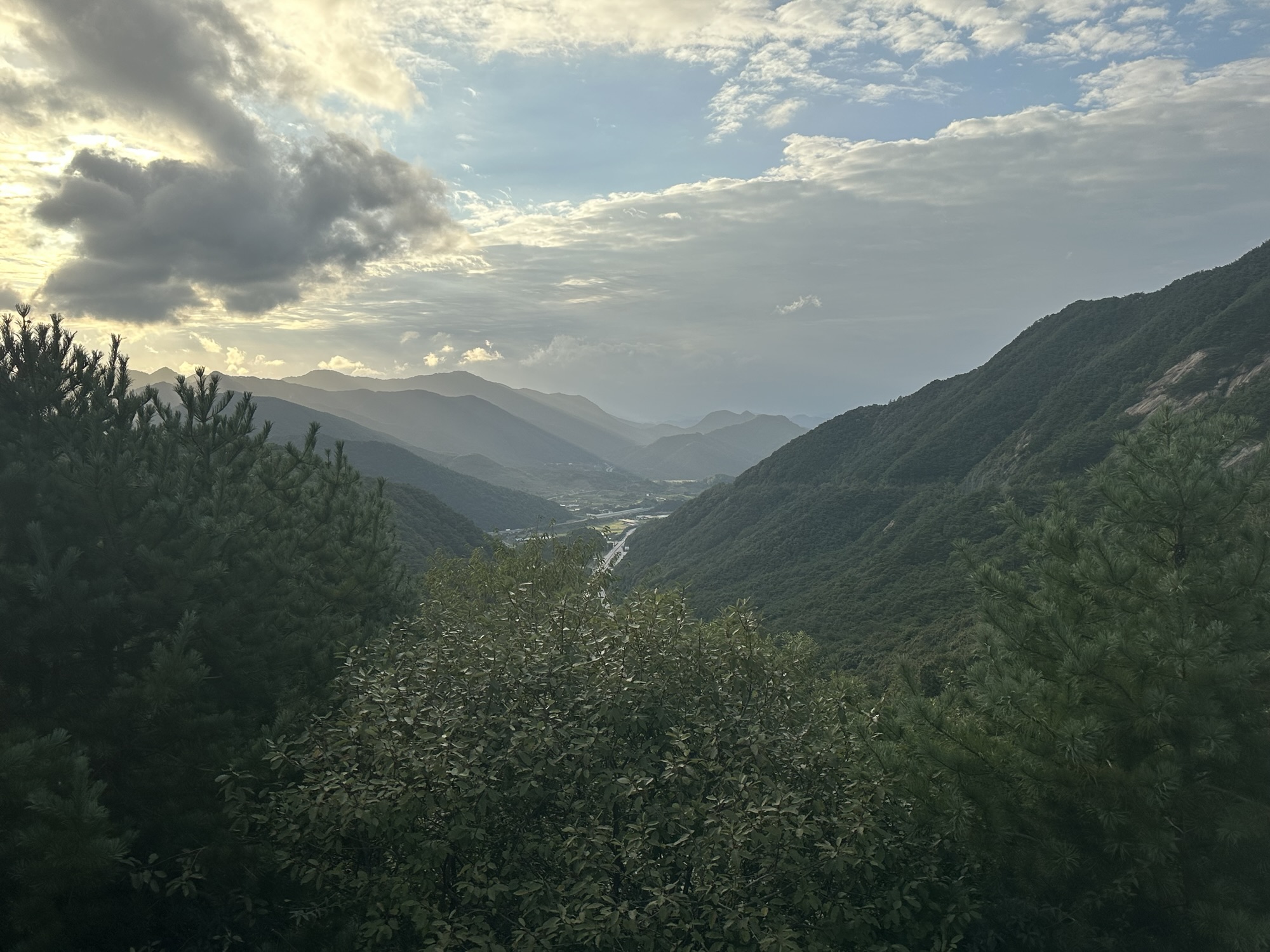
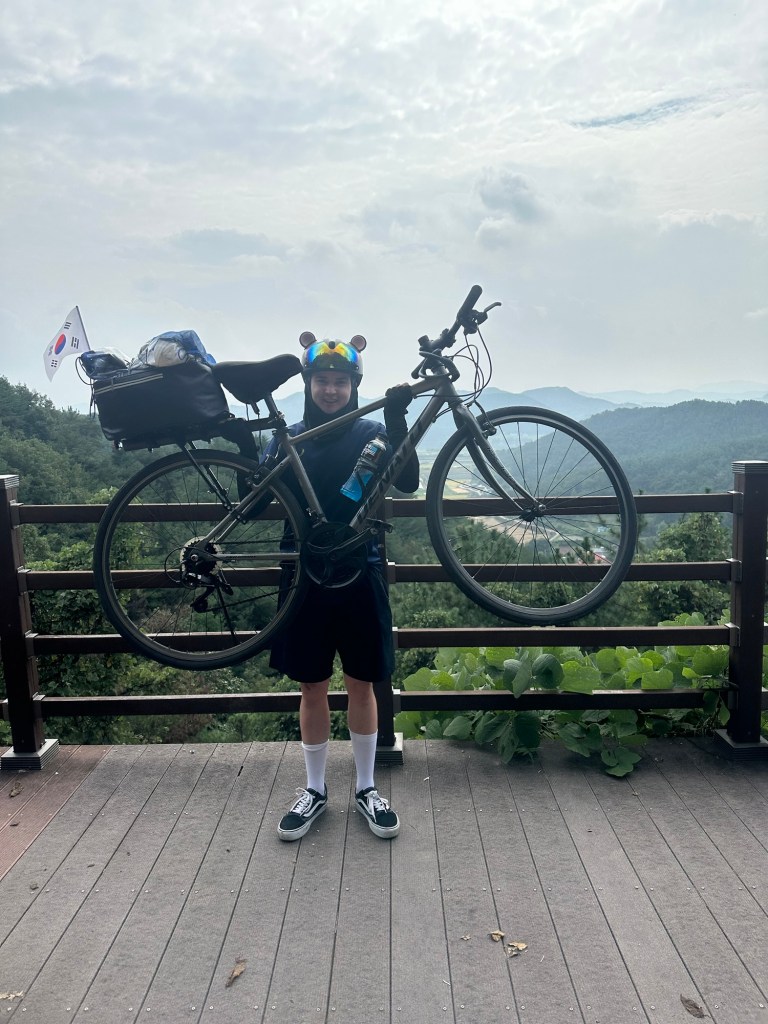
    Today there was a relatively difficult mountain that we had to go up. It was my first time going up a mountain on a bike, so it was difficult… But this is not even close to the highest point in the trail.

    This was the only “view point” in the trail, but it wasn’t actually the end of the climb…

    Anyways, I feel like we made good progress on this day.

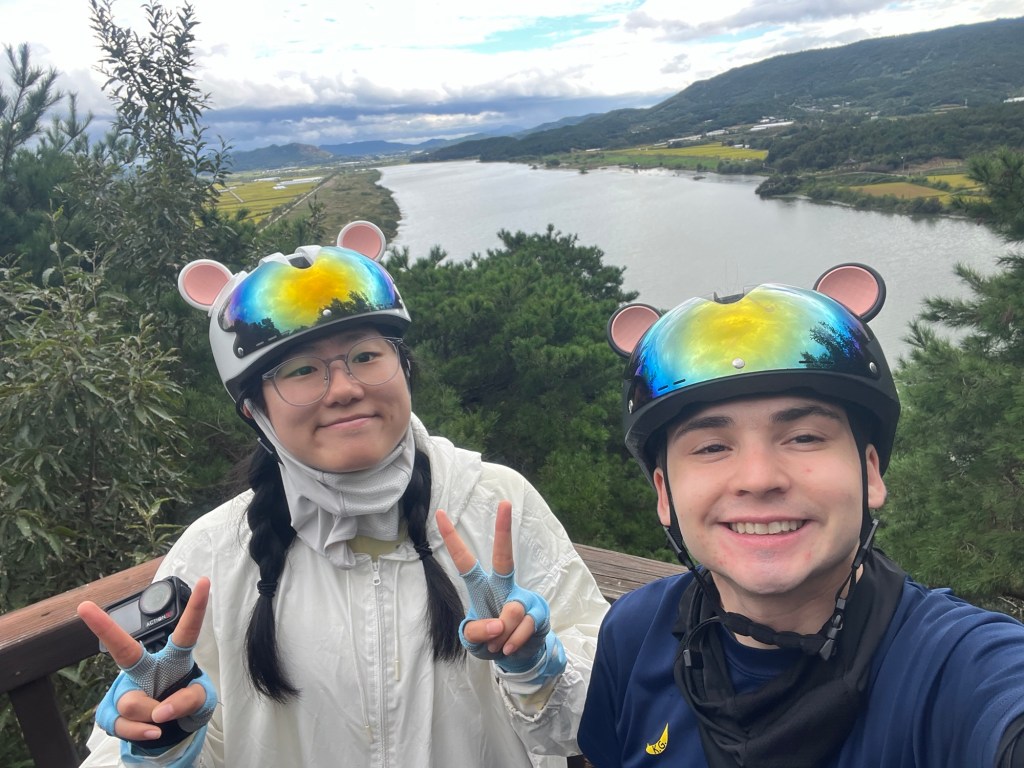
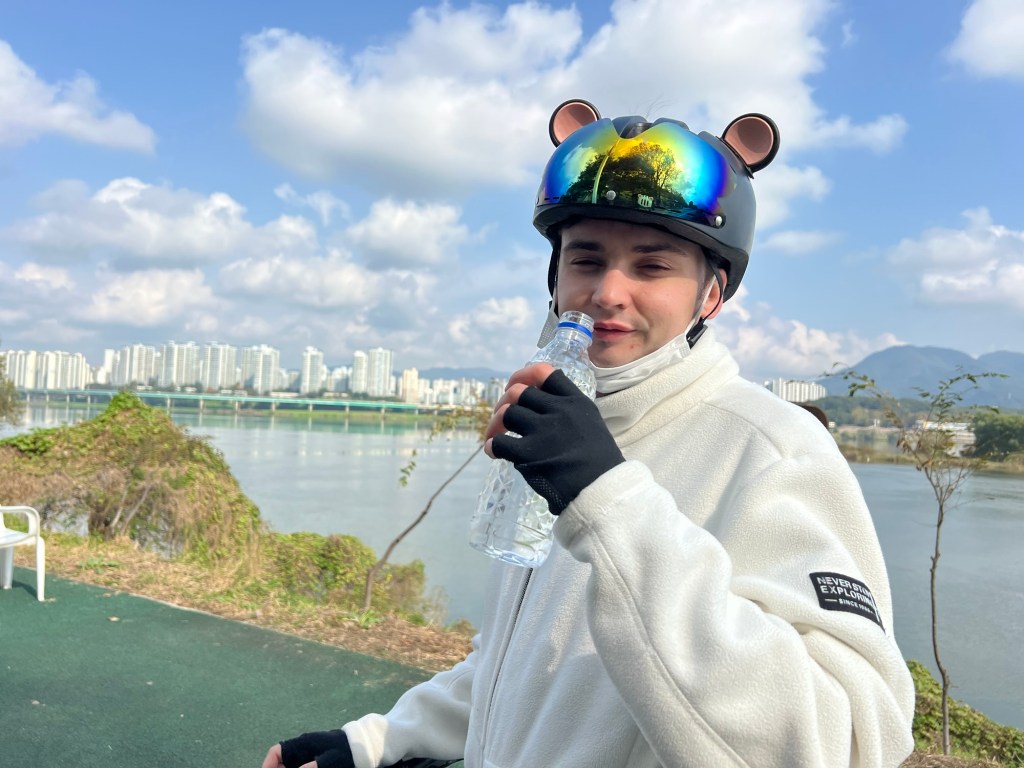
    Morale is high!

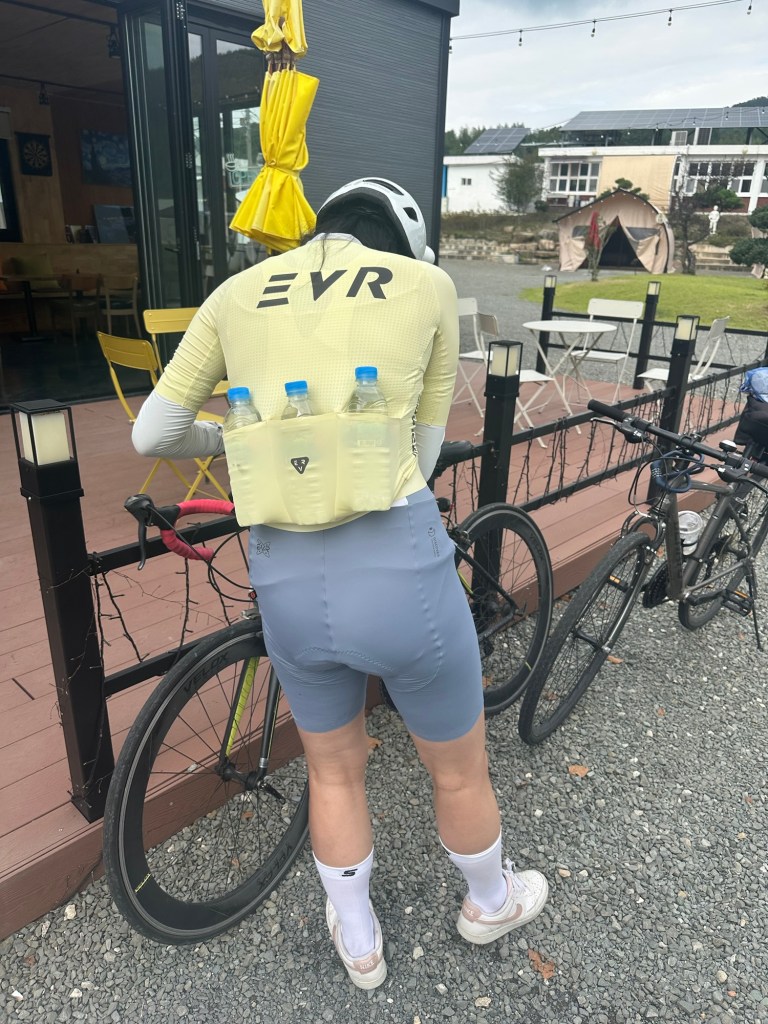
    And I made Hyeonjeong carry water like a camel, because I was jealous she had no luggage connected to her bike unlike me.

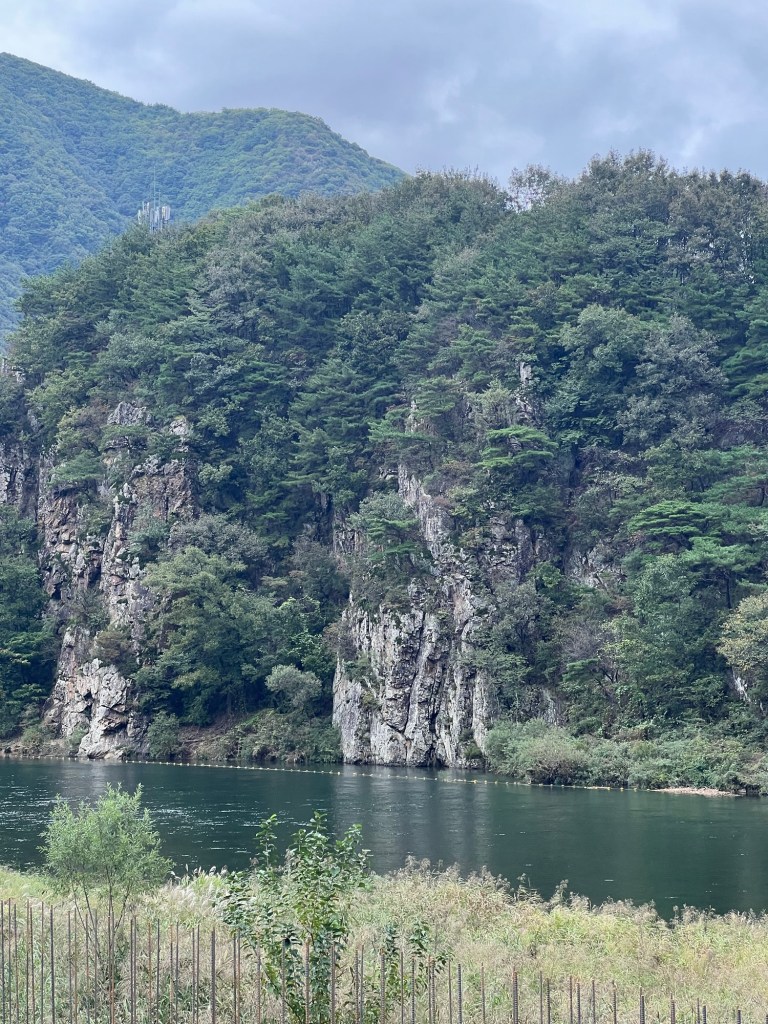
    Then there was another climb, I remember that it was a little harder than the other one. The view of the river is beautiful!

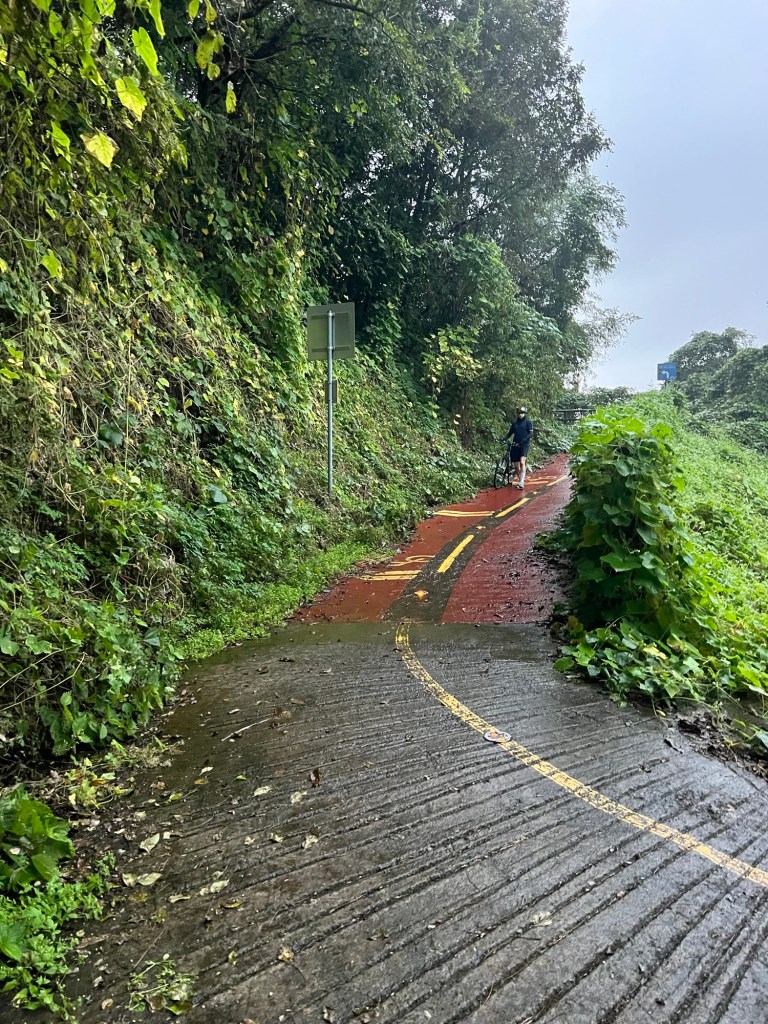
    But suddenly it started raining heavily, and we were made to walk in many parts of the trail because it was slippery, further slowing us down. We weren’t able to make it to our goal today either.

    I’m not having fun.

    We only made it to Guji-Myeon, just south of Daegu.

    Blue line

    I started off okay, because it’s not a big deal if it rains a bit, right? But on the way to Daegu, I slowly lost my sanity because the rain was so heavy. Our plan was to just get to Daegu and wait out the bad weather for a day.

    絶望

    I was in despair because we were making poor time and the weather was horrible. All I could focus on was getting to the destination and didn’t have the right state of mind to enjoy the scenery.

    Even if I looked, it was hard to see anything due to the heavy rain and clouds.

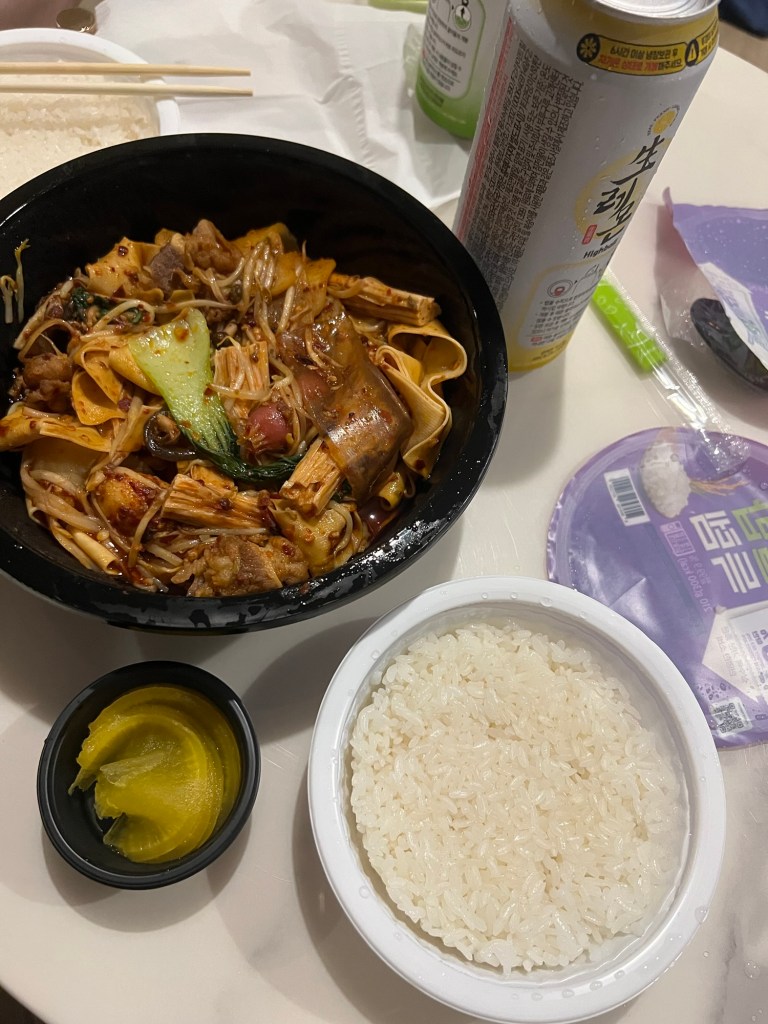
    Anyways, let’s go to Daegu and order marashango.

    The next day, we went to a cafe, a place in Daegu called Spark Land, and played Taiko no Tatsujin.

    We set off the next day menaced by dark clouds. It had rained all day the day before, but I had a feeling we wouldn’t be able to catch a break.

    Why are you so happy?

    Wouldn’t this be so beautiful if the weather was better?

    Why would God do this?

    The dark clouds chased us and it rained on and off. As soon as you got dry from the shower before, it would start raining again.

    But towards the end of the day, the weather got better.

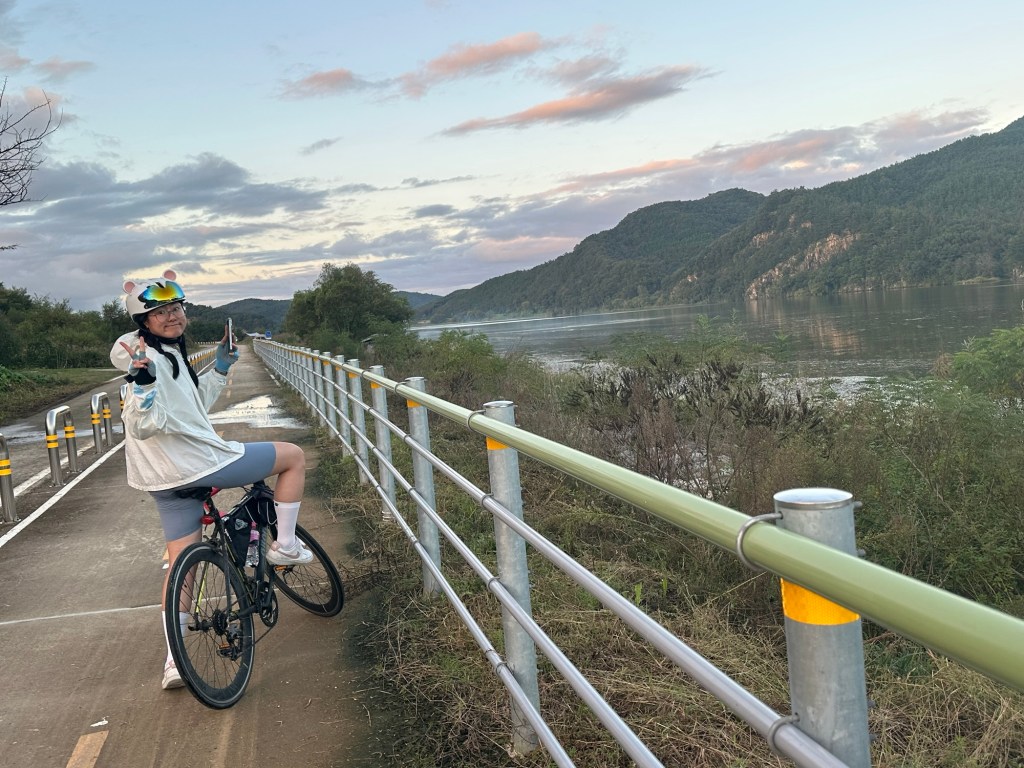
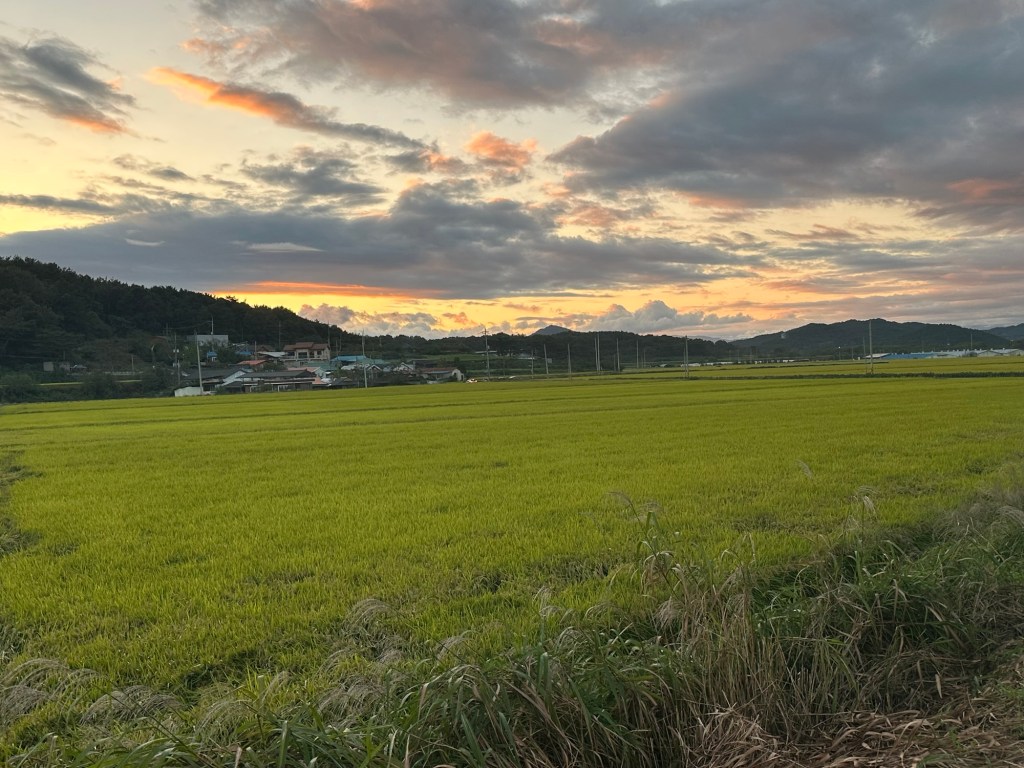
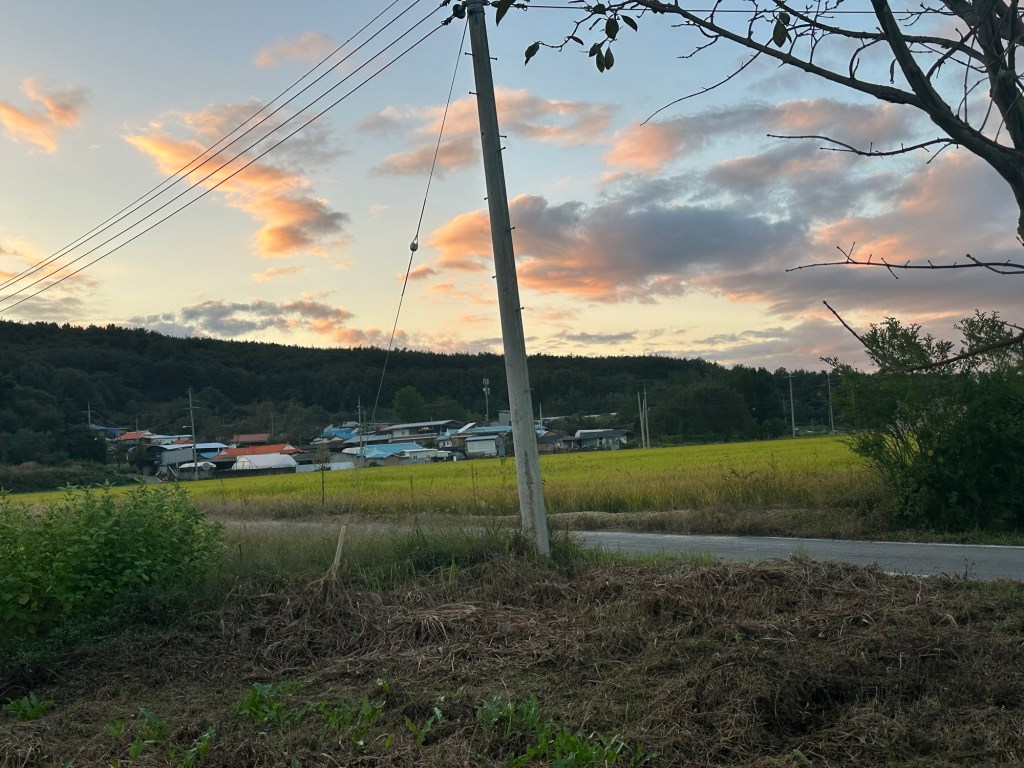
    This is the real countryside of Korea!

    Anyways, some random pictures.

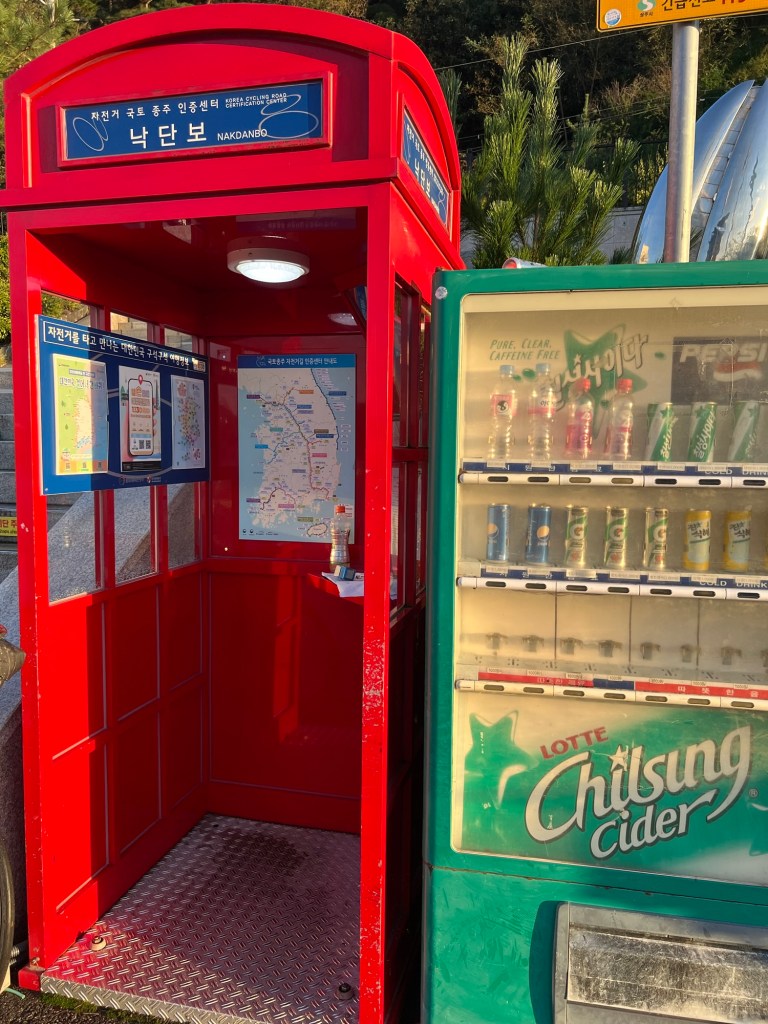
    Our hostel name was Nakdanbo Jajeongeo Minbak. The owner was very nice and there were a lot of kittens. It came with a free dinner and breakfast and a lot of old Korean men.

    We ended our day here!

    Anyways, I’ll write the rest in part 2.

  • It was over a month ago, but I want to finish the second part of my Mongolia blog.

    I’ve been so busy since I applied for the JLPT N1. I want to study for a few hours every day, just to make sure I pass in December and don’t waste my money. I have a good feeling, but you never know.

    And, I am getting my job applications ready for next year when I go back to Japan, and training for my cross-country bike trip… I think I don’t have much time these days.

    And to top it all off, my just-out-of-warranty Macbook’s motherboard decided to explode when I used a power delivery USB hub, so I am out of a way to write at home even if I wanted to. ㅠㅠ

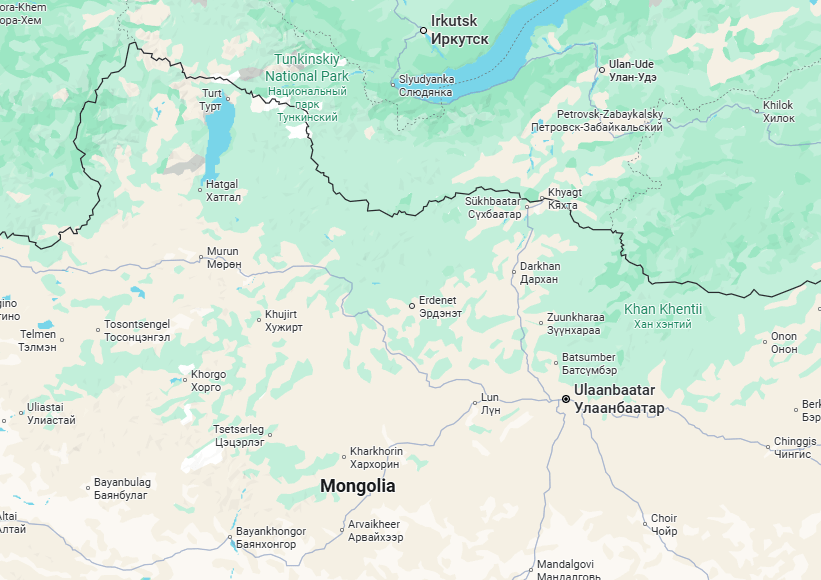
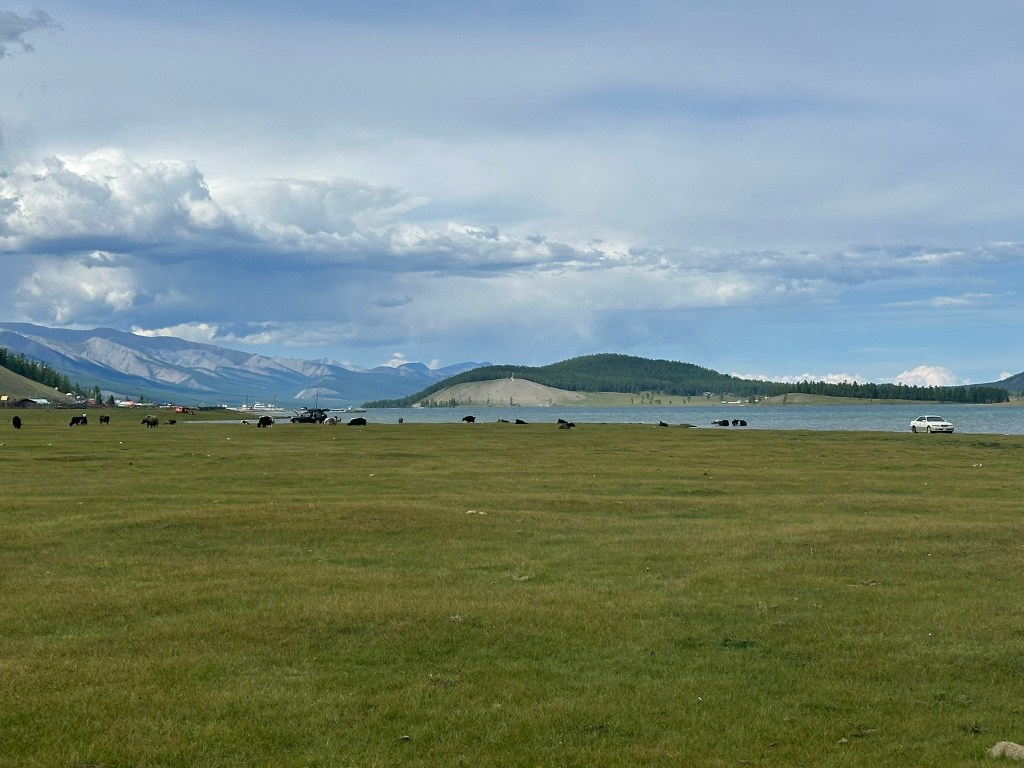
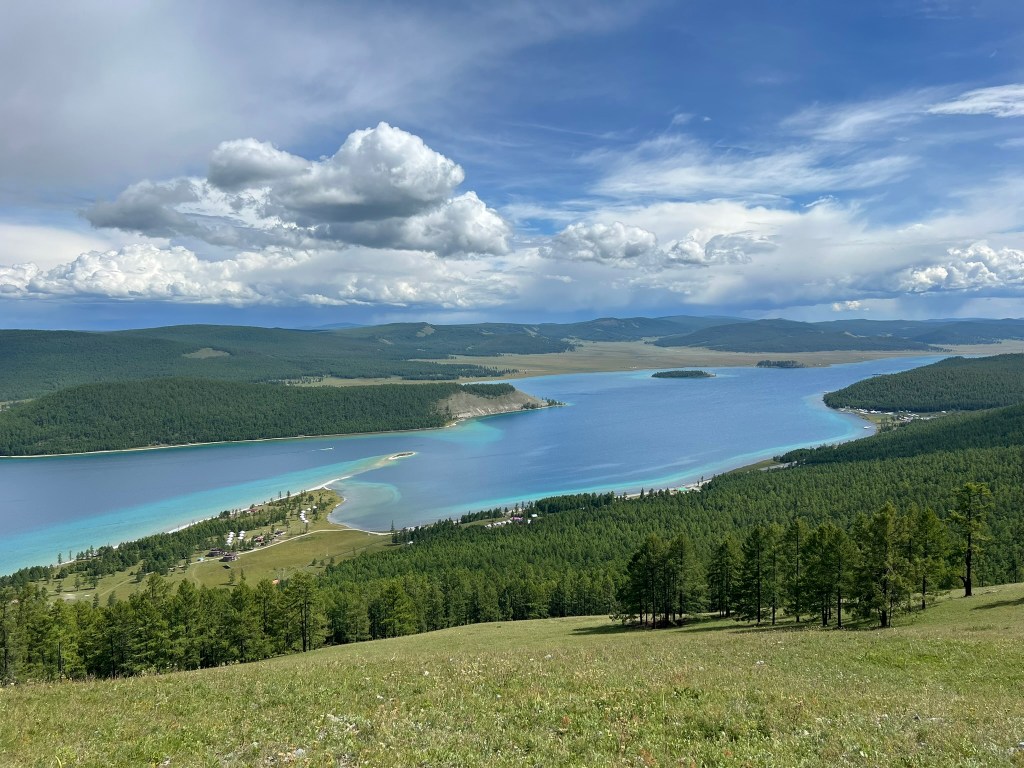
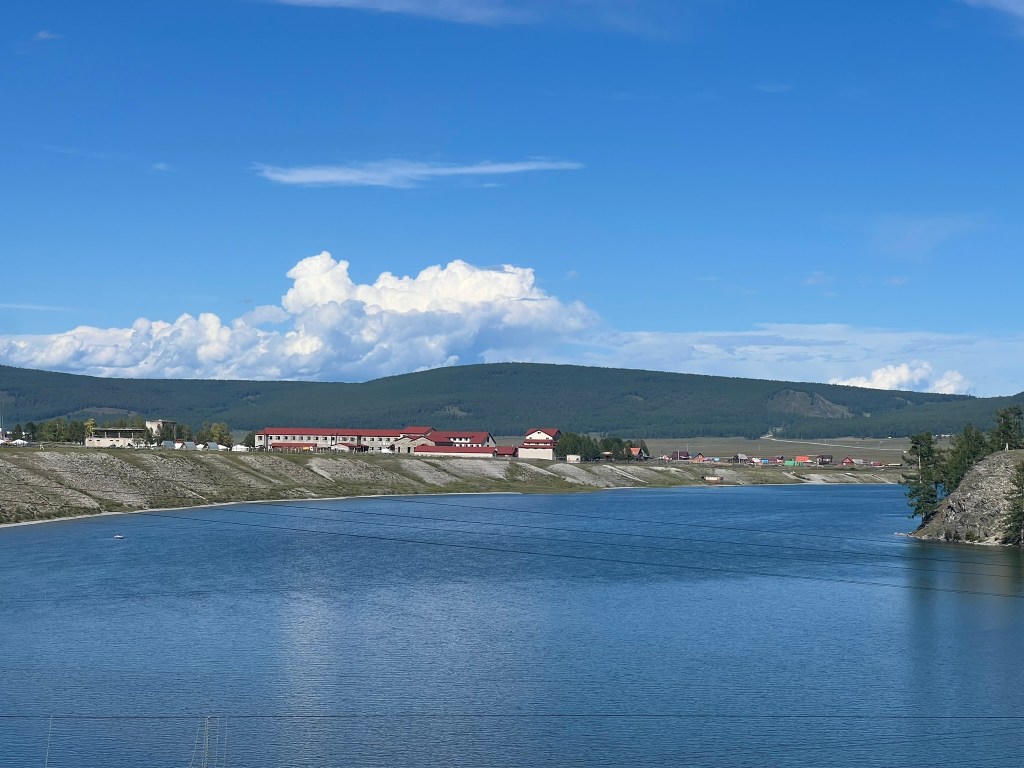
    Lake Khuvsgul is a fairly popular tourist destination in Mongolia. It’s the lake in the top right above “Hatgal.”

    We took a night bus from Ulaanbaatar to Khuvsgul. According to navigation, it would take 40 minutes to drive, so we wanted to leave 2 hours early because the traffic is so bad.

    And it ended up being really close. It would have been faster to walk. We were considering getting out of the taxi and running towards the end. There is something wrong with a city if it takes 1 hour to drive 10 km.

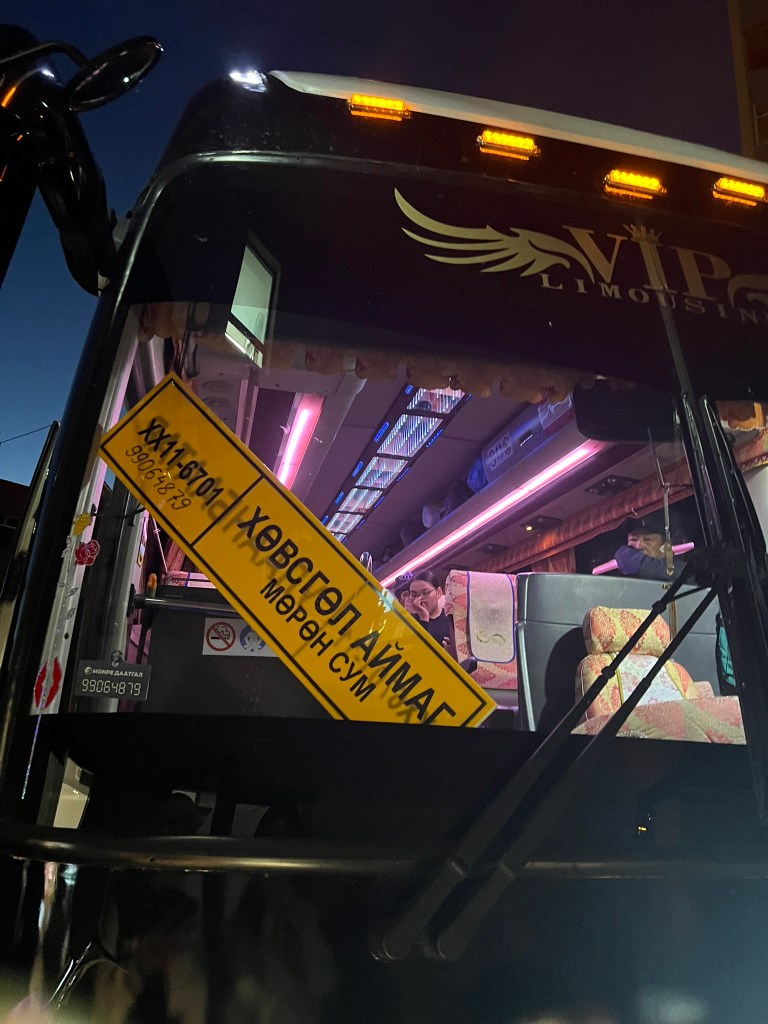
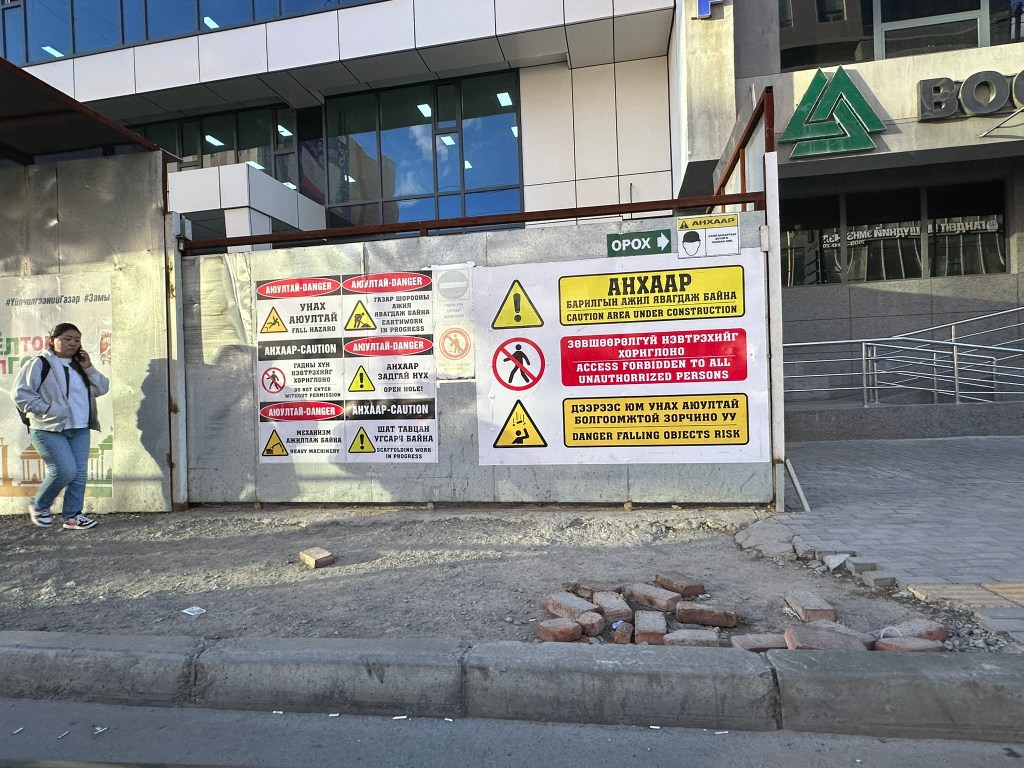
    We are going to Murun. It’s a good thing I learned some Cyrillic when I was here, or we couldn’t read the sign.

    I have taken a few night buses in my life. In Korea and Japan there are some unspoken rules about behavior on the night bus. You don’t talk or play music. You don’t put your seat back if someone else is behind you.

    Both of these rules are readily ignored here. The person in front of me put his seat so far back it was basically on top of me and I couldn’t move, and got some pain. And the kids in front are watching YouTube without headphones…

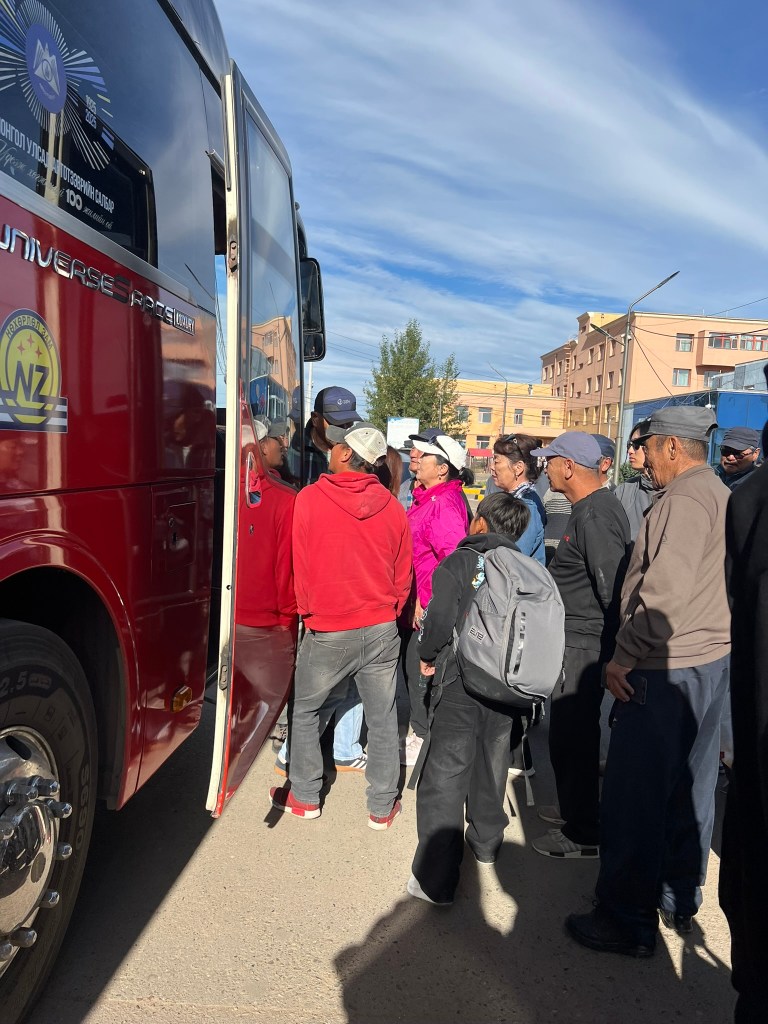
    And there are random people crowding around the exit to the bus to harass people for a taxi, so it’s difficult to get off. I don’t find it an endearing way to behave, especially considering they will scam you if you are a tourist.

    Anyways, finally arrived at Mulun, so we take our accommodation’s taxi to the lake. It takes a little over an hour to get to our accommodation.

    After everything that’s happened, we are moved by the quality of the accommodation. The owner is incredible and a very hard worker, and will organize tours and activities for you. When you’re finished, just pay everything to the owner. It’s so easy.

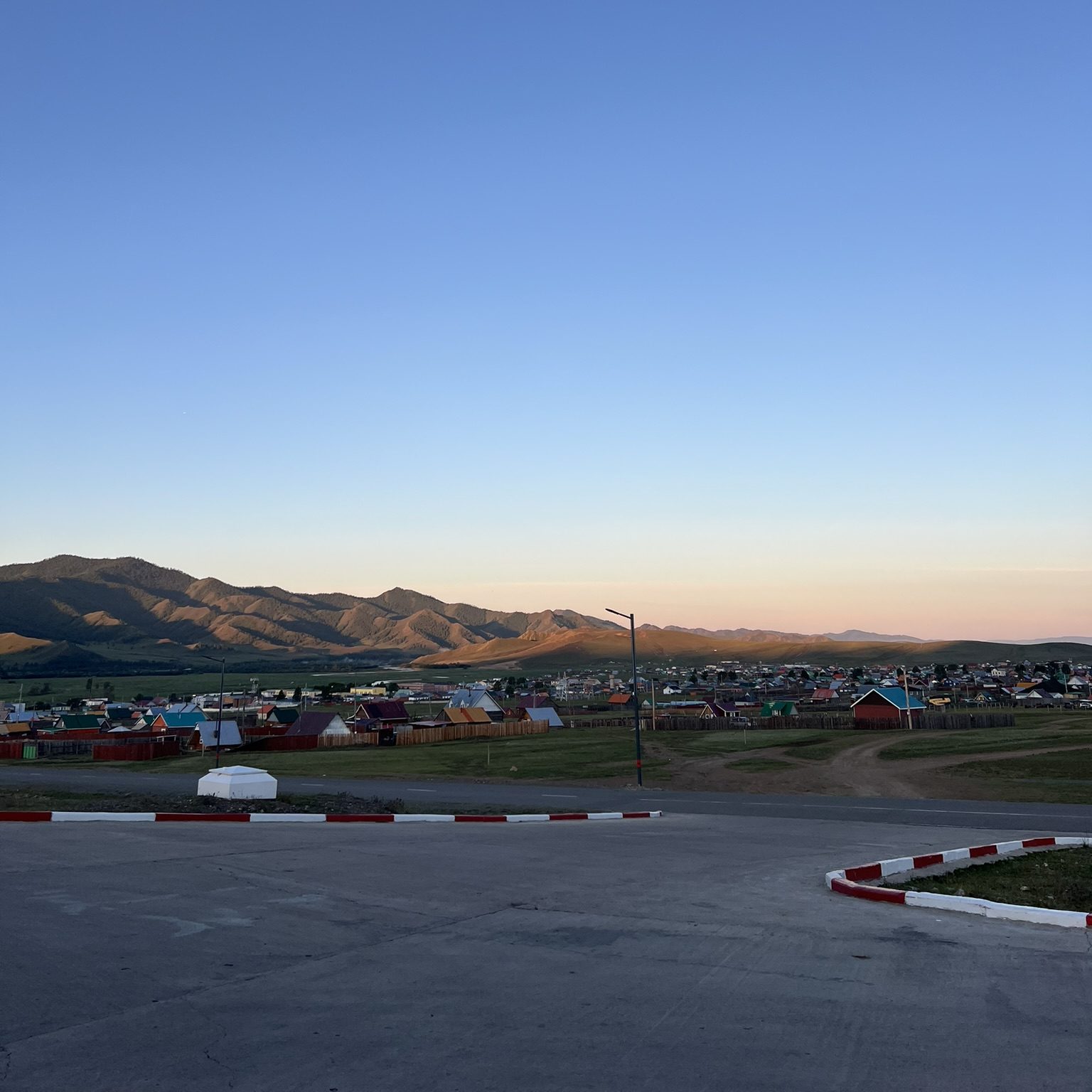
    This is the average Mongolian neighborhood

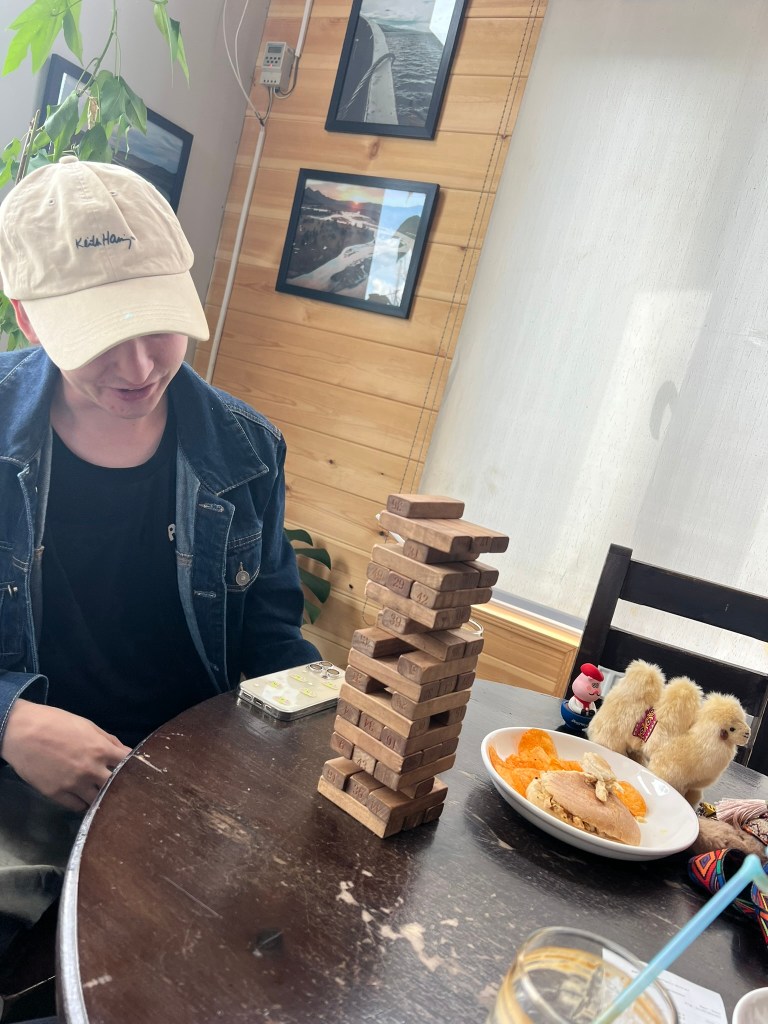
    There’s no food in the area, so we go to a coffee shop ..!

    And play Jenga. I realized whoever invented this game is a genius. It’s such a fun game.

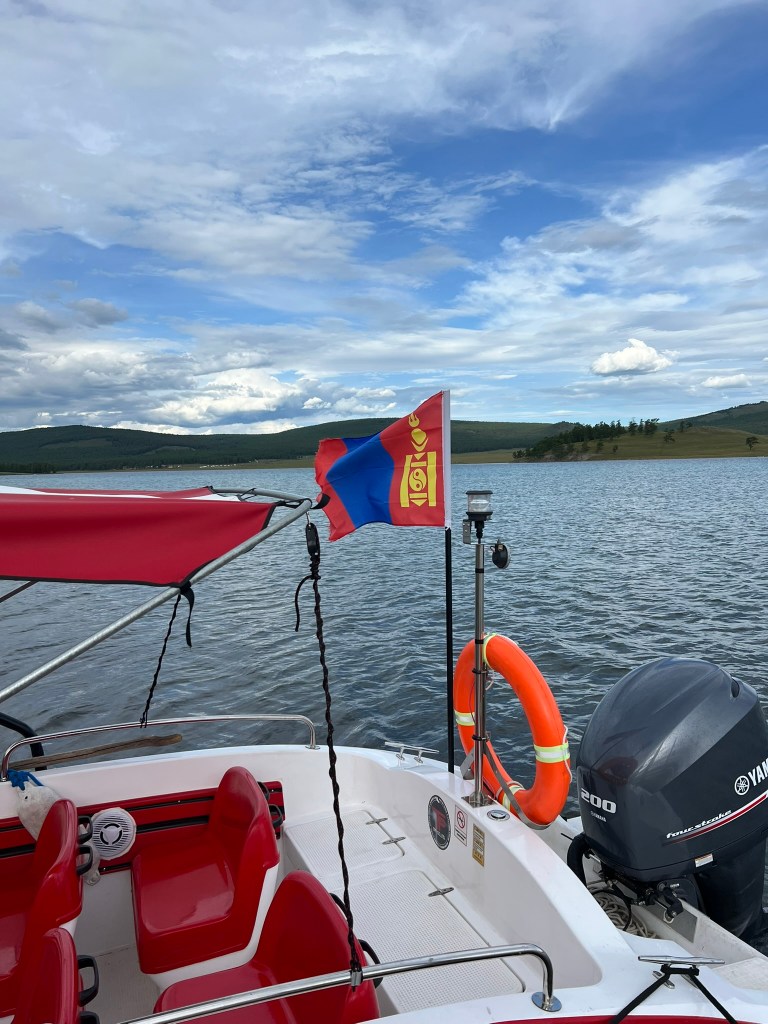
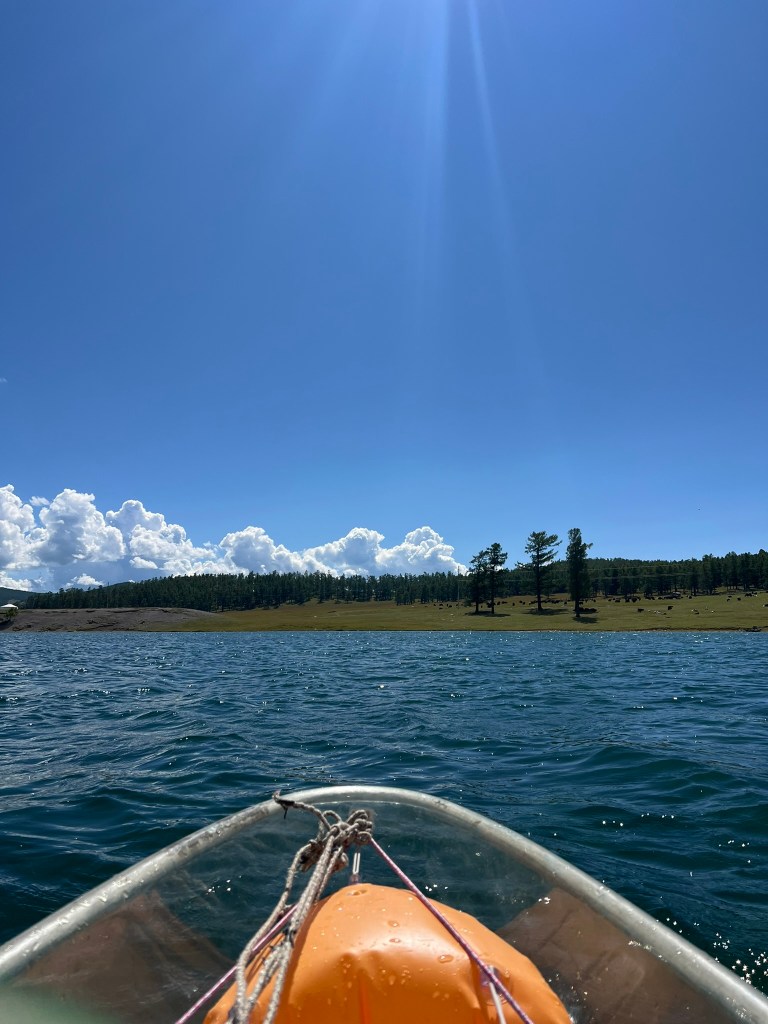
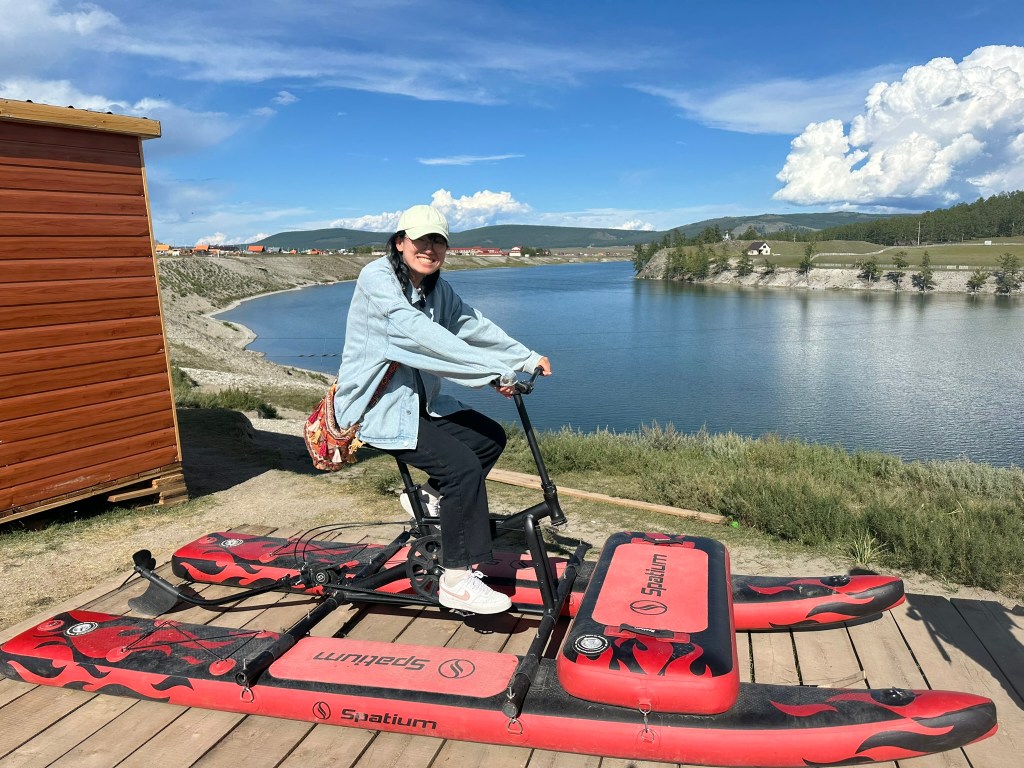
    And then go ride in a boat and hang out in the lake.

    There is a group of Chinese people that came with us, and I thought they were so funny.

    Not because they were nice, but they were totally self-absorbed the entire time (not just on the boat). They just would not stop taking pictures for the whole hour. It’s not an exaggeration.

    If you keep taking pictures of the same thing, does it really have any meaning?

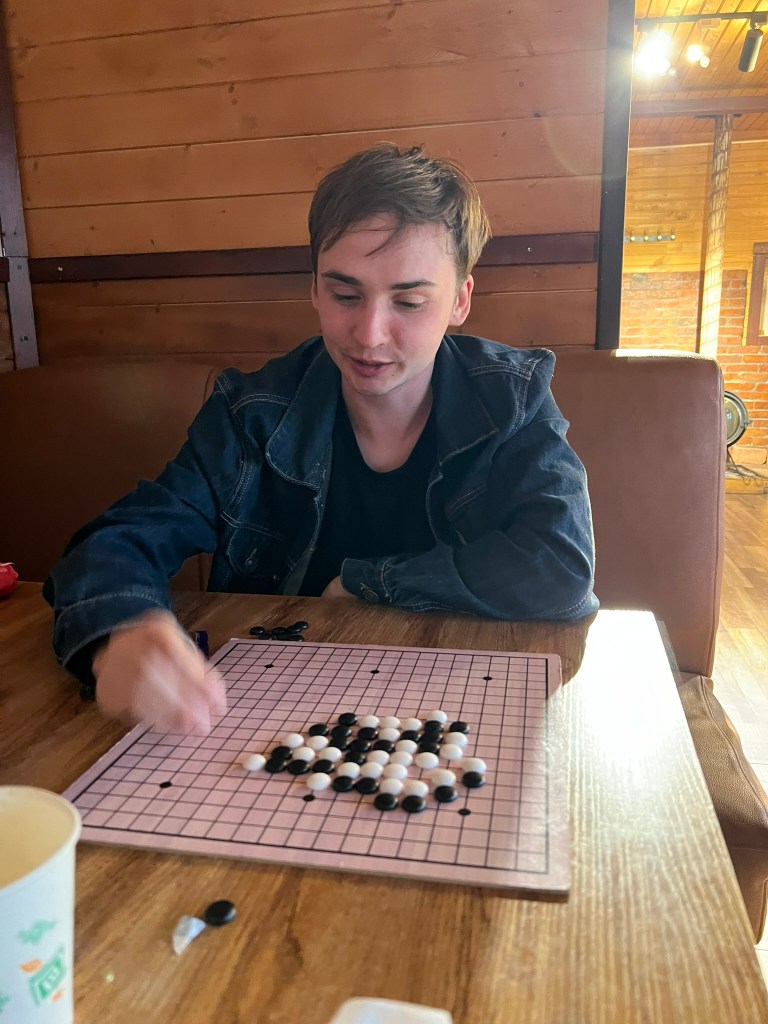
    And I played Baduk. But I’m so bad at the game, I can never win.

    There’s nothing more fun than sitting on an animal that’s bigger than you and riding it around.” – Nathan Fielder

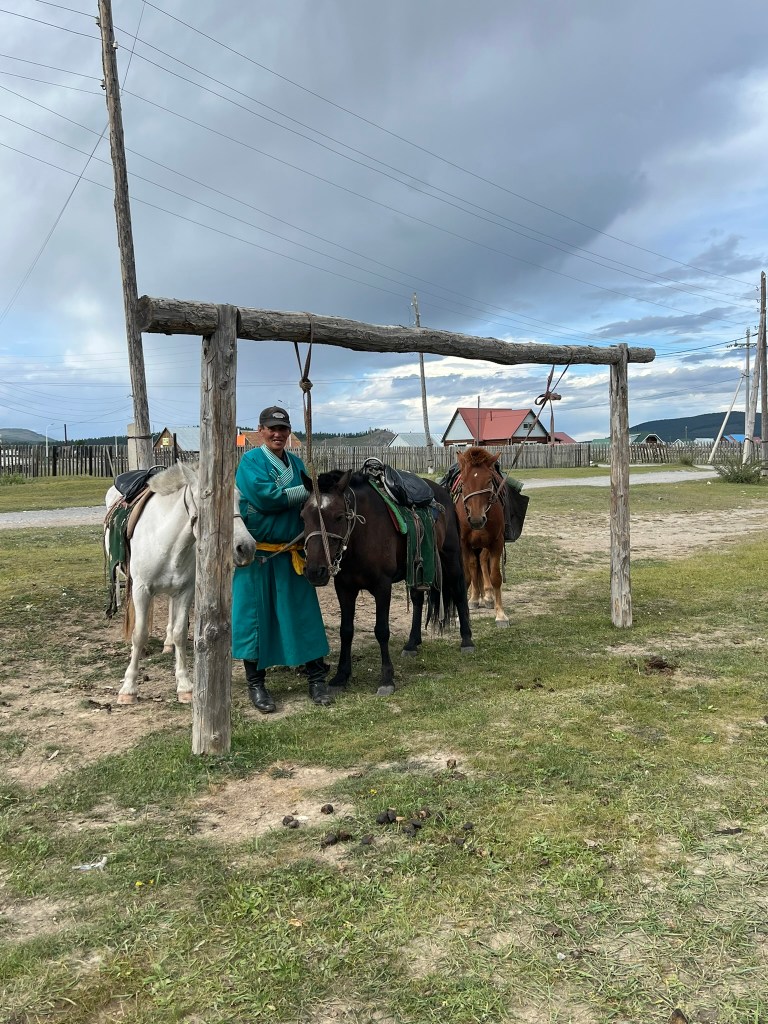
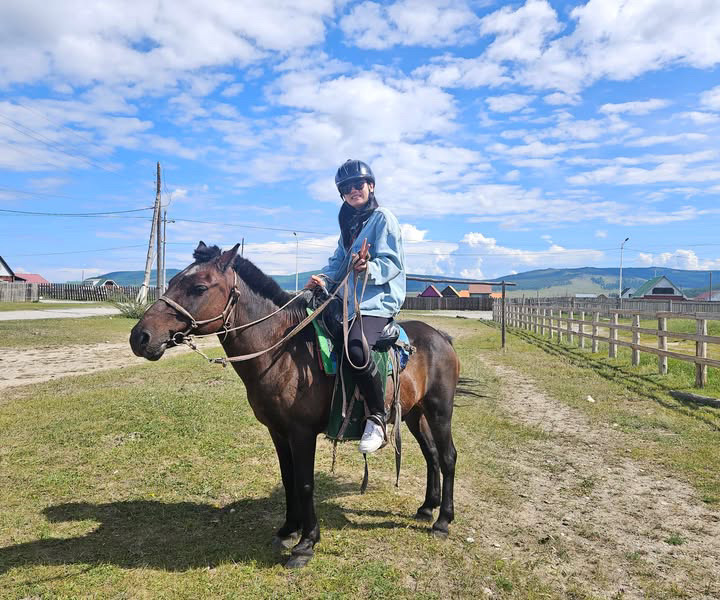
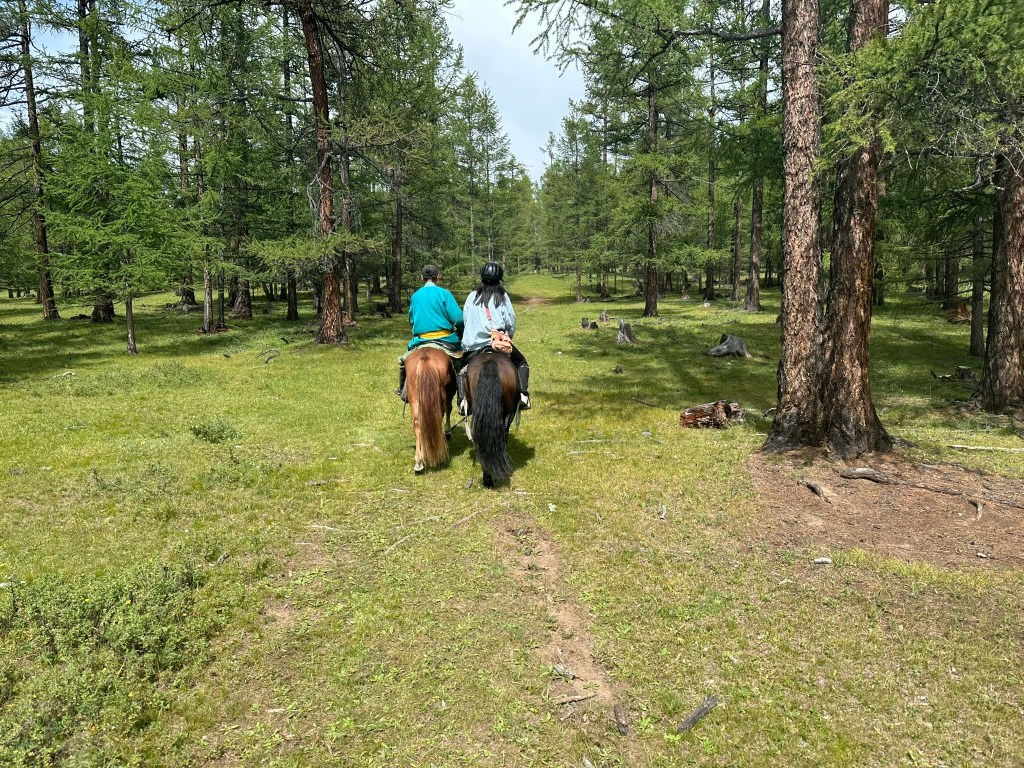
    The next day we decided to go on a horse ride. It was a lot longer than I thought, and the stirrups weren’t adjusted correctly, so I was in pain.

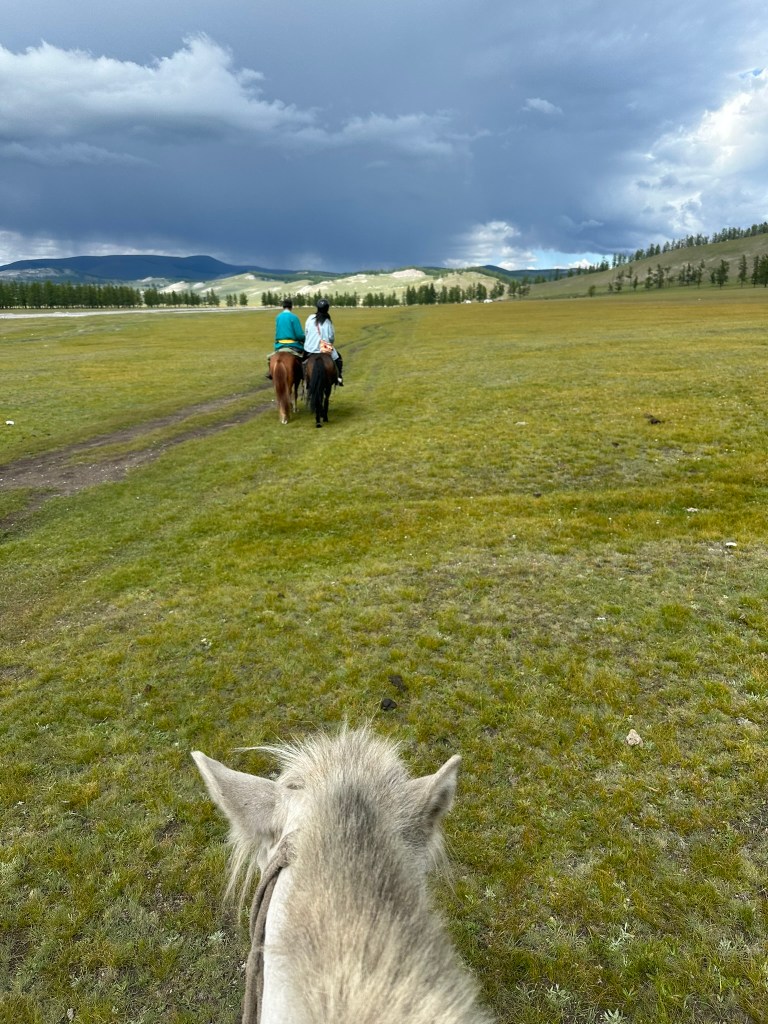
    And it’s Hyeonjeong’s first time riding on a horse, so the horse doesn’t respect her and just goes running around eating grass. The horseman had to attach her horse to his.

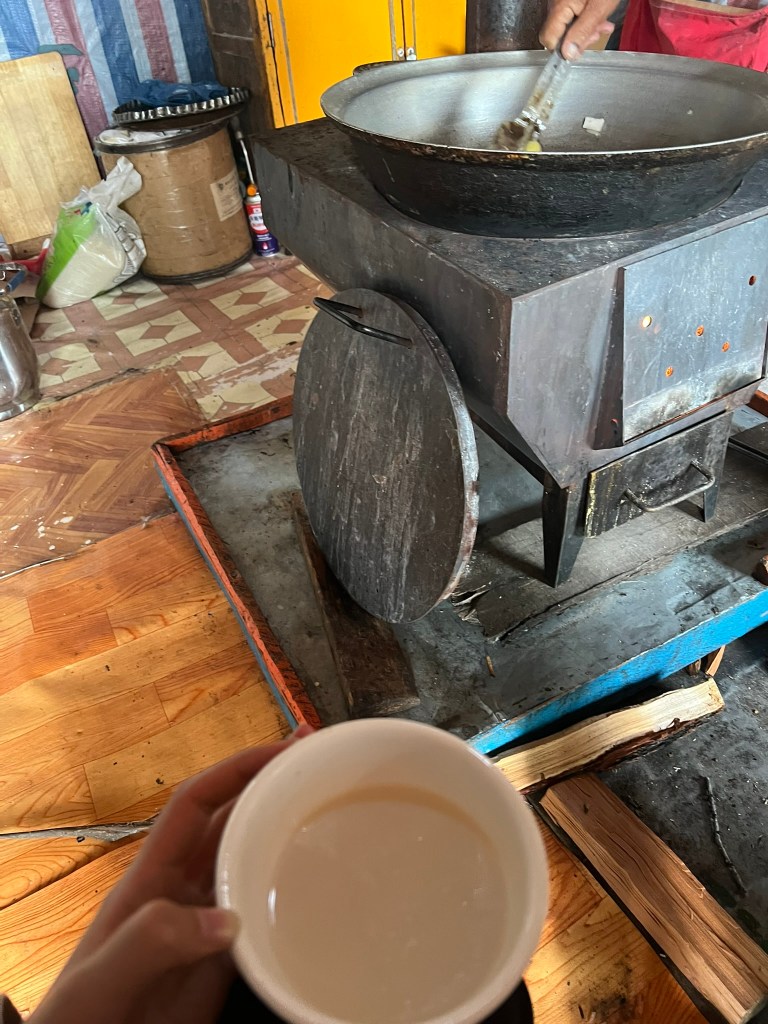
    We go very, very far, but it starts raining partway through, so our driver took us to some random person’s Ger.

    This is the average Mongolian ‘house’

    And there was a young child who was absolutely insane, screaming and playing. It looked like all of his toys were beyond broken, but he was playing with them anyways.

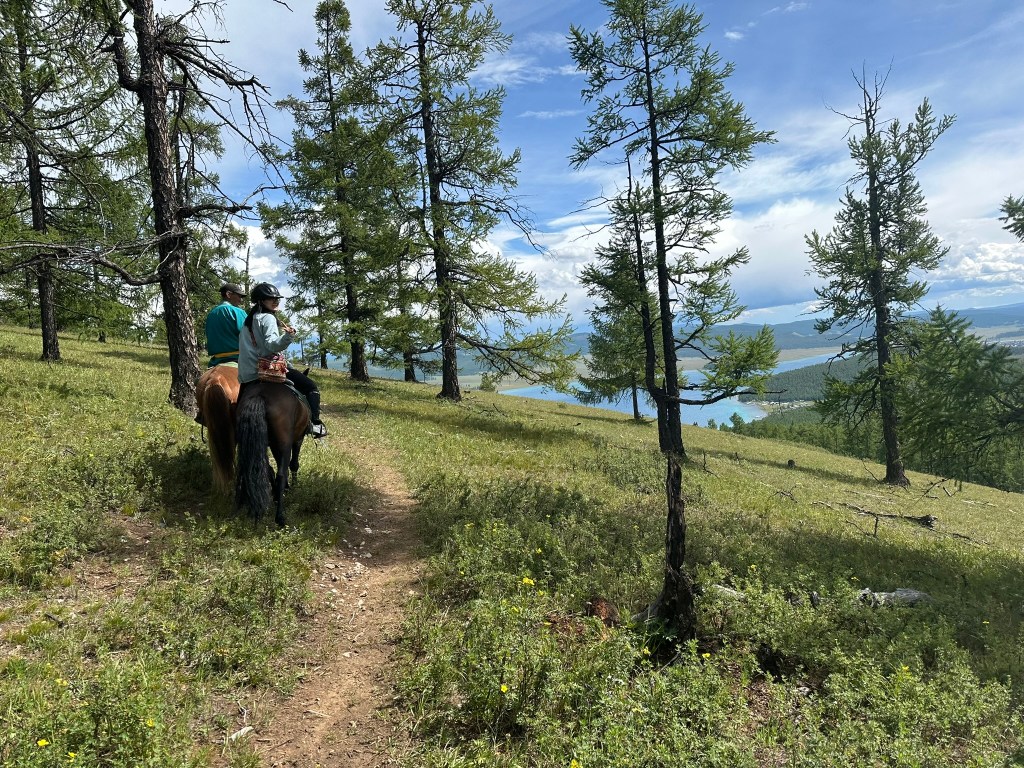
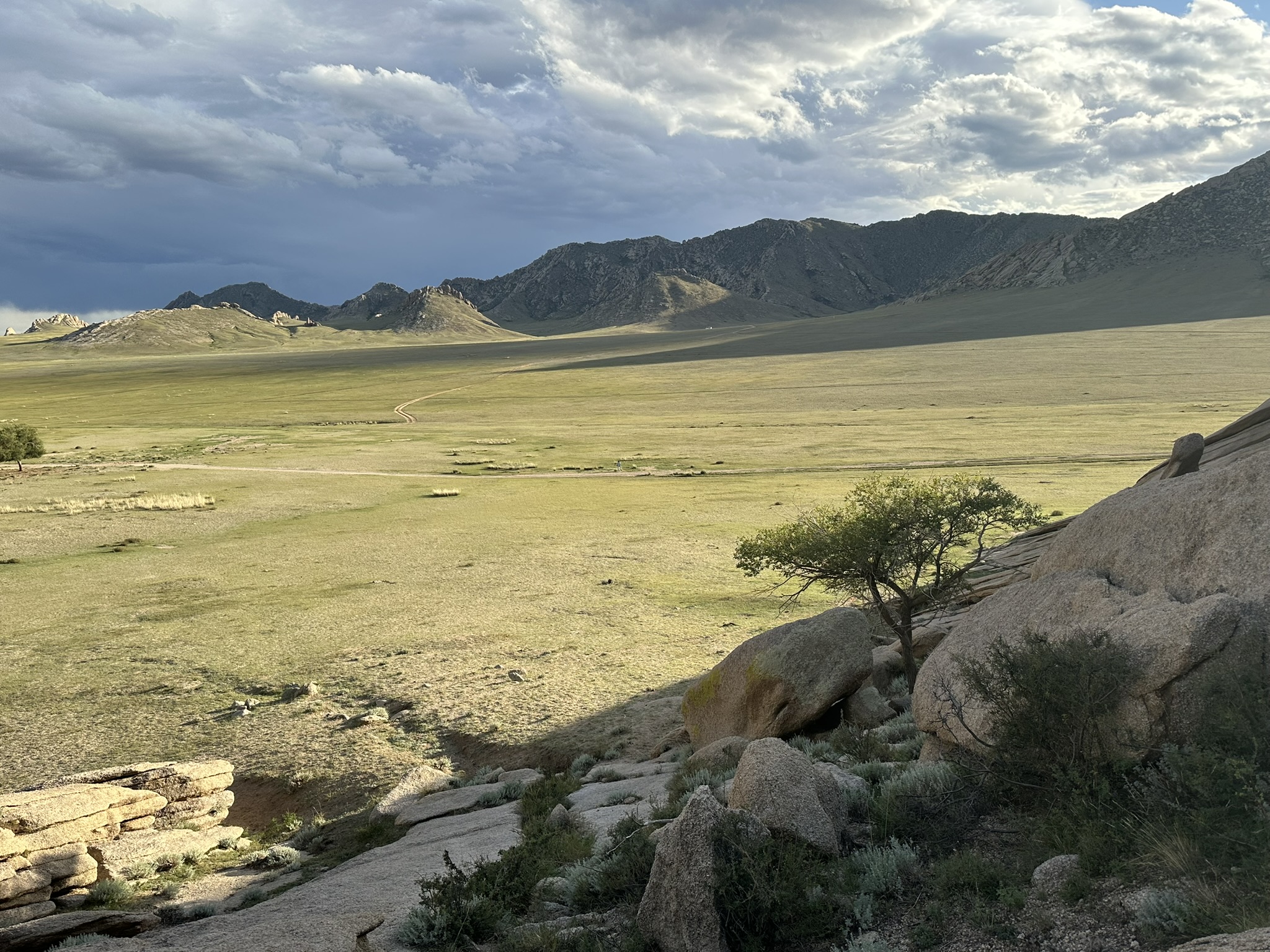
    Through the woods and up the mountain, to a really beautiful view.

    Then, our last day in Khuvsgul before we return to the city and go home.

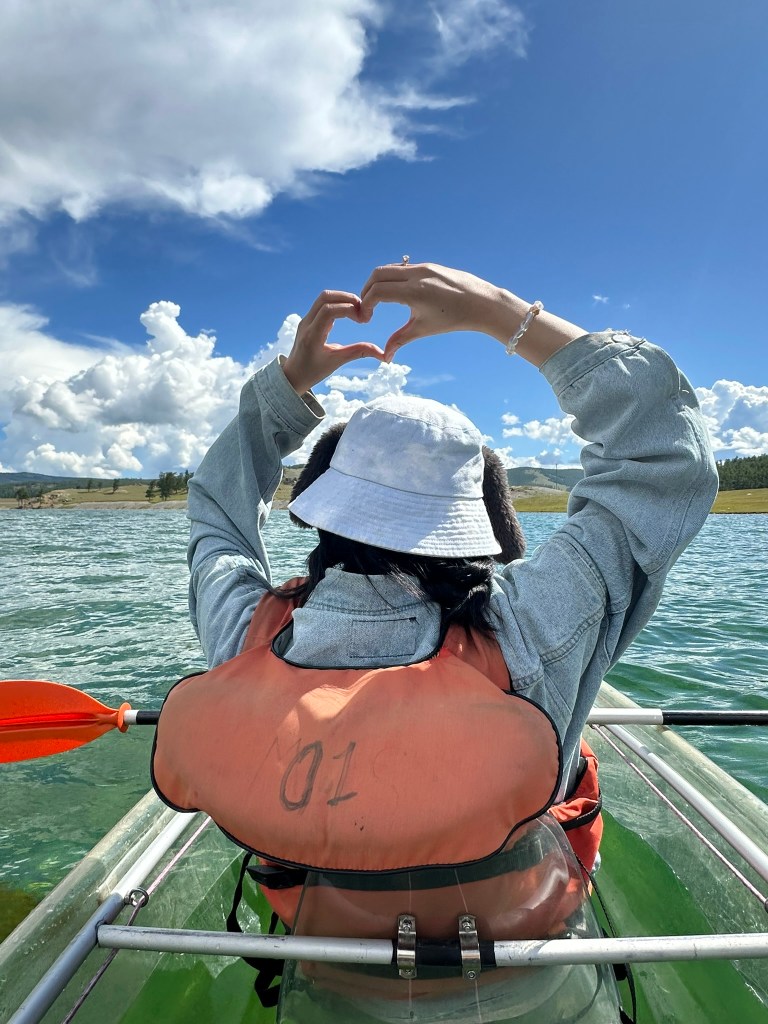
    We ride a canoe, and wanted to take some engagement pictures. But we are always terrified of losing the ring.

    So for our final activity, we went ziplining across the lake!

    Finally, we take our taxi and ride the night bus back. The taxi driver could speak some English, Korean, Japanese, and Mongolian! He seemed to really like the American music.

    There’s nothing really of note after we got back to the city. I had some mediocre pizza and met some old ladies from Chicago. They had an incredibly strong Chicago accent.

    Time to go home! I enjoyed the trip, but I don’t think I would go again ^^

    I thought Mongolia was a pretty developed country, and in the city it seemed like at least on the higher end of developing countries (like India I guess?)

    But the countryside is very undeveloped, and I wasn’t prepared for the ways in which it would affect me, such as access to clean water…

    However, people can live like this because they have a very strong foundation of trust and rely on each other. That is something I felt very endearing about Mongolia despite its flaws.

    Thanks for reading.

  • There are many phrases/grammar structures that use the word 限る.

    And because the N1 is testing for precise knowledge of nuance, and what sounds or feels the best out of every answer instead of what might be grammatically correct, I want to write a little about the nuance of each one to reference later.

    On the off chance that I get a question asking me to choose which one fits best in a given sentence.

    ~に限り

    意味: ~だけは特別だ・例外だ。かたい言い方

    Meaning: ~only is special / other. A formal way of speaking.

    例文

    ①このチラシをご持参のお客様に限り、すべての商品を1割引きでお買い求めいただけます。

    英: Limited to the customers that have the flyer, you may ask for a 10% discount on all products.

    ②欠席理由が正当な場合に限り出席扱いにしますが、それ以外の欠席は認めません。

    英: Limited to the absence excuse that is justifiable, we will handle the absence, however other absences will not be recognized

    ③この病院は午後6時までですが、急を要する患者さんに限り、時間外でも診察いたします。

    英: This hospital is open until 6 pm, however, limited to patients with need of urgency, we will examine you at other times as well.

    接続

     +に限り

    ニュアンス

    ⚠️ 公に説明するときの言い方。例外的に扱われるものを表す言葉につく。後には、その例外だけ適用されることを言う文が来る。普通、否定の文や働きかけの文は来ない。

    ⚠️ When explaining publicly, it is attached to a word that indicates something treated as an exception. After it, a sentence stating that only that exception applies follows. Usually, a negative sentence or an imperative sentence does not come after it.

    ~限り(は)

    意味:~の状態が続いている間だけは、同じ状態が続く。

    Meaning: As long as ~’s state continues, the same state will continue.

    例文

    ①この町に住んでいる限り、いつでも新鮮な食べ物が手に入る。ここは野菜も魚も豊富だ。

    英:As long as (someone) lives in this town, you can always obtain fresh food. The vegetables and fish are plentiful here.

    ②社長が考え方を変えない限りは、この会社は何も変わらないのではないか。

    英:As long as the company president does not change his way of thinking, (isn’t it the case that) nothing will change in this company?

    ③親である限りは子供に対する責任があると思う。

    英:As long as (somebody is) a parent, they have a responsibility towards their children.

    接続

    普通系現在

    ex. 生きている限り、気を付けてない限り

    (ナ形ーな / ーである・名ーである)+限り(は)

    な形容詞

    ex. 丈夫 ⇒ 丈夫な限り

    名詞

    ex. 親 ⇒ 親である限り

    ニュアンス

    ⚠️ 前にも後にも状態を表す言葉が来る。条件の意味を持つ文なので、後には過去の文が来ない。

    ⚠️ Words expressing a state come both before and after. Since it is a sentence with a conditional meaning, a past-tense sentence does not follow.

    ~限りでは

    意味:情報源の範囲を~だけにすると、あることが言える。

    Meaning: If the scope of the information source is limited to ~, something can be said (or concluded).

    例文

    ①今回の調査の限りでは、書類にミスはなかった。

    Limited to the results of the investigation this time, there is no error in the documents.

    ②ちょっとみた限りでは、こちらの商品とあちらの商品では違いがないと思うのですが、どうして値段が違うんですか。

    From the little bit I looked (limited to what I saw), I think this product and that product are no different, but why is the price different?

    ③私が知っている限りでは、この近所に花やはありません。

    As far as I know (limited to what I know), there is no flower shop in this neighborhood.

    接続

    名ーの・動詞辞書形/た形/ている形 + 限りでは

    ニュアンス

    ⚠️ 情報を得ることに関係のある言葉(見る・聞く・覚えている・知っている・調査など)につく。後には、ある判断や情報を表す文が来る。

    ⚠️ It attaches to words related to obtaining information (see, hear, remember, know, investigate, etc.). After it, a sentence expressing a certain judgment or piece of information follows.

    ~に限って

    意味:A ⇒ ~は普段と違っている

    meaning: A ⇒ ~is different from standard

    例文

    ①ふだん酒などあまり飲まない彼が、今日に限ってかなり飲んだ。何かあったのだろうか。

    The guy who normally doesn’t drink much, only today he drank a lot. I wonder if something’s up.

    ②わたしはいつもは駅前で買い物するのだが、その日に限って車で遠くのスーパーまで行った。

    Normally I shop at in front of the station, but only that day I went far by car to the supermarket.

    ③どうしてあの日に限って別の道を通ろうと思ったのか、思い出せない。

    Why I thought to go down a different road only that day, I can’t remember.

    接続

    名 +に限って

    ニュアンス

    ⚠️ 後には、「いつもとは違う、特別だ」という意味の文が来る。

    ⚠️ After it, a sentence with the meaning of ‘different from usual, special’ follows.

    ~を限りに

    意味:⇒の時までで、それまで続いていたことを終わりにする、と宣言する

    Meaning: From the time of ⇒, announcing that something that has continued from that time will be ended.

    例文

    ①本年度を限りにこの講座の受講生募集を行わないことになりました。

    As of this fiscal year, the recruitment of course students will no longer be taking place.

    ②今日を限りにタバコを止めるぞ!

    As of today, I’m gonna quit smoking!

    ③これを限りにお前とは親子の縁を切る。以降親でもなく、子でもない。

    As of this (now), I am cutting the bond between parent and child. Hereafter, (I am) neither a parent nor (you) a child.

    接続

    名 +を限りに

    ニュアンス

    ⚠️ 時を表す言葉(今日・今回・本年度など)につくことが多い。

    ⚠️ It often attaches to words expressing time (such as today, this time, this fiscal year, etc.).

    ~に限らず

    意味:「~だけでなく」、「~のみならず」といった意味合いで使われ、話題にしていることの範囲を広げる際に用います。

    Meaning: It conveys the meaning of “not only… but also” or “not limited to” in English. This phrase is often used to broaden the scope of what is being discussed.

    例文

    ①このイベントは若者に限らず、年配の肩にも人気があります。

    This event is popular with not only young people, but also old people.

    ②学生に限らず、社会人もこのセミナーに参加しています。

    Not only students, also office workers are participating in the seminar.

    ③漢字は外国人に限らず、日本人にも難しい。

    Not only foreigners, kanji is also difficult for Japanese people.

    接続

    名詞+に限らず

    ニュアンス

    ⚠️「にらず」は「(A) だけでなく (B)」を文型です。これは「に」と五段動詞る」、そして文語助動詞「ず」のわせです。「ず」は「ない」と意味ち、じように動詞いて使われます。

    ⚠️この表現名詞かれ、の (B) の部分で (A) と範囲やカテゴリーにまれることの説明きます。

    ⚠️”に限らず” is a sentence pattern that expresses “not only (A) but also (B).”
    It is formed from the particle “に,” the godan verb “限る” (to limit), and the classical auxiliary verb “ず.”
    “ず” has the same meaning as “ない” (not) and attaches to verbs in the same way.

    ⚠️This expression is placed after a noun, and in the (B) part of the sentence, an explanation follows showing that (B) belongs to the same range or category as (A).

    ~に限ったことではない

    意味:〜だけに言えることじゃない / 〜だけでなく、他にもある

    Meaning: Used to express that a certain issue, situation, or characteristic is not exclusive to one particular thing but can apply more broadly.

    例文

    ①正しい敬語が使えないのは、若者に限ったことではない

    As for using proper Keigo, it’s not just limited to young people.

    ②このように思うのは私に限ったことではない

    As for this way of thinking, it’s not just limited to me. / I‘m not the only one who thinks this way

    ③ 犯罪が起こるのは私の国に限ったことではありません

    As for the occurring of crimes, it’s not just limited to my country. / My country isn’t the only one where crimes happen.

    接続

    名+に限ったことではない

    ニュアンス

    ⚠️「にったことではない」は、五段動詞る」を活用した文型つで、かなり強調的表現です。これは、格助詞「に」、「る」の過去形った」、名詞「こと」、助動詞「だ」の連用形「で」、副助詞「は」、そしてイ形容詞「ない」がわさってできています。この文型文字通り「 (A) に限定されない」ことをし、「(A) だけではなく (B)」や「(A) にらず (B) も」といった意味使われます。

    ⚠️この文型名詞き、まった場面使われることがいです。

    ⚠️にったことではない is a fairly emphatic expression that, like several other grammar patterns, makes use of the う-Verb る ‘to limit’. It is a combination of the case-marking particle に, the past tense of る, った, the noun こと ‘thing’, the conjunctive form of the auxiliary verb だ, で, the adverbial particle は, and the い-Adjective, ない. The literal translation is ‘it is not something that is limited to (A)’, but other common interpretations include ‘not only (A), but (B)’, or ‘not restricted to (A), (B) too’.

    ⚠️ This structure will be used following nouns, and tends to be reserved for fairly formal situations.

    に限る
    例文

    ①暑い日は冷たいシャワーを浴びるに限る

    As for a hot day, there’s nothing better than taking a cold shower. / There’s nothing better than taking a cold shower on a hot day.

    ②回転ずしはくら寿司に限る

    As for kaiten-sushi, there’s nothing better than Kurazushi. / When it comes to kaiten-sushi, there’s nothing better than Kurazushi.

    ③休みの日には仕事をしないに限る

    On days off, there’s nothing better than doing no work.

    接続

    る動詞 +に限る

    名詞 +に限る

    ない動詞 +に限る

    ニュアンス

    ⚠️「に限る」は、格助詞「に」(場所を表す)と、動詞「限る」の組み合わせです。この表現は「Aに勝るものはない」「Aが一番だ」といった意味に訳せます。

    ⚠️「に限る」は、動詞の基本形や名詞とともに使うことができます。

    ⚠️にる is a combination of the case marking particle に (marking a location), and the う – Verb る ‘to limit’. This expression can be translated as ‘there’s nothing better than (A)’, or ‘there’s nothing like (A)’.

    ⚠️にる may be paired with verbs in their base form, or with nouns.

    とは限らない

    例文

    ①日が出てても暖かいとは限らない.

    Just because the sun is out doesn’t mean it’s warm.

    ②日本に2年間住んでいるからといって、日本語を話せるとは限らない

    Just because (someone) lives for two years in Japan, doesn’t mean they can speak Japanese.

    ③田舎でも静かだとは限らない

    Just because it’s the countryside, doesn’t mean it’s quiet.

    接続

    動詞+とは限らない

    い形容詞+とは限らない

    な形容詞+とは限らない

    名詞+だ+とは限らない

    ニュアンス

    ⚠️「とは限らない」は、よく「Aが必ずしもそうとは限らない」「Aである保証はない」といった意味で使われます。

    ⚠️この表現は、結果を示す「と」、取り立ての助詞「は」、そして動詞「限る」の否定形「限らない」の組み合わせです。

    ⚠️「限らない」は文字通り「限定されない」「縛られない」という意味を持ちます。したがって、「と」が結果を示していても、その結果が「唯一の可能性ではない」と明確化しているのです。

    ⚠️とはらない is regularly used to convey the meaning of ‘(A) is not necessarily so’, or ‘there is no guarantee that (A)’. This expression utilizes the case marking particle と in its use for highlighting results, the adverbial particle は, and the negated form of the う – Verb る ‘to limit’.

    ⚠️ らない literally means ‘to not be bound’, or ‘to not be limited’. Therefore, despite と highlighting a result, that result is then being clarified as ‘not the only possibility’.

  • I’ve never thought much about modern-day Mongolia until a few months ago. It suddenly became a trending travel destination, especially in Korea.

    We booked our flight without any concrete plans, because you get a more fair price for tours if you find them within the country.

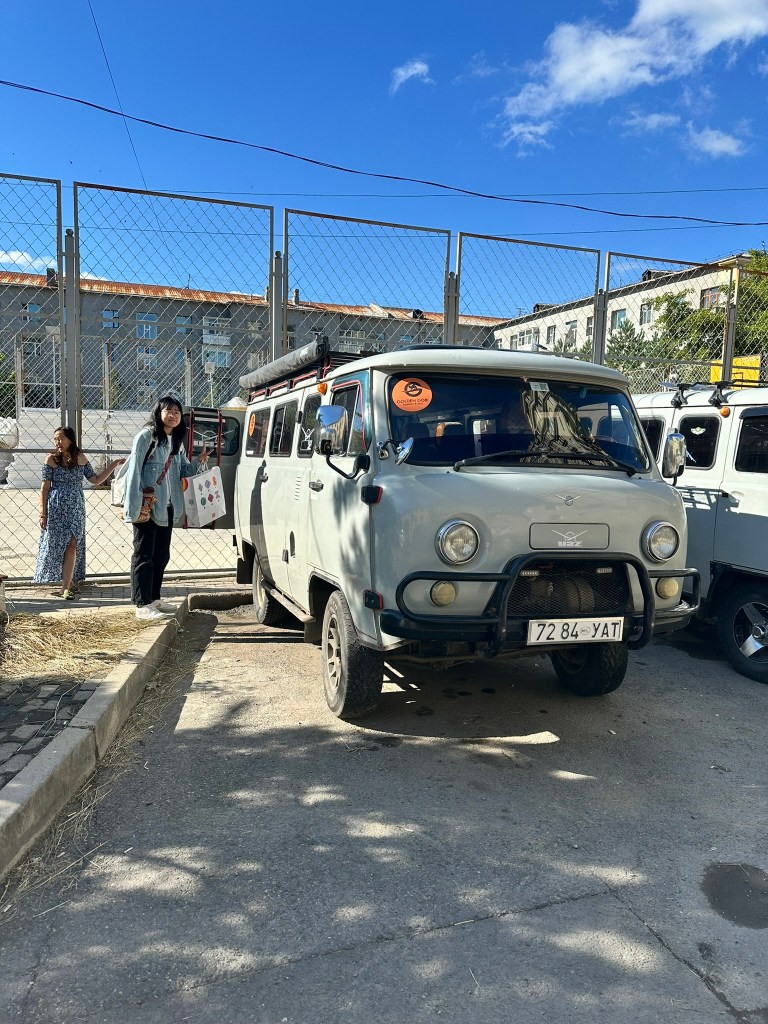
    This ended up being true, we had no problem finding a tour with our hostel, Golden Gobi.

    This was a company that was well recommended across many social media sites. But it seemed like for us, everything that could go wrong did… I would recommend finding another company.

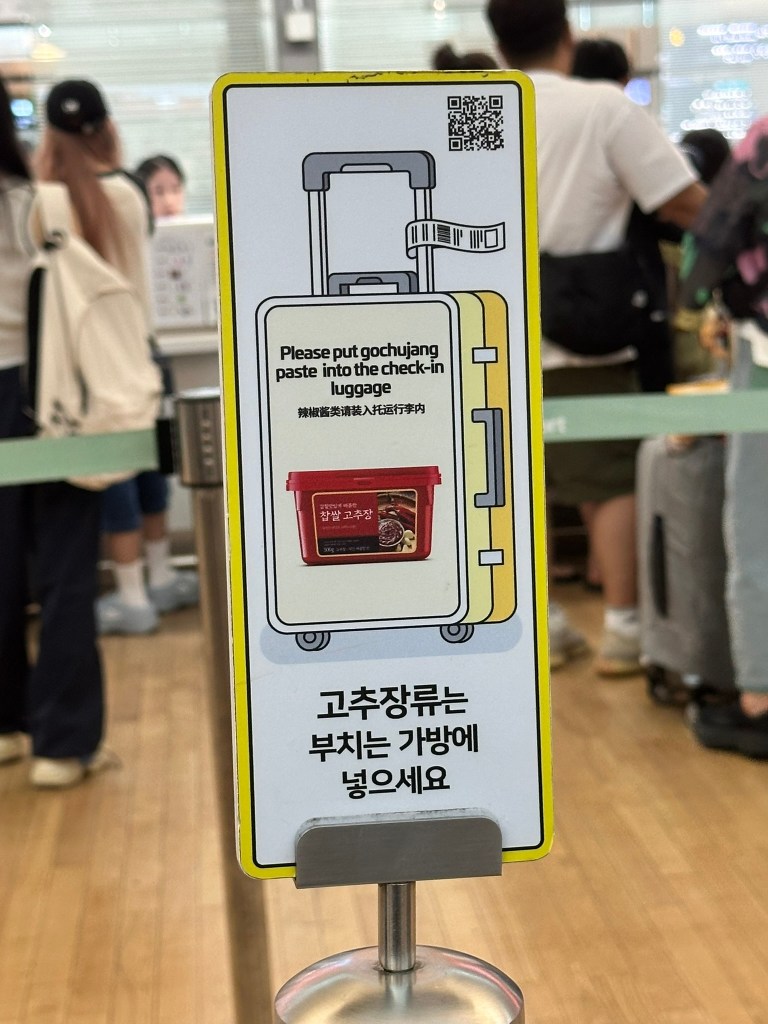
    First, a warning to Koreans desperate for Korean food on their trip to Mongolia. Make sure to properly store the gochujang.

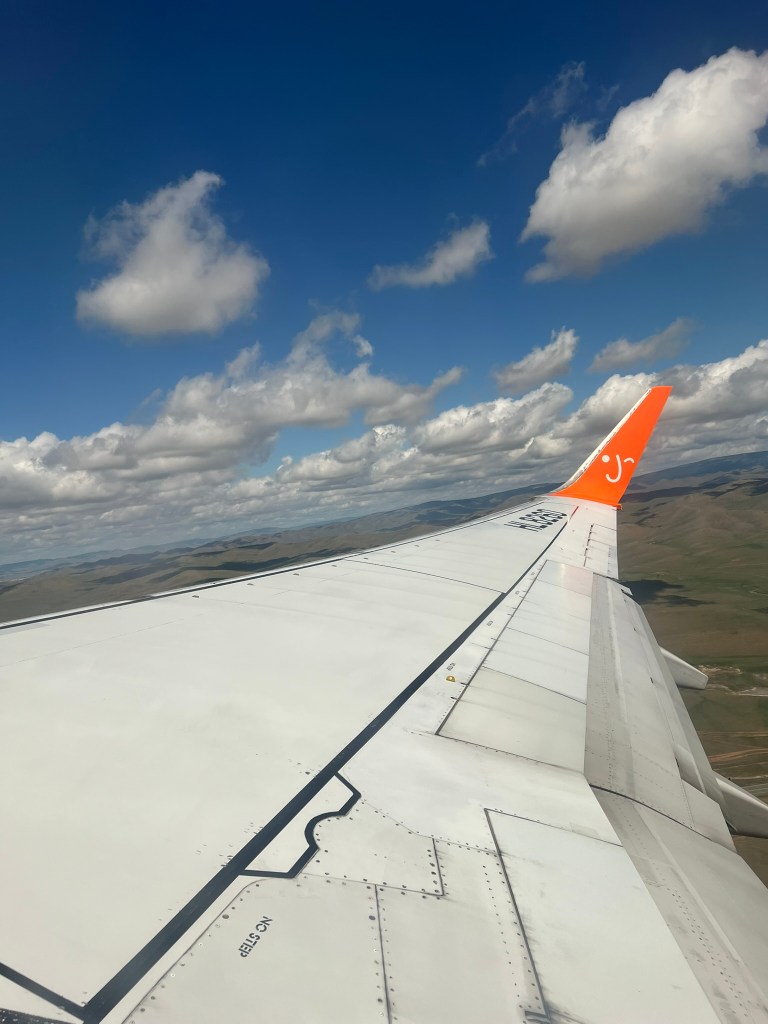
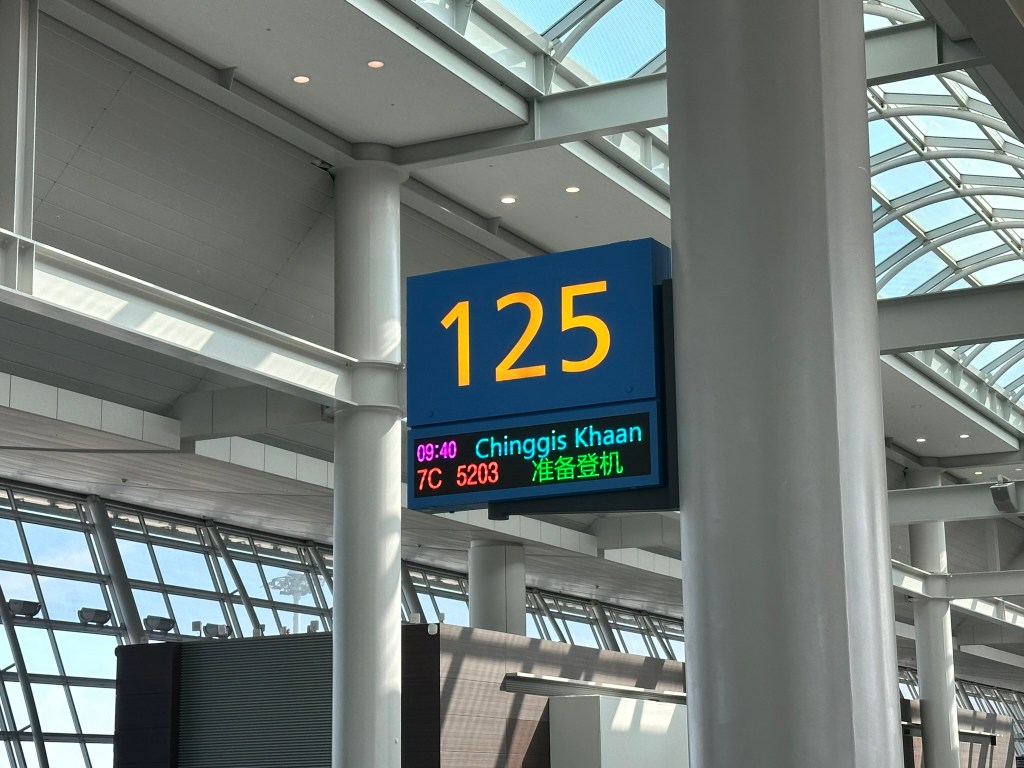
    I went with Jeju Air for this flight, as usual. The plane was a little delayed, but it was no problem.

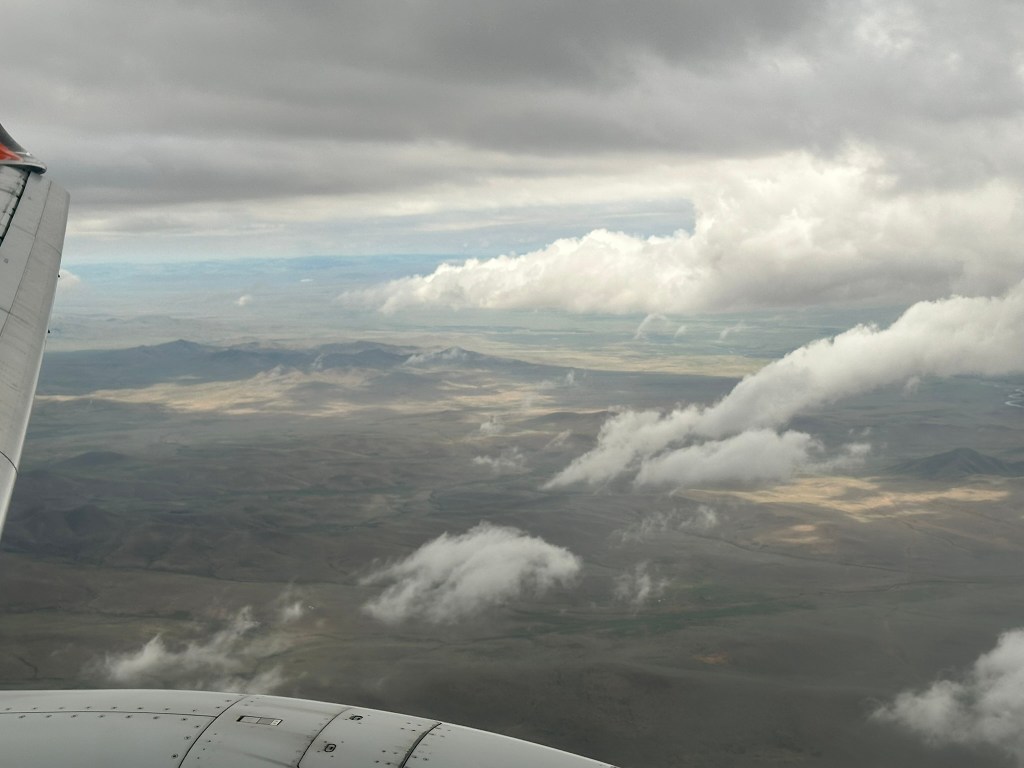
    I thought, wow, there’s really nothing here…

    I would recommend taking the airport shuttle bus. It’s very easy, and you can avoid getting scammed by people in the airport claiming to be taxis.

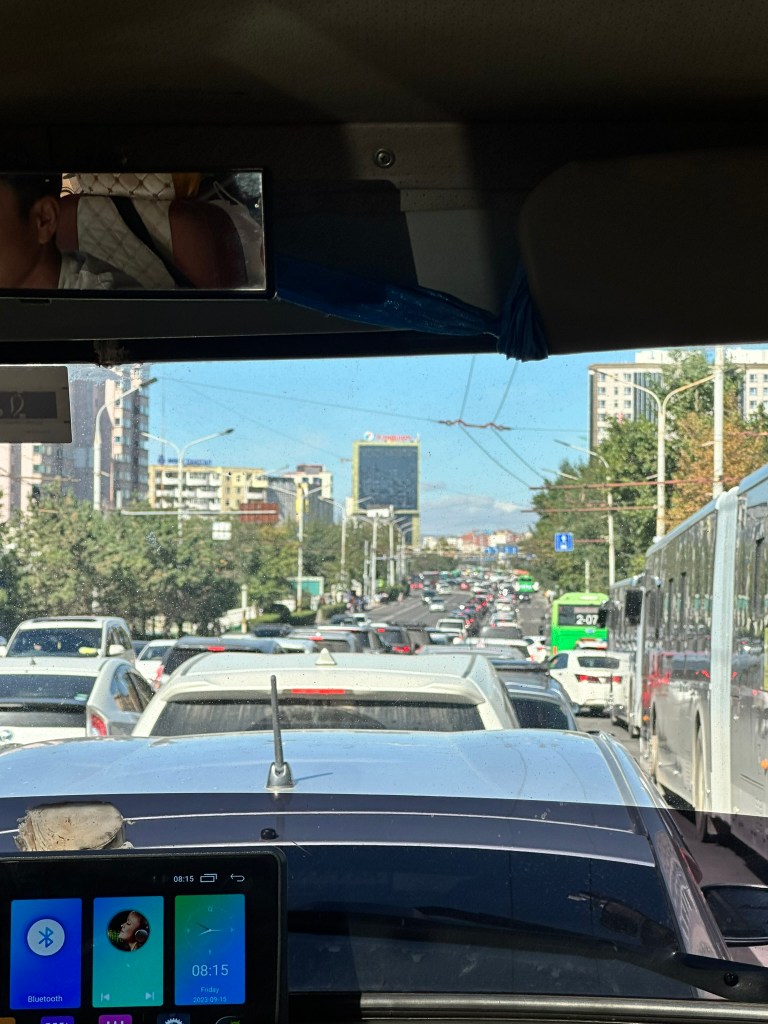
    But we spent an hour and a half in stop and go traffic once we arrived in the city. Why don’t they make bus lanes…?

    We arrived at the hostel, but were a bit confused. We had let them know in advance we were coming and that we were going to do a desert tour in two days, but I guess that’s not how it works, because they didn’t seem to know what was going on. The owner was extremely busy, and we didn’t get any confirmation of what was going on or if we could go on our tour until the next day.

    I think that Golden Gobi must have something going on with an Israeli tour company, because the guesthouse was well over 50% Israeli tourists. It was very hectic.

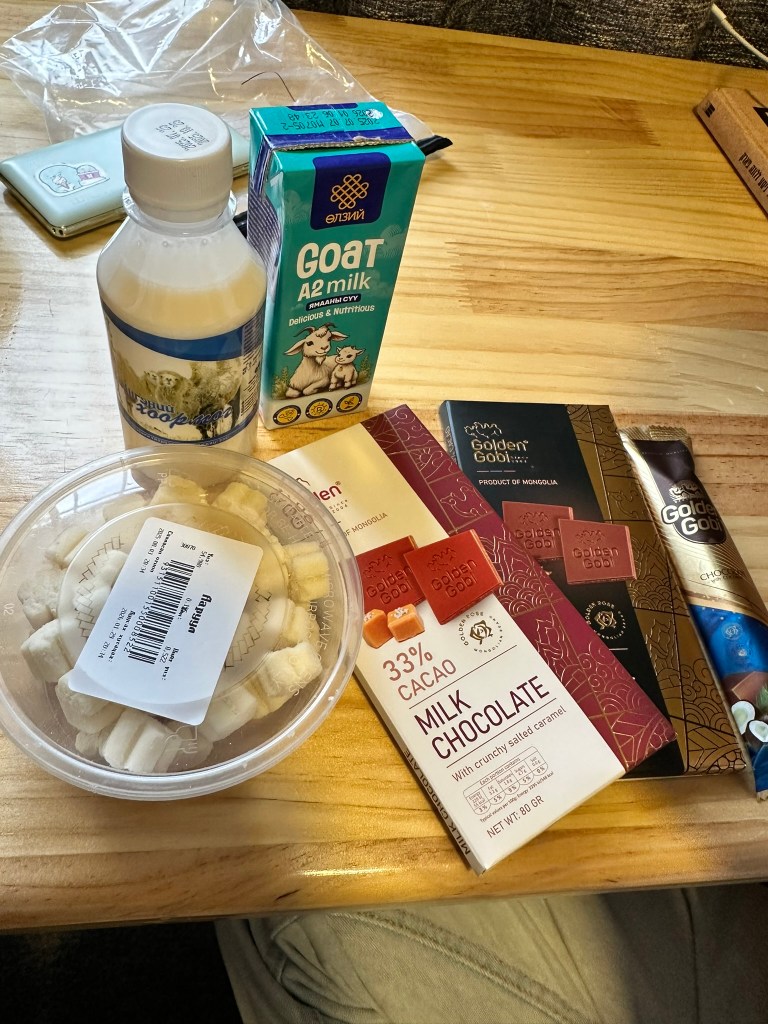
    We went to the State Department Store to try some Mongolian food. Some camel and goat milk, and some kind of sour cheesy snack…? I wouldn’t eat it again, but it’s not terrible.

    Anyways, we spent the day in the city and trying to book our bus tickets for Khuvsgul lake.

    But this city is the worst city I’ve ever been to. It takes an hour to move 10 km, because the traffic is terrible. And the air smells polluted from cars. Taking a car is only slightly faster than walking, and sometimes slower.

    Also, there are no official taxis. So most people will try to scam you into paying 2 or 3 times the price of a normal taxi. You should only be paying 2000-2500 Tugrik per kilometer.

    And it’s said to be wary due to pickpockets.

    It’s a culture shock to us both, coming from such an honest and efficient society.

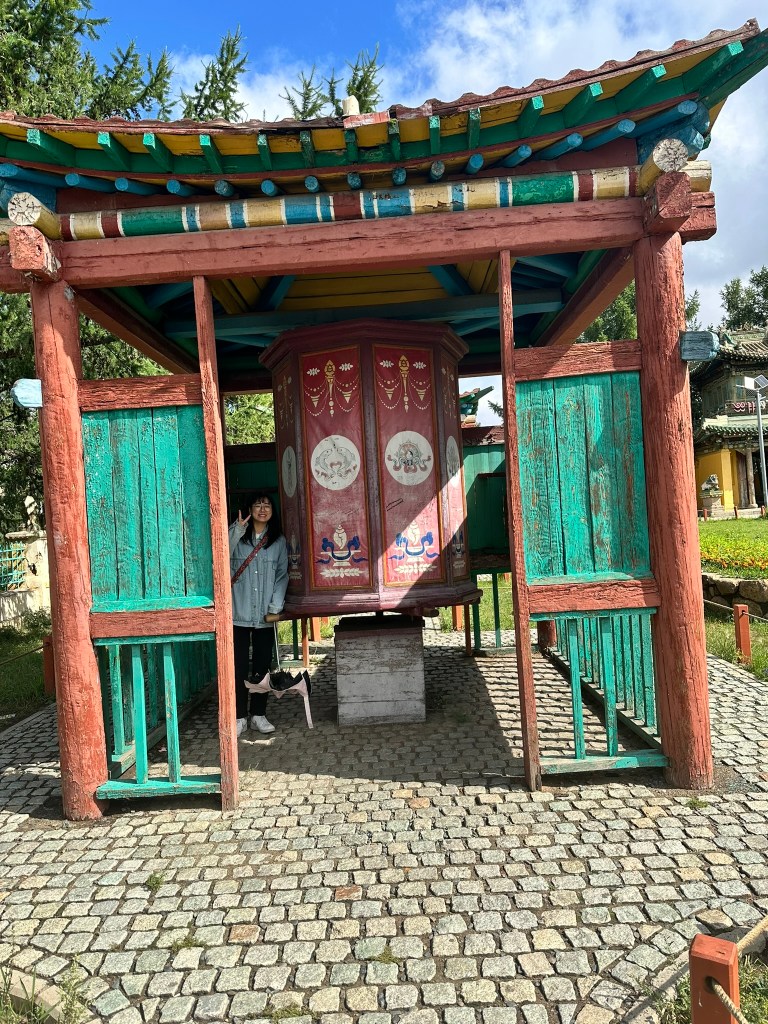
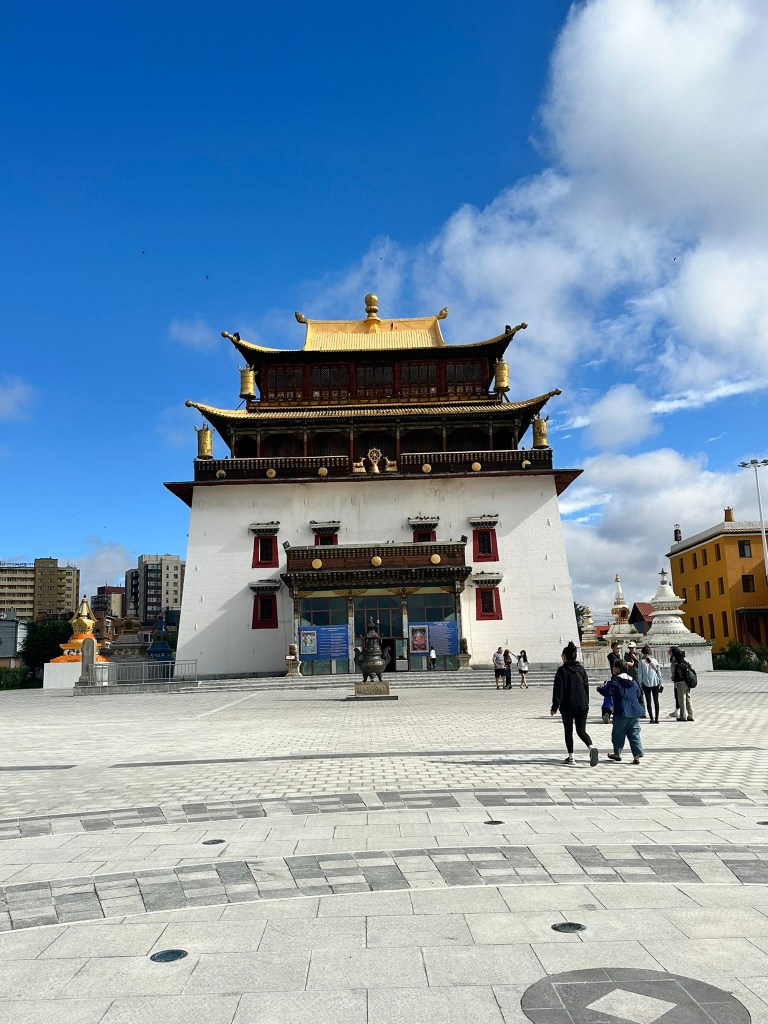
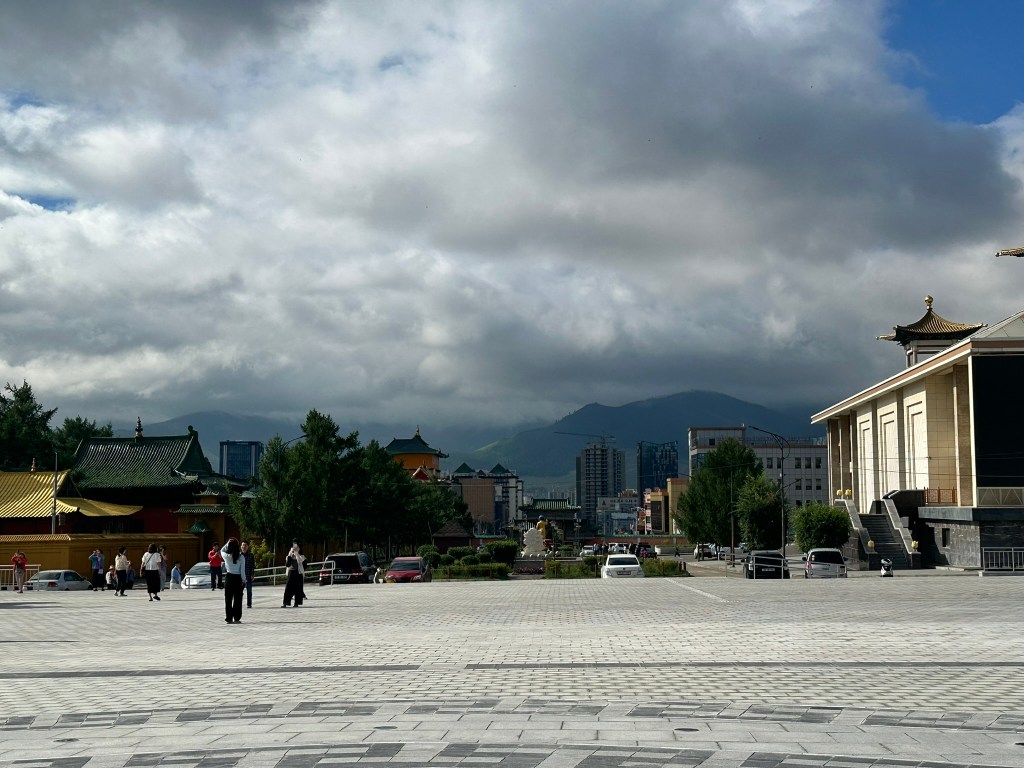
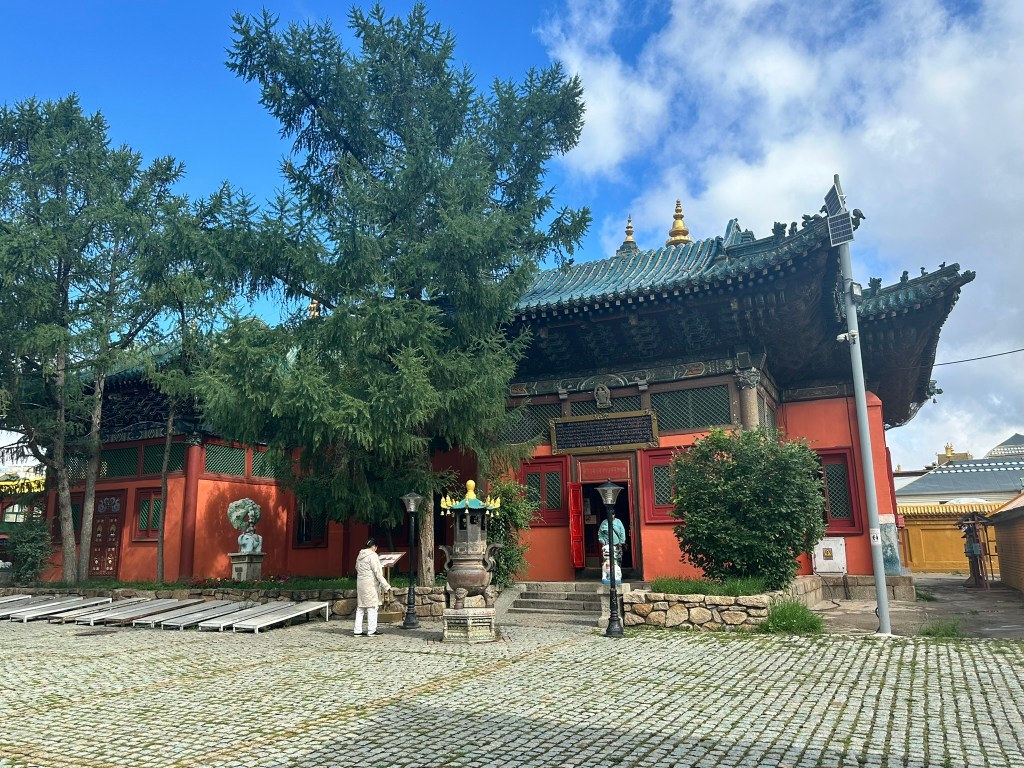
    Anyways, I’m going to a Buddhist temple.

    And the next day, we finally get to go on our tour.

    Due to some problem, we are sent without a group. But the company said that they had already found other people to go in the group…? We had paid for a group tour, but it ended up being private.

    And once again, the traffic is terrible. Let me escape the city!!!

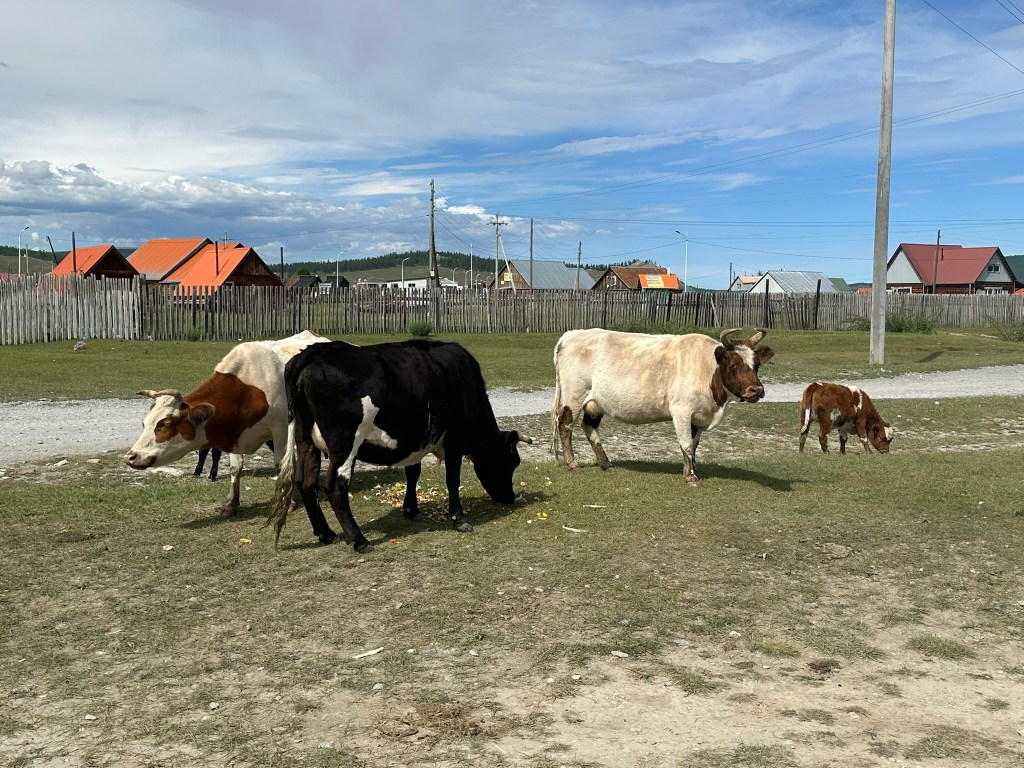
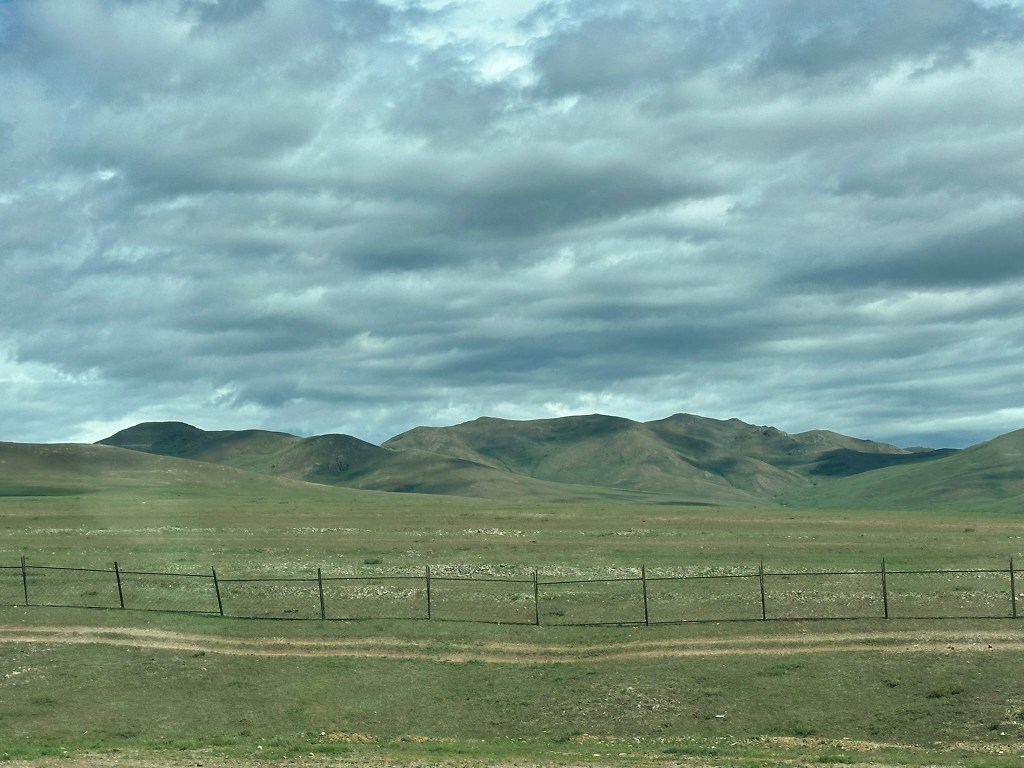
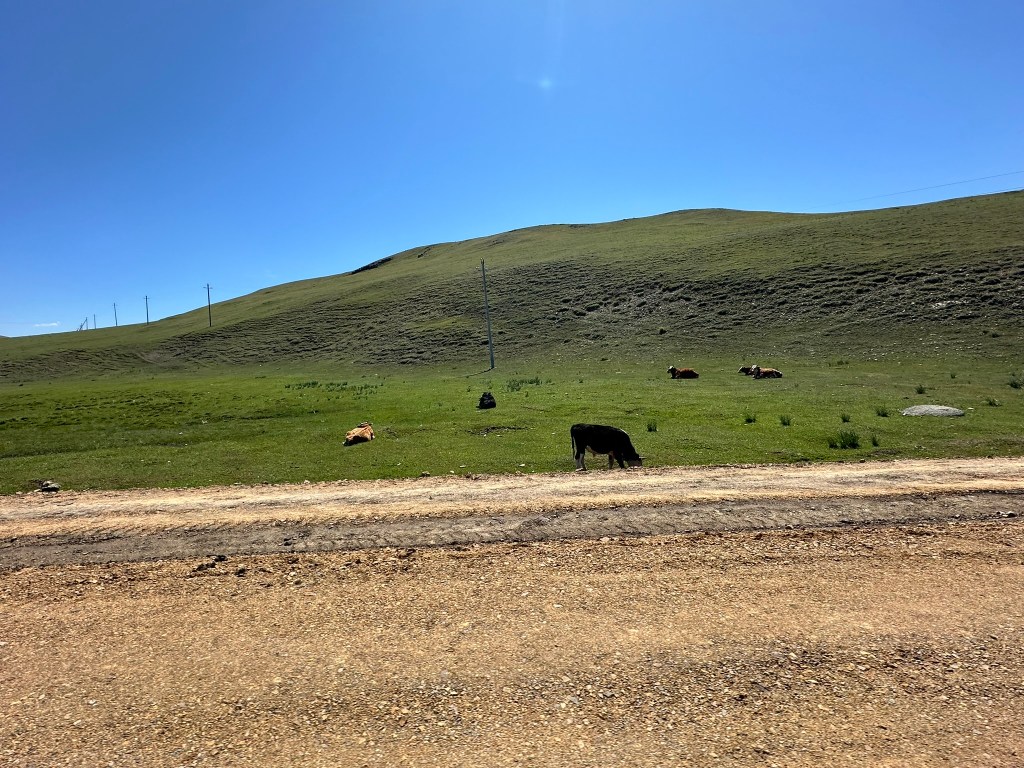
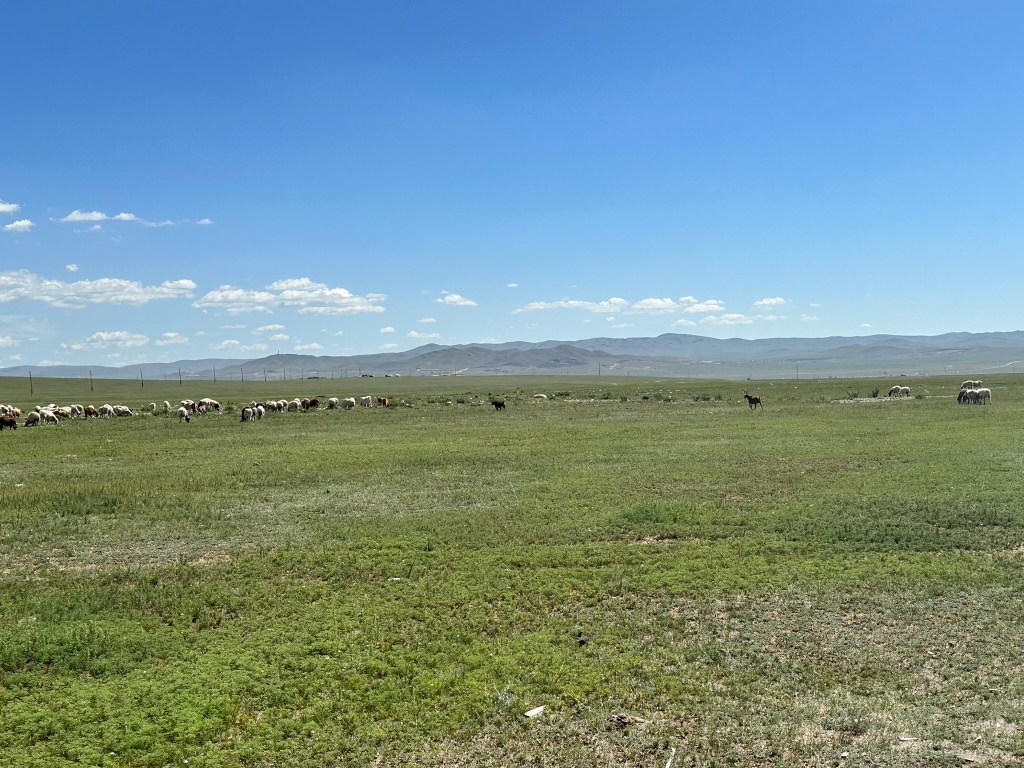
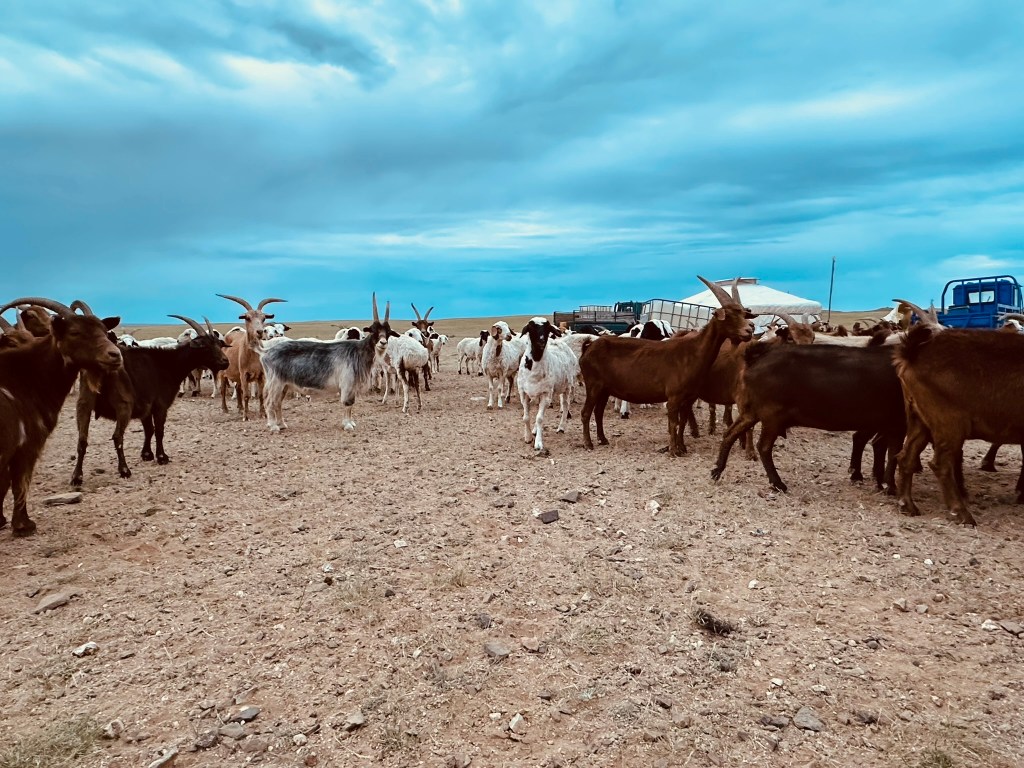
    I heard there were a lot of animals in Mongolia, but I didn’t know they are all free ranged. There are no pens or cages for the animals, because the families have to move a few times a year.

    And our lunch spot for the day..

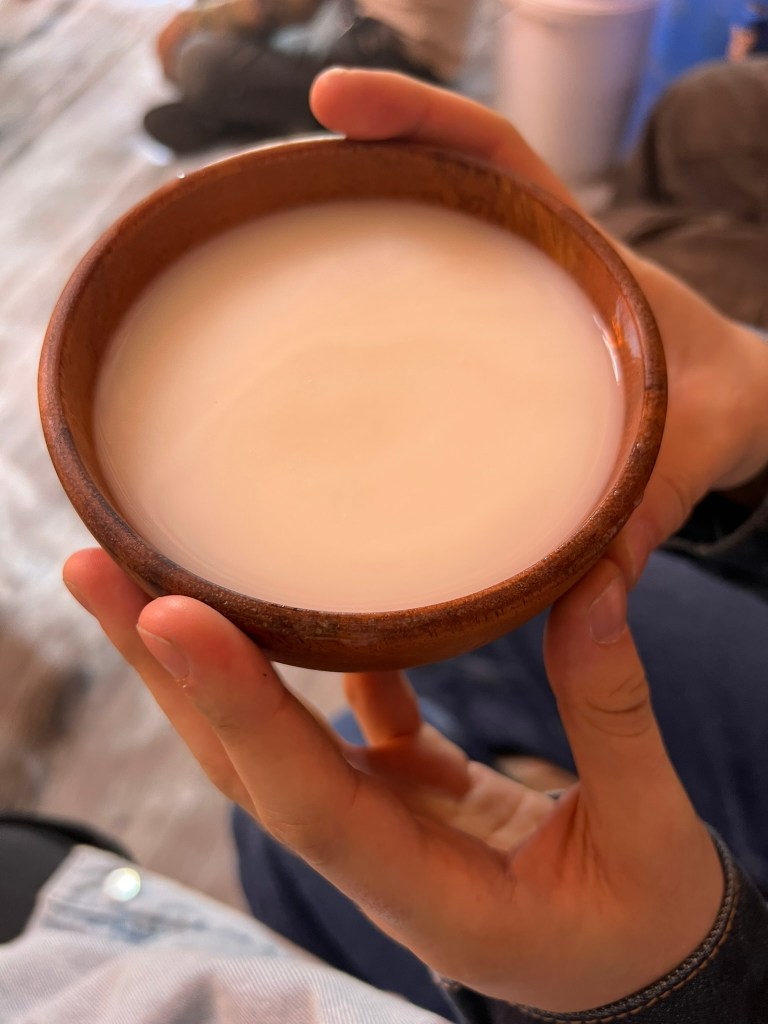
    Hyeonjeong asked if people drink horse milk, which was understood as a request by our guide and driver. They drive off the road and go to seemingly some random person’s house and ask for some. They have barrels full of uncovered fermented horse milk. Is this Mongolian culture … ?

    It tastes like sour makgeolli, by the way.

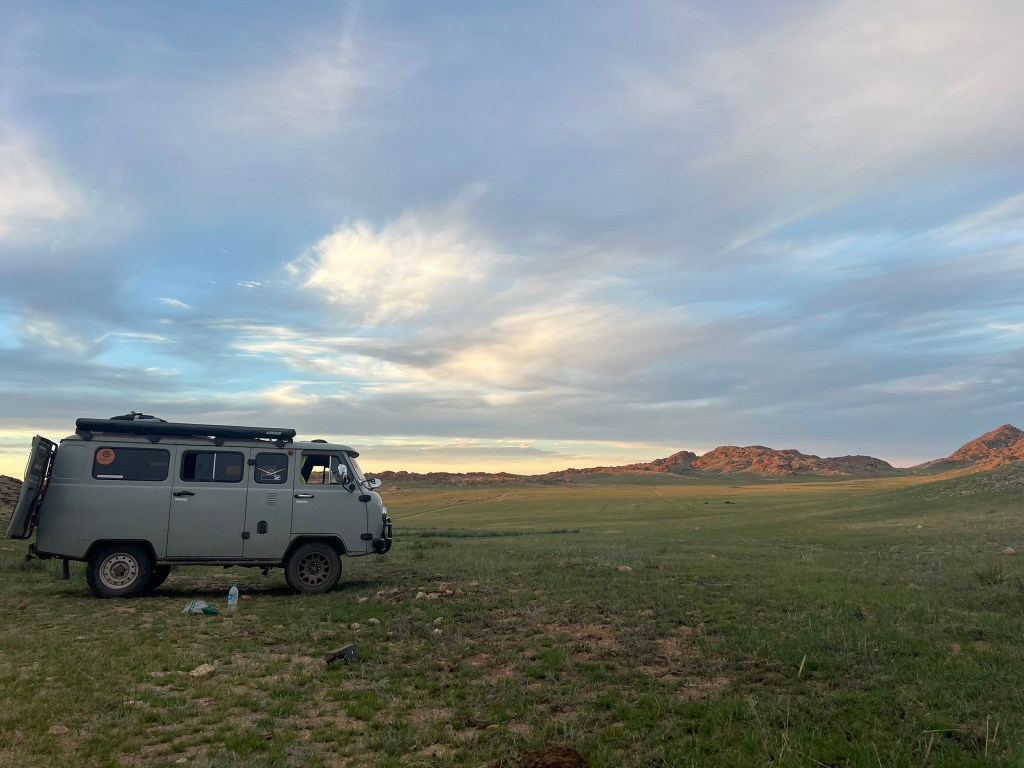
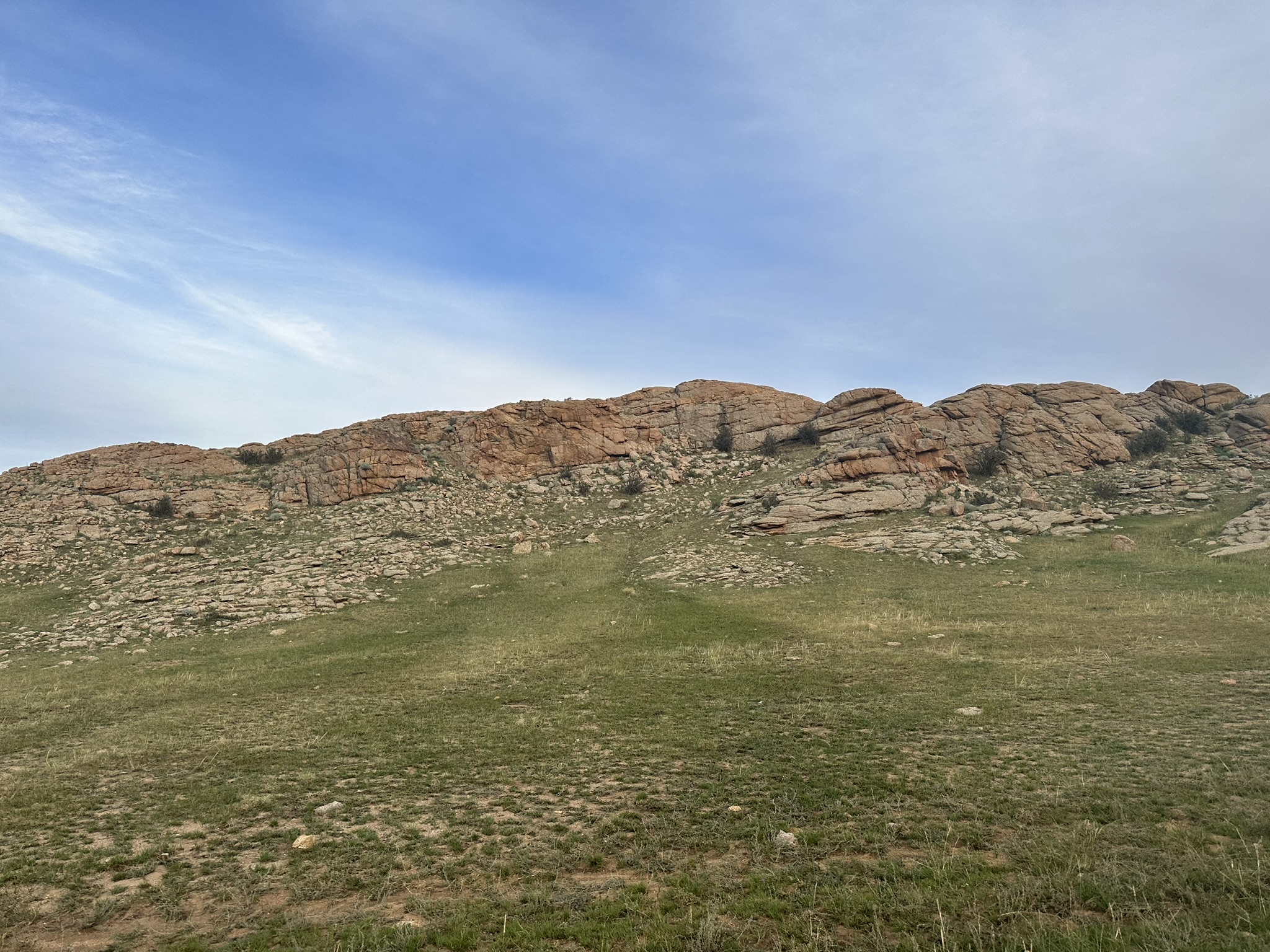
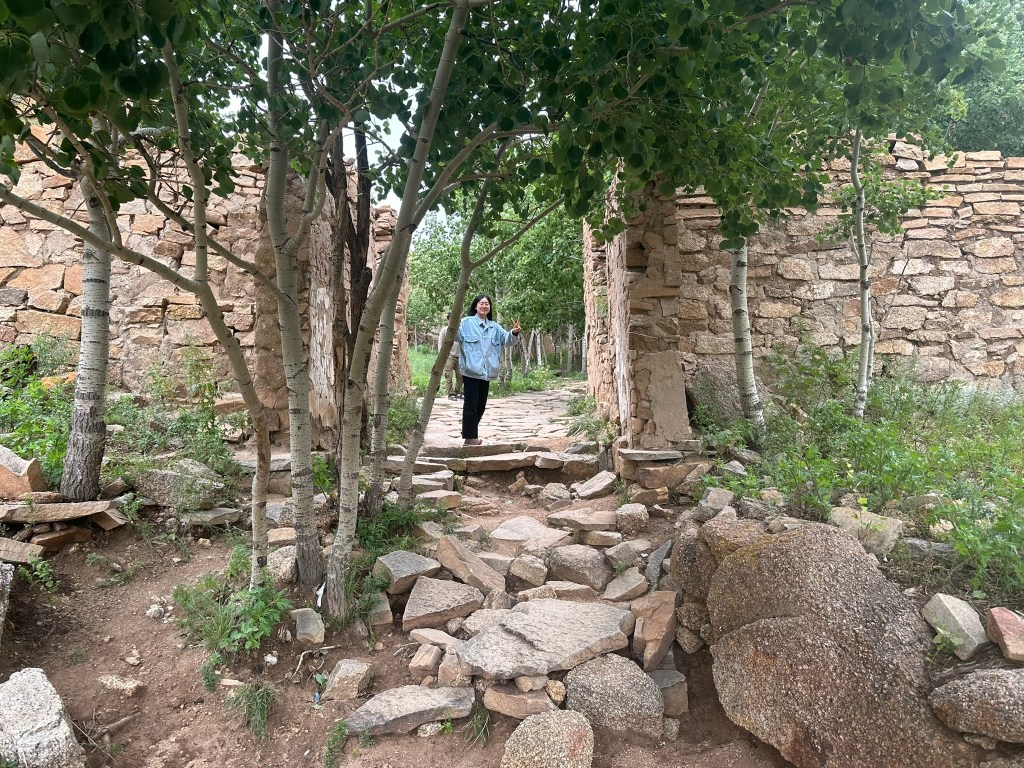
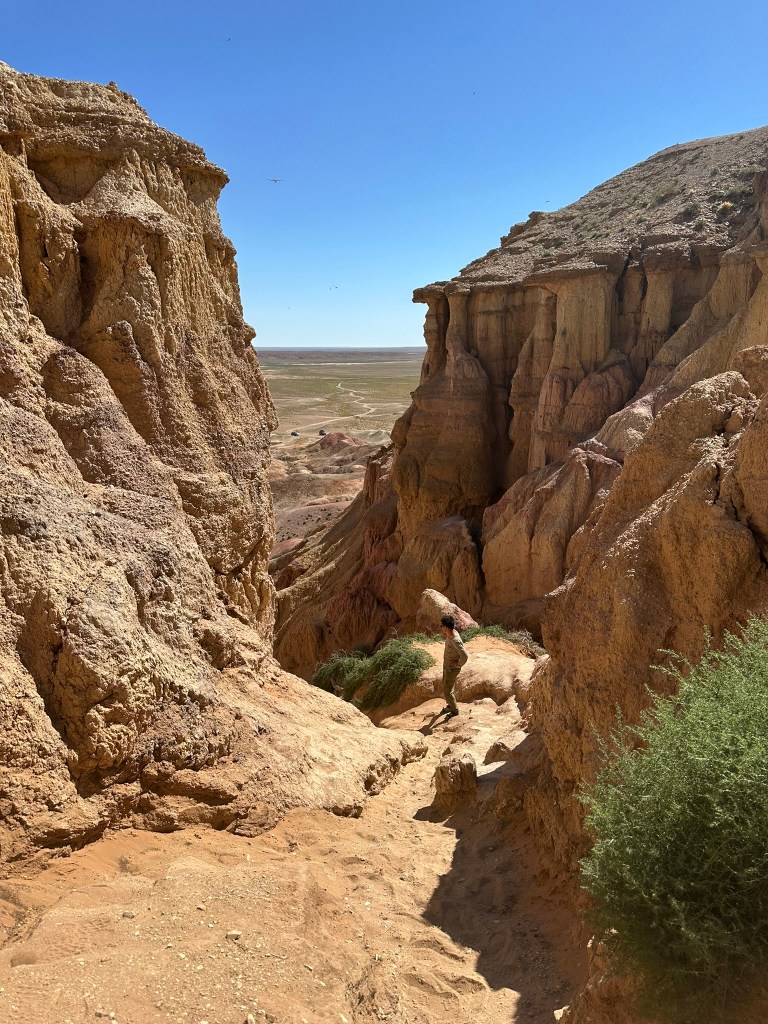
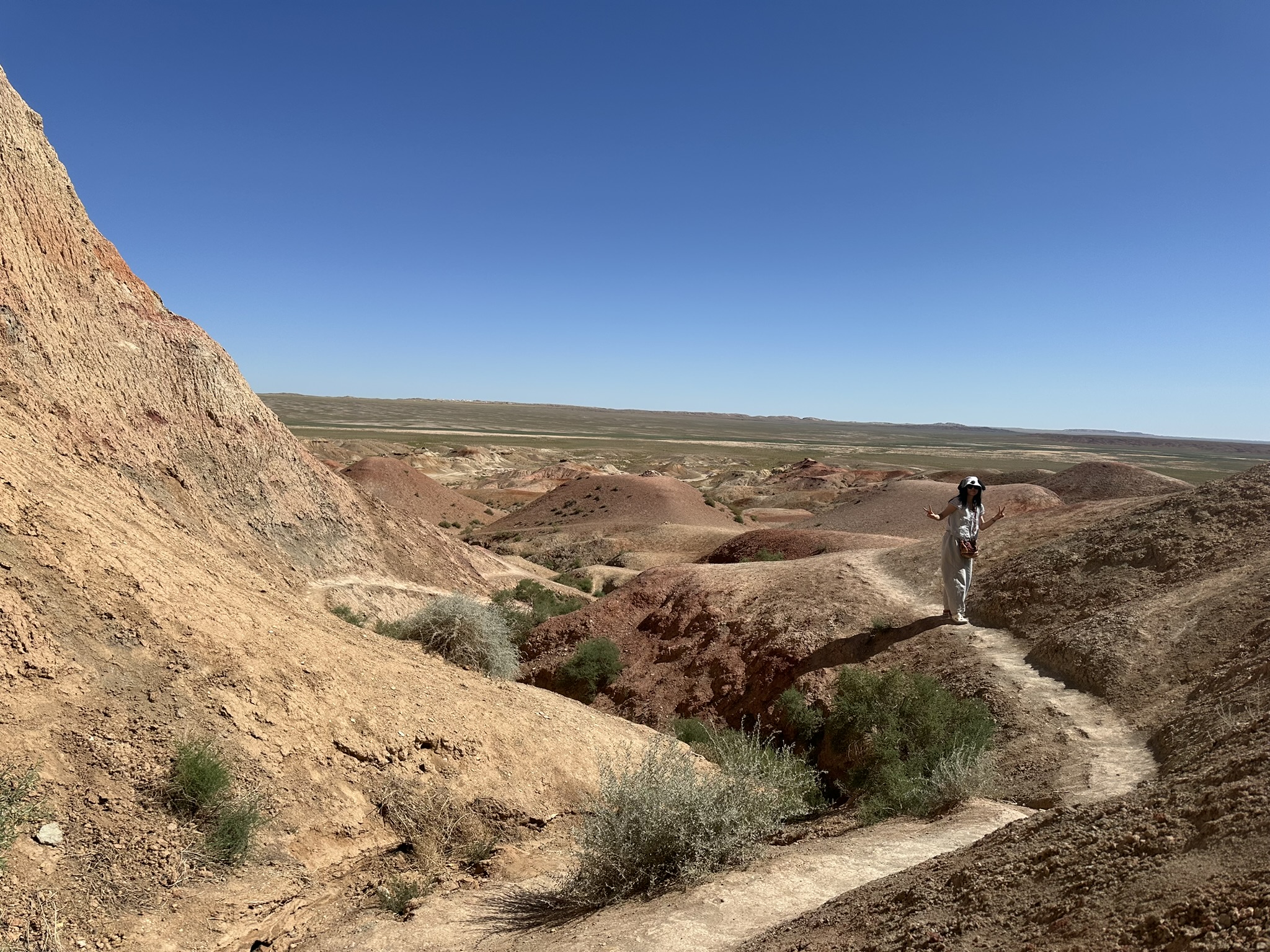
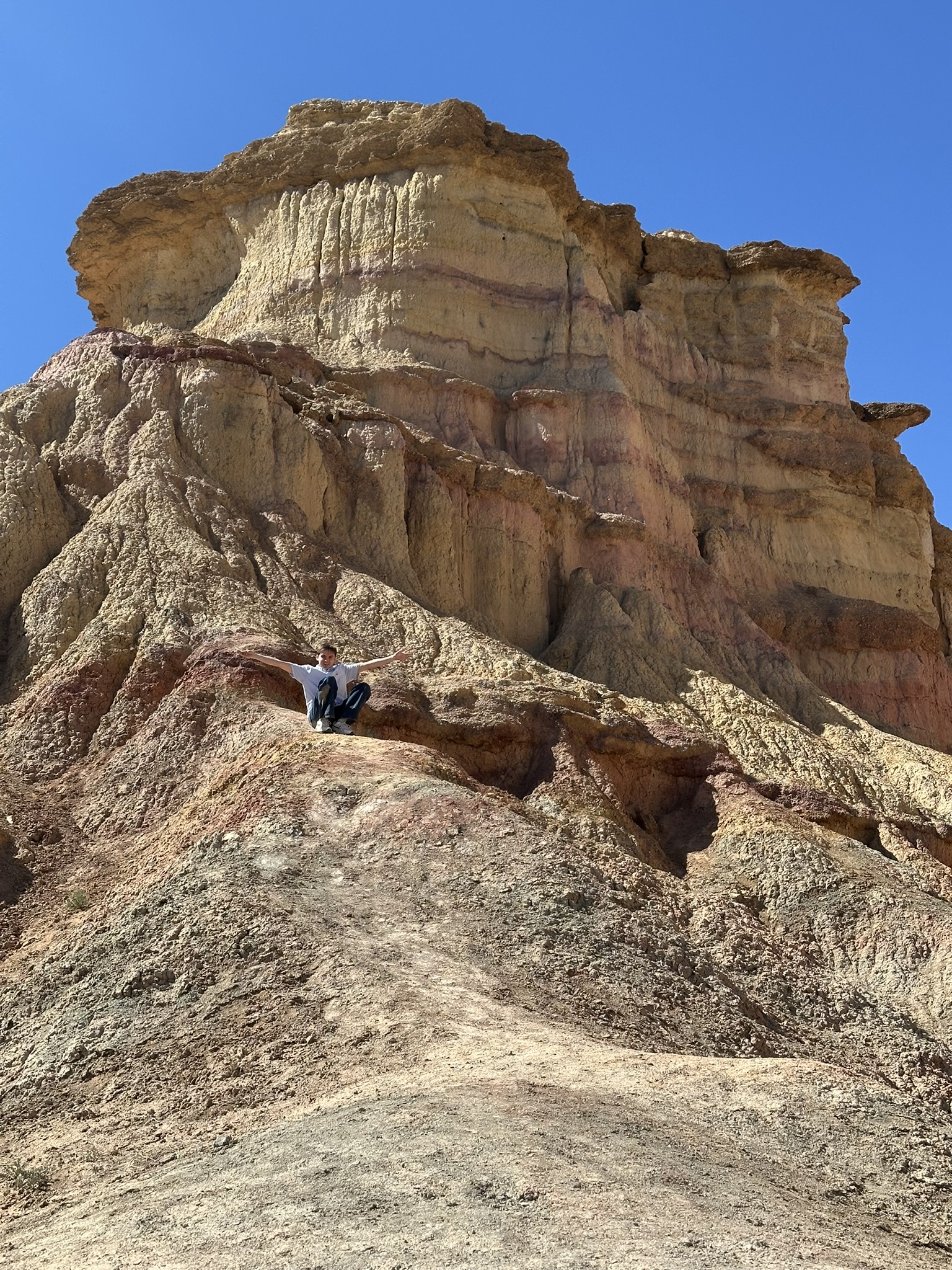
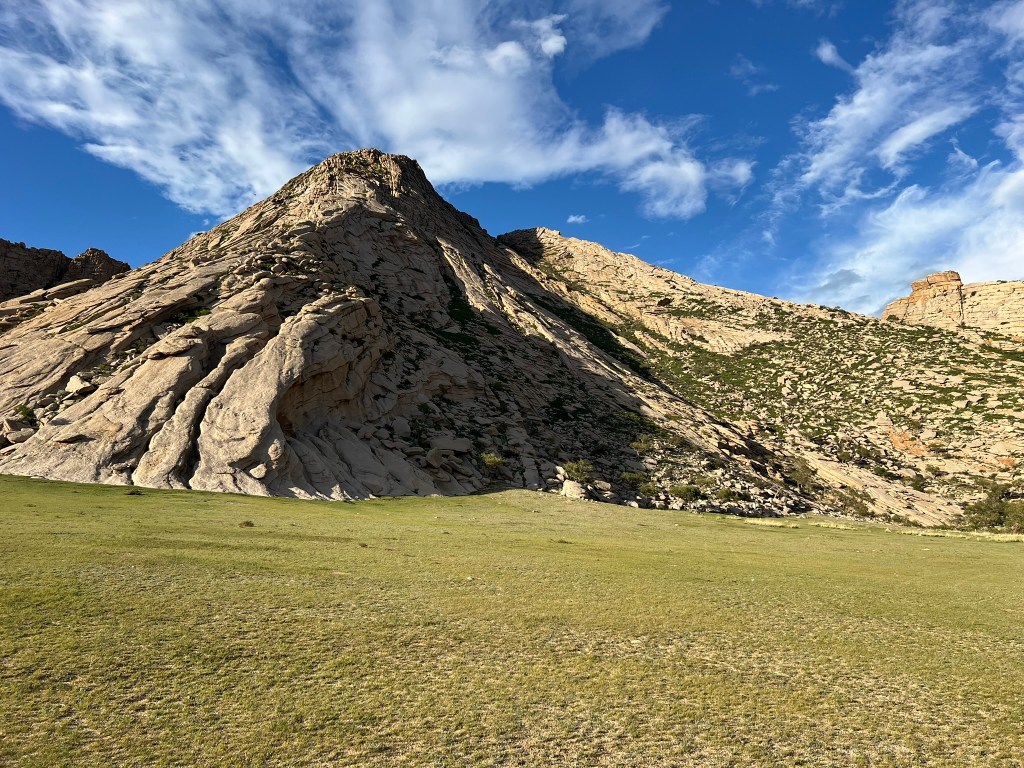
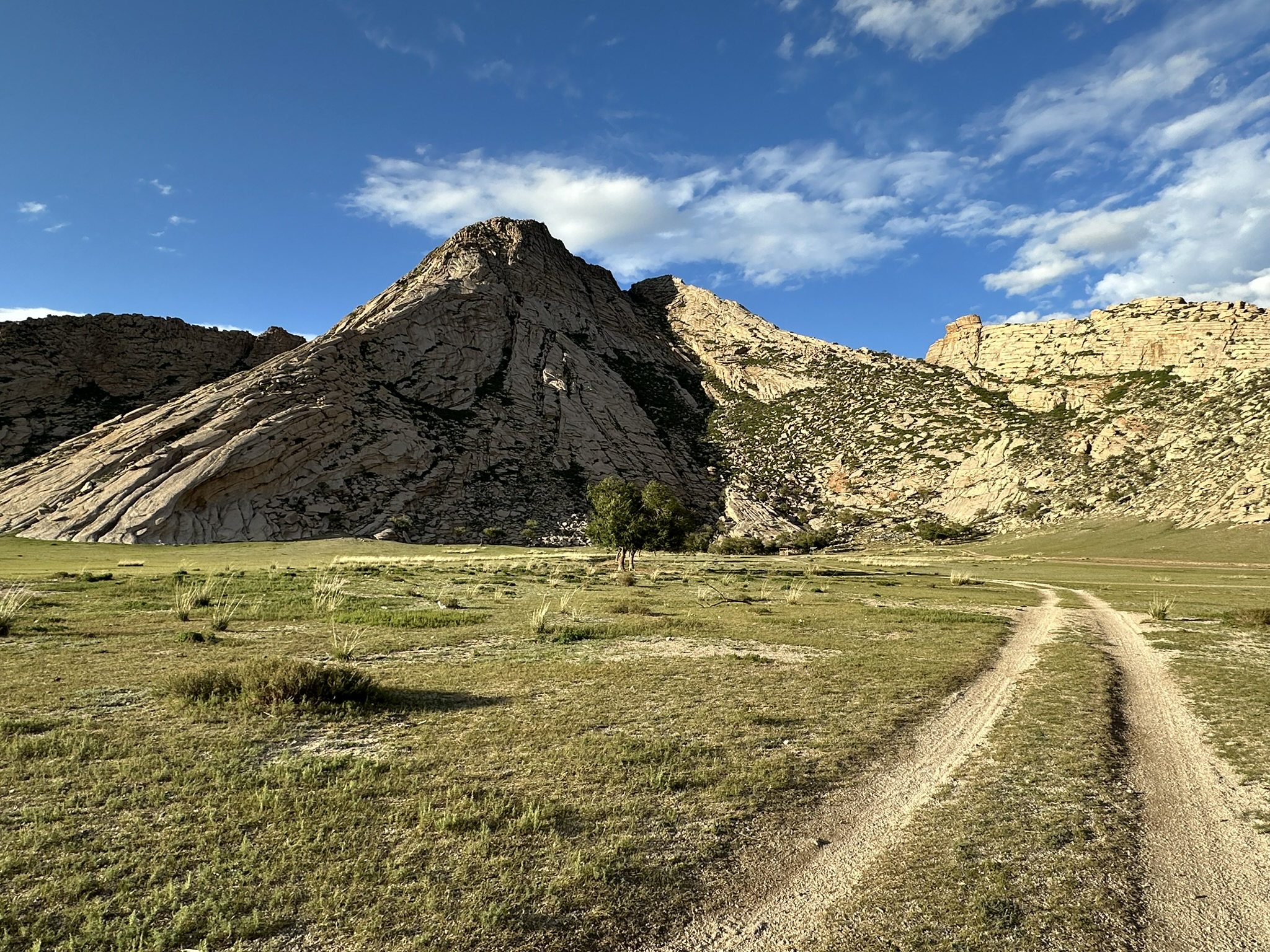
    After many hours of driving, we arrive at our camp in Baga Gazariin Chuluu. It was already so late, so we had to go to see the area the next morning.

    It used to be the site of a temple, which was destroyed by communists when Mongolia was a USSR satellite state.

    Mongolia was communist until the 1990s, which is why they still use the Cyrillic script.

    But now, they are trying to get rid of the Russian influences, starting with readopting their old script, which looks a little bit like a mix between Thai and Arabic.

    The next day, our car broke down, and we were stuck for hours.

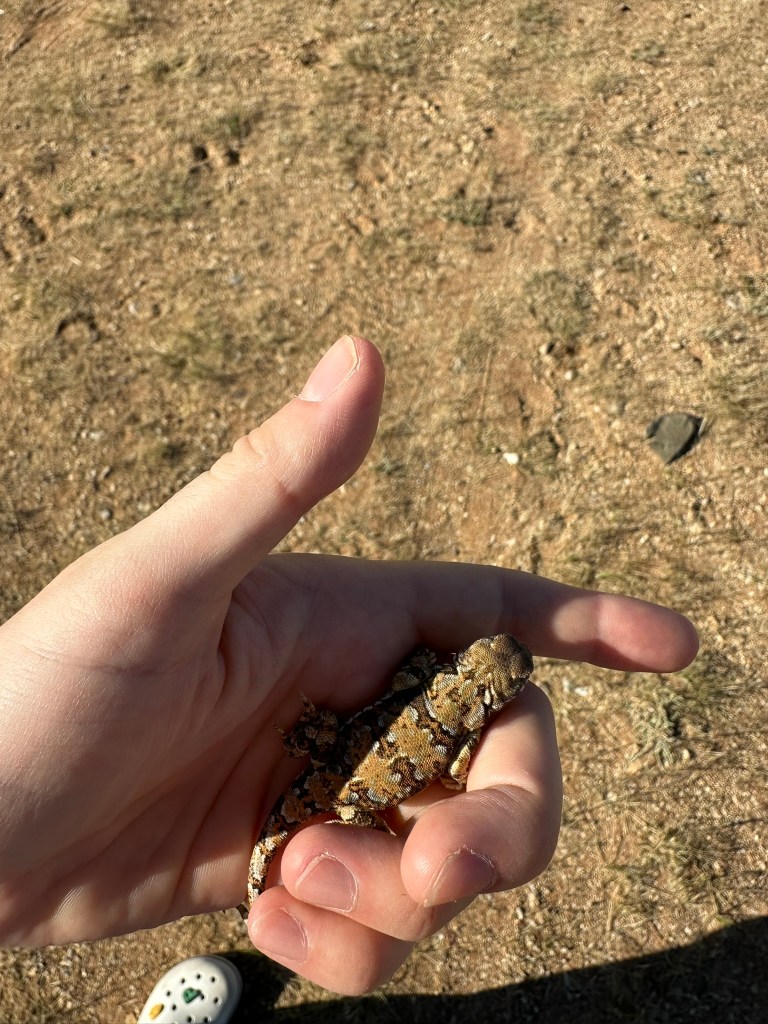
    But I made the best of it by catching lizards.

    I told the guide that we can just walk to a far camp to get help, but he kept saying it was fine. Finally, he decided to walk to the camp.

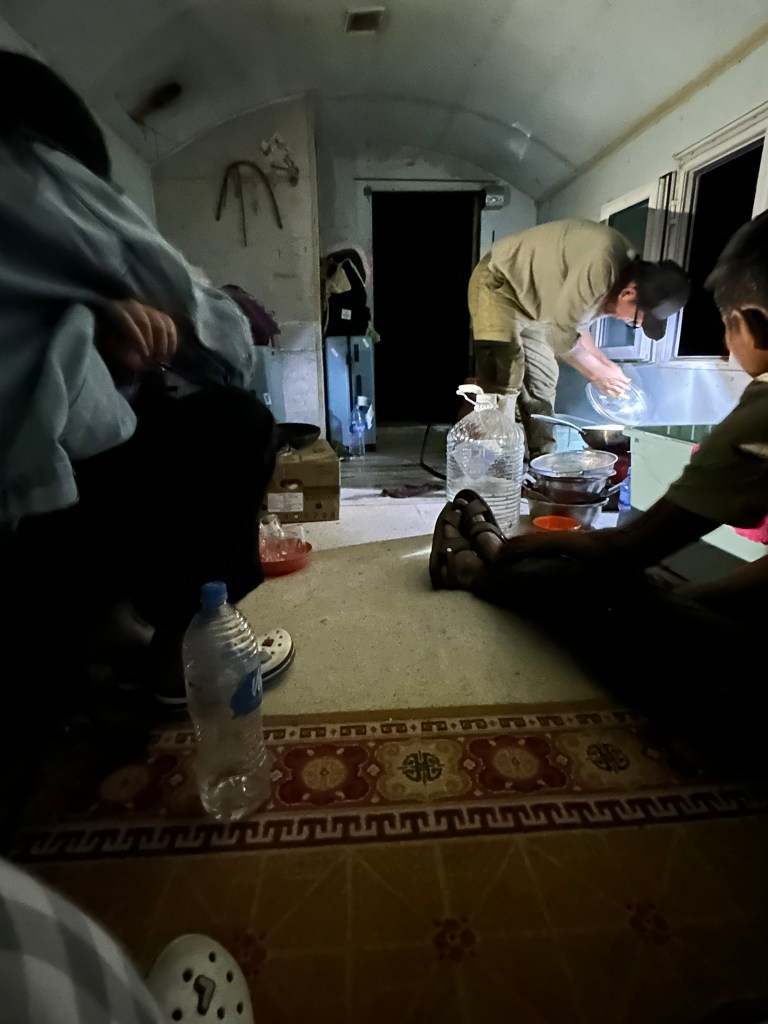
    And our lodging for today… つらい….

    The goats all gather around the entrance, because this is where their food comes from. And in the night, there was a terrible windstorm, which caused all of the windows to suddenly burst open. The windstorms in the desert are no joke…

    Our car got downgraded and we got a new driver as well.

    Anyways, the next day is Baga Gazariin Chuluu. We were supposed to go yesterday, but our car broke down.

    We have to go again right away, because there’s 2 places to see in one day.

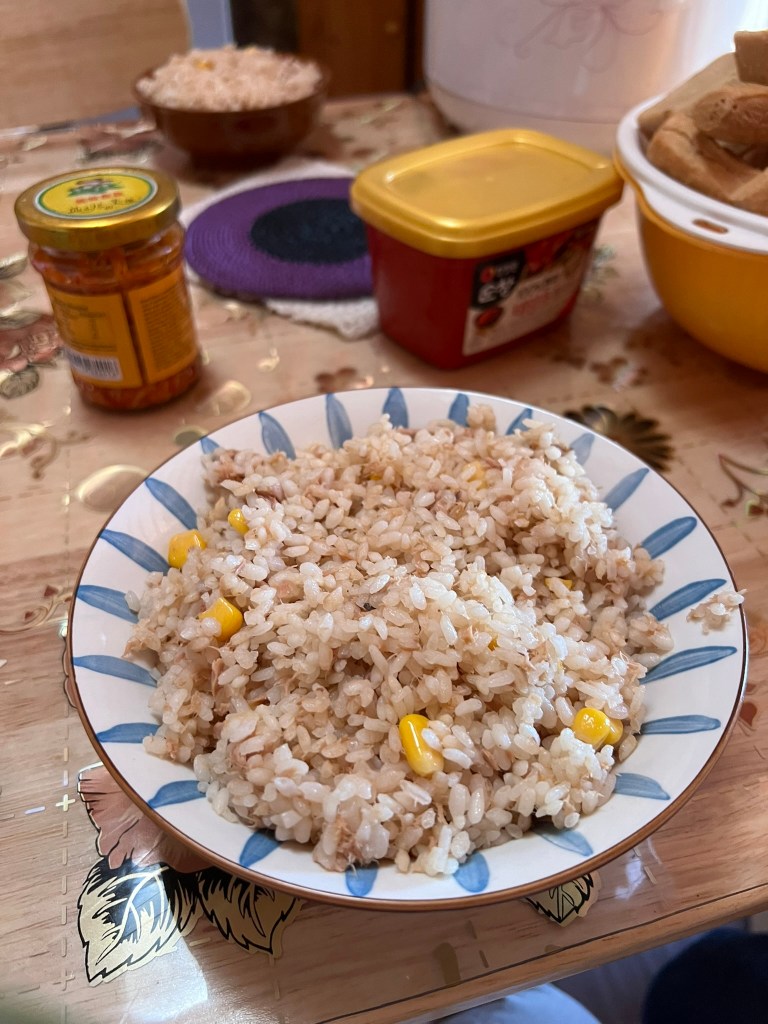
    So we stop at the driver’s house, and the food is really terrible. They don’t have access to clean water, so it has sand and dirt, and is an off color… And the food is really poor.

    But… We paid a lot of money for the tour, so why can’t you use that money?

    We decided the reason was that they were trying to cut costs because there were not enough people in the group. The owner told us that even if she is losing money, she would send us.

    But compared to the quality of other people’s tours from the same company, ours is different. I understand that the owner is making less money from this tour, but we paid the same amount as everyone else… So it’s unfair.

    This is like something I would eat in college when I had just a few dollars left in my bank account

    And eating well is almost a virtue in Korea。

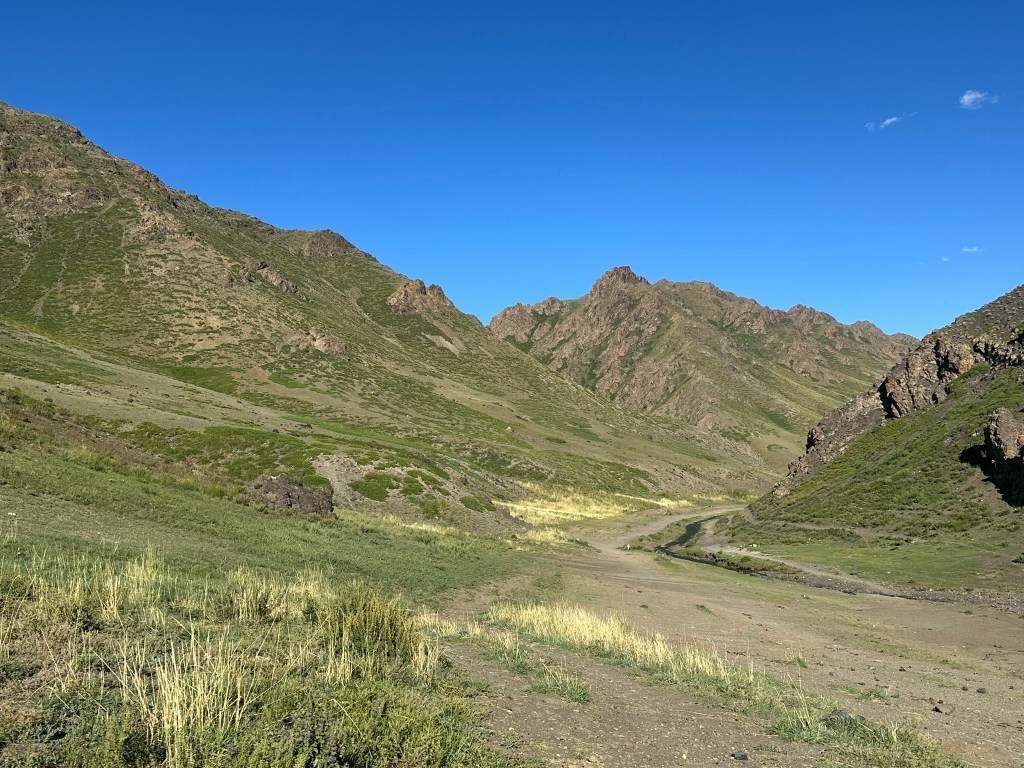
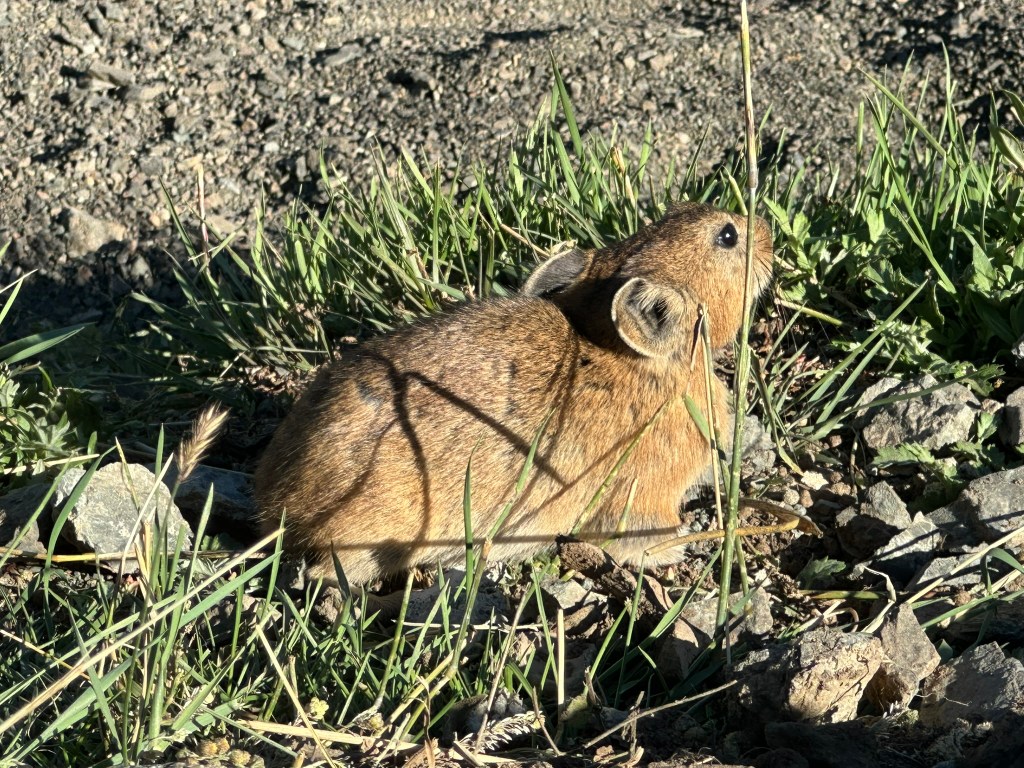
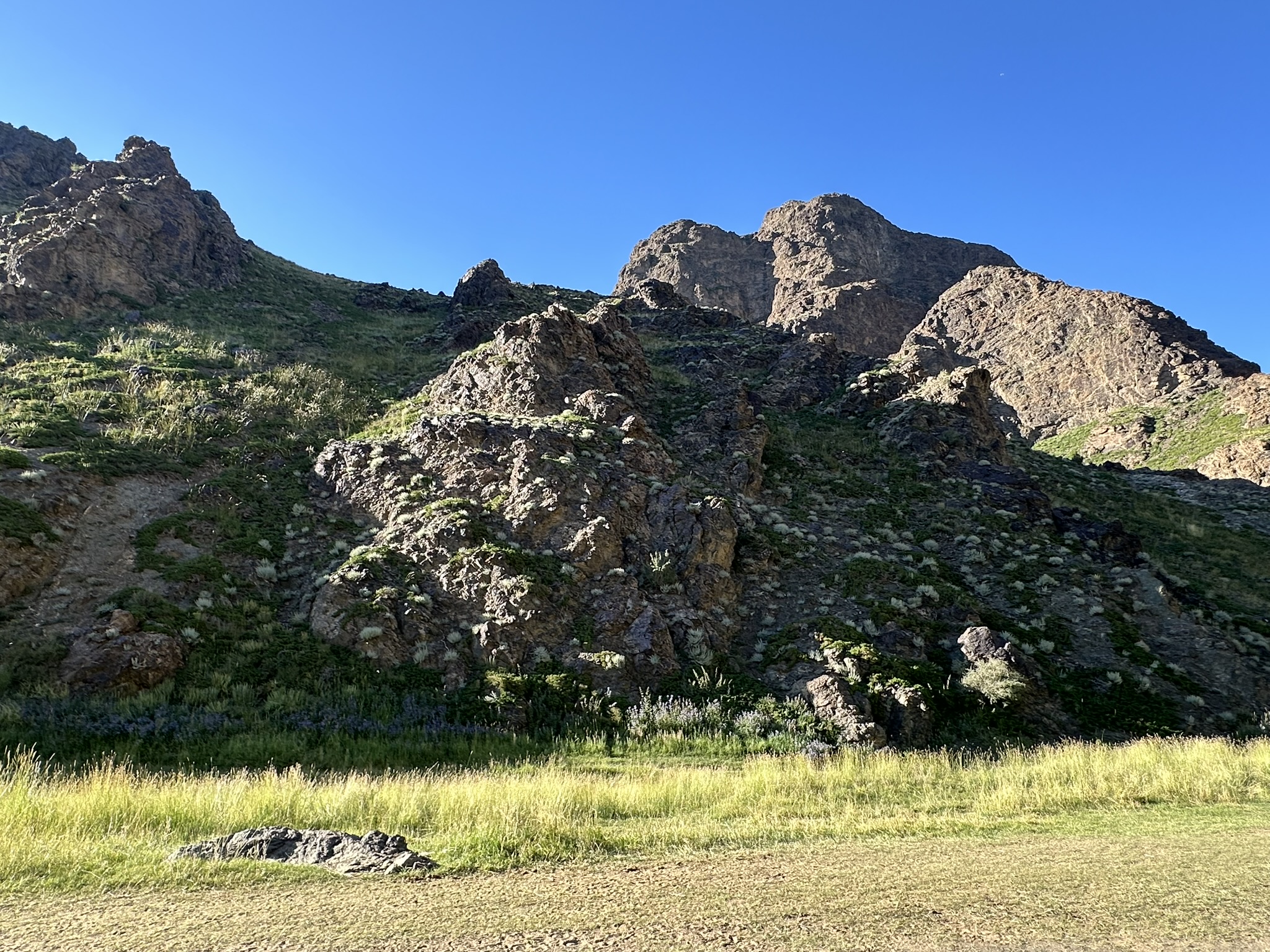
    Next is the Dund Sayahani Nuruu. There’s little mice-rabbit things running about, which are apparently called Pikas.

    Not afraid of humans

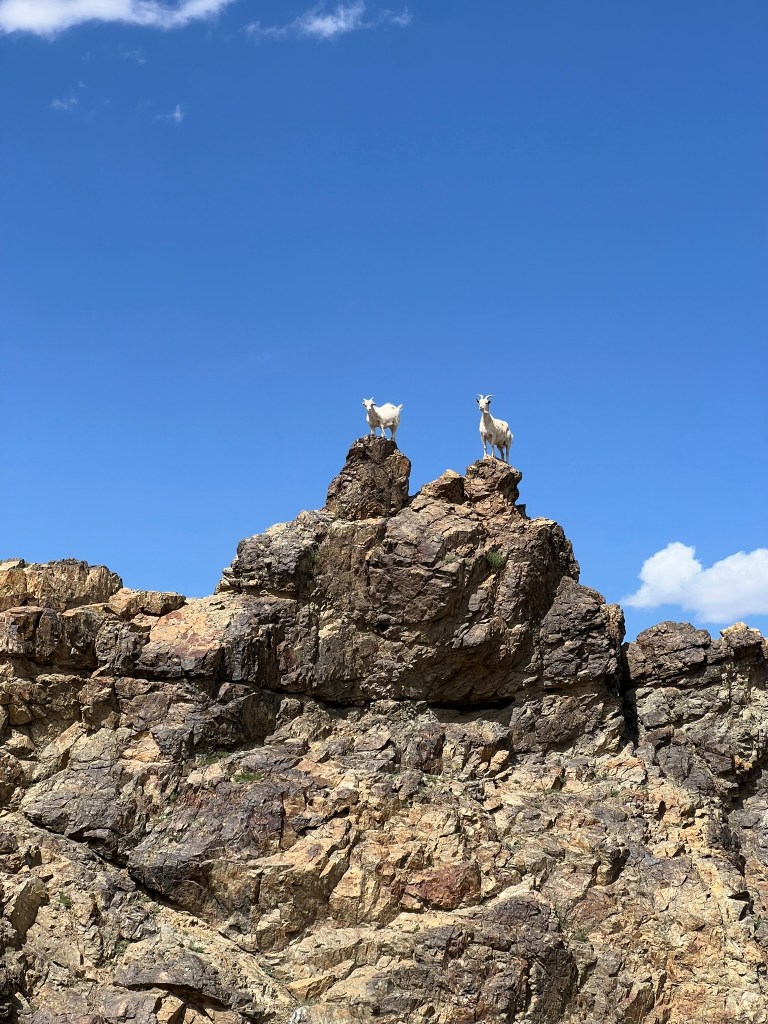
    On the way, some rock climbing goats.

    Why do they do this?

    And the next day, we finally get to stay in a Ger!

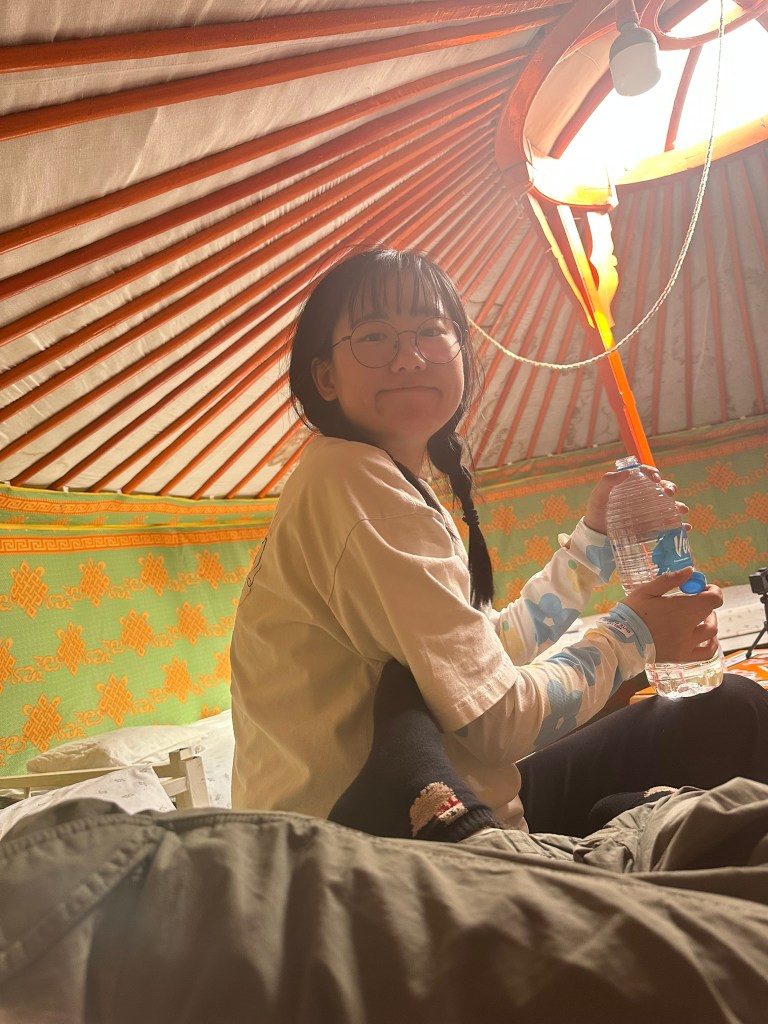
    Clean water and a bed… So she is happy.

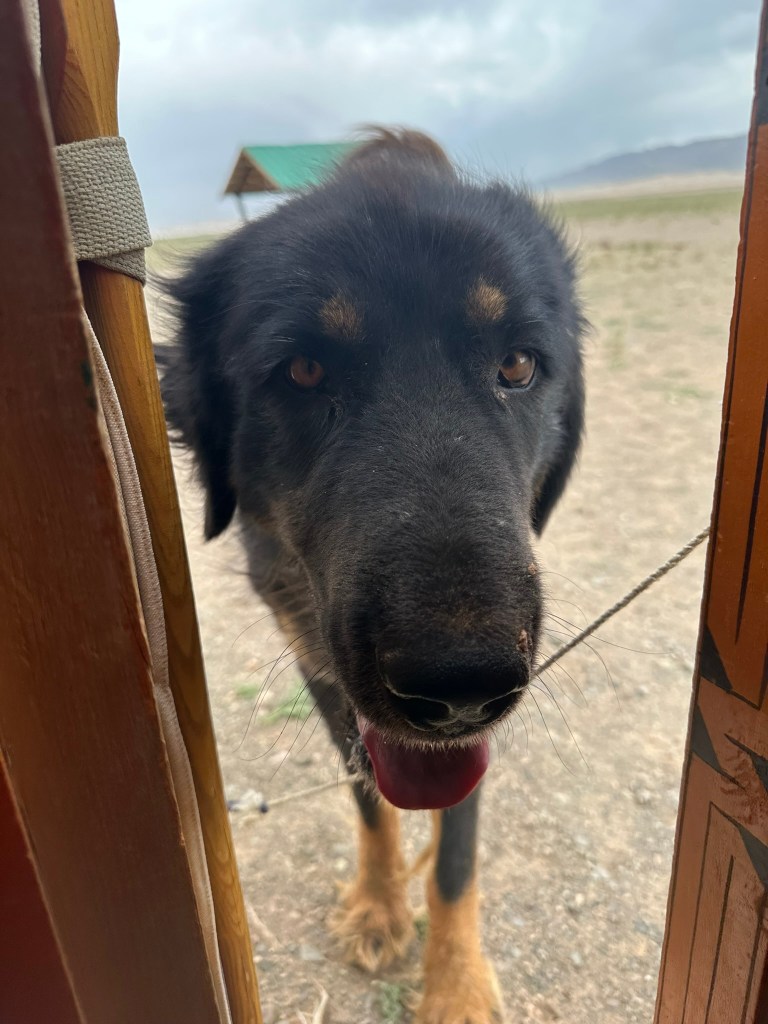
    And this is a Mongolian dog. It’s almost the only kind of dog out in the country. They are friendly and incredibly dirty.

    I think it’s not a good combination.

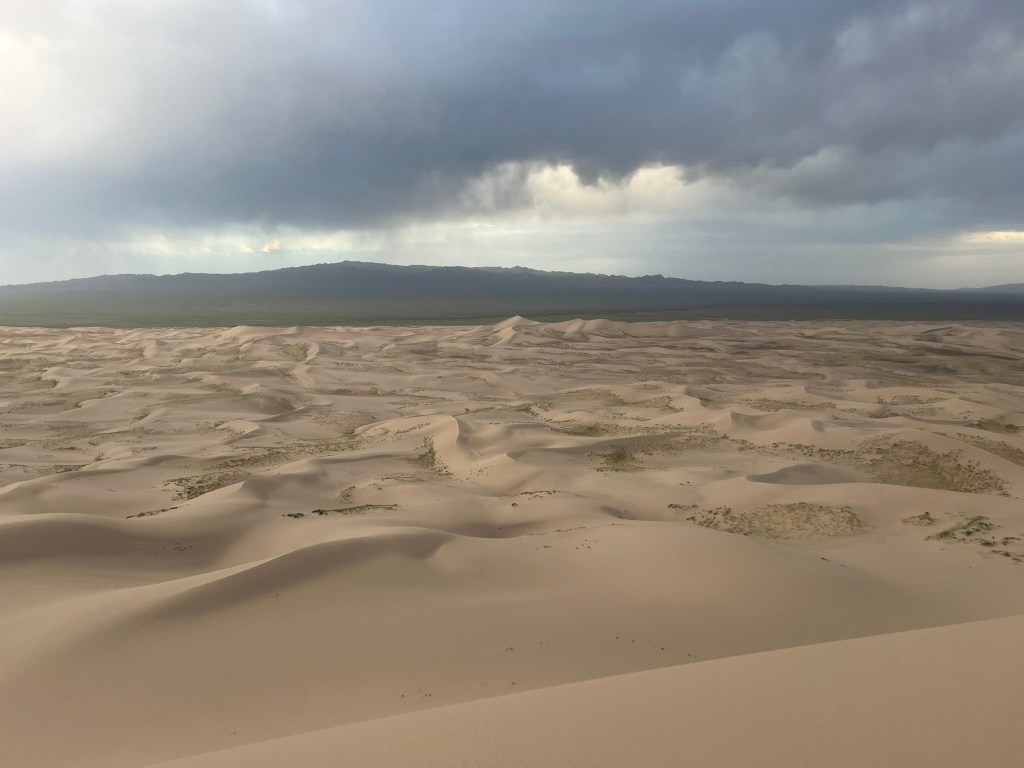
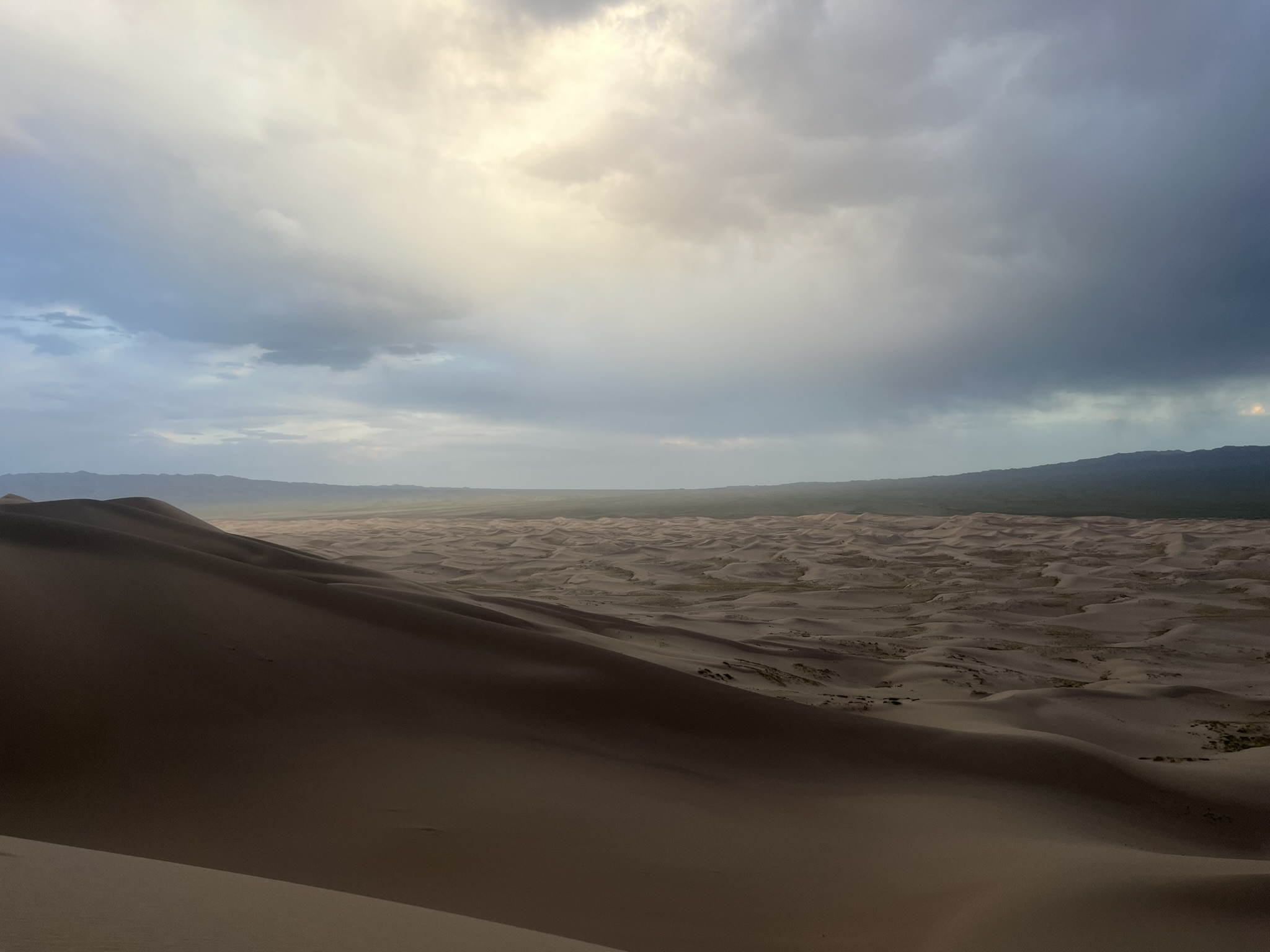
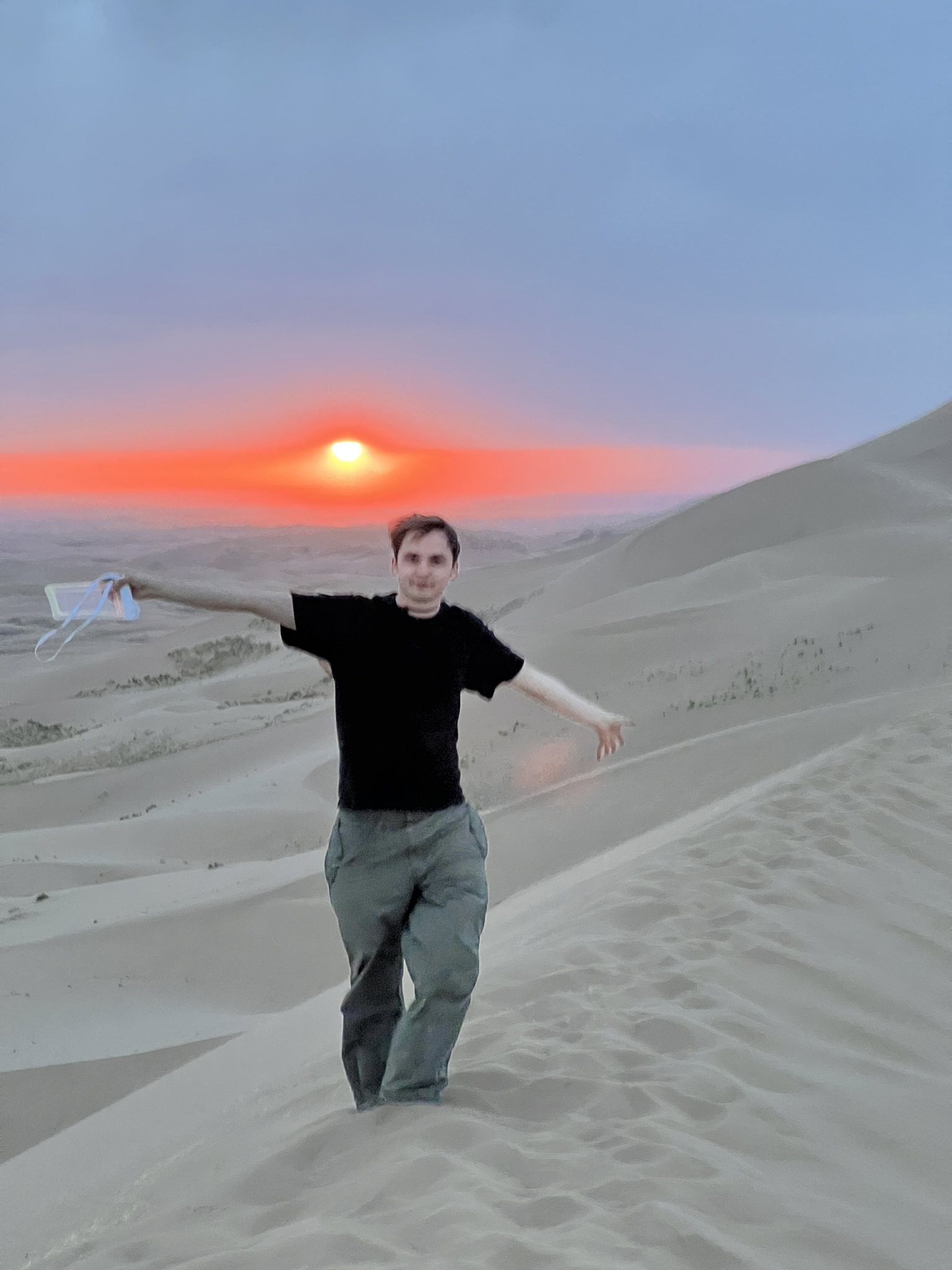
    Three more days of the tour… next is the singing sand dunes.

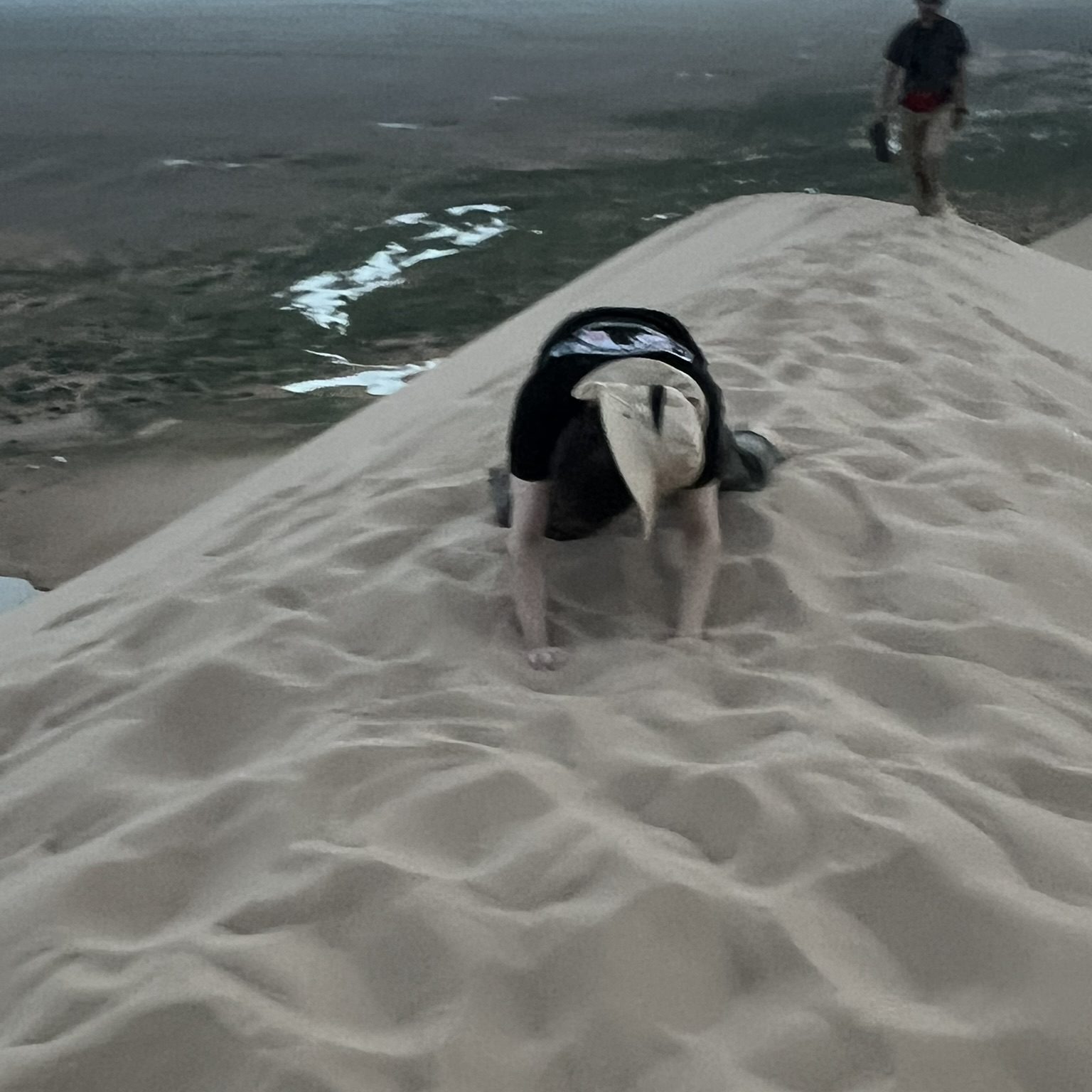
    It’s not just as easy as going up a tall mountain. The past year I have exercised a lot, so I don’t think I’m in bad health. I can climb mountains and bike, and it’s not so bad.

    망했다

    So I’m not really trying to exaggerate by saying it was some of the most difficult exercise I’ve done in my life. But it’s quite worth it!

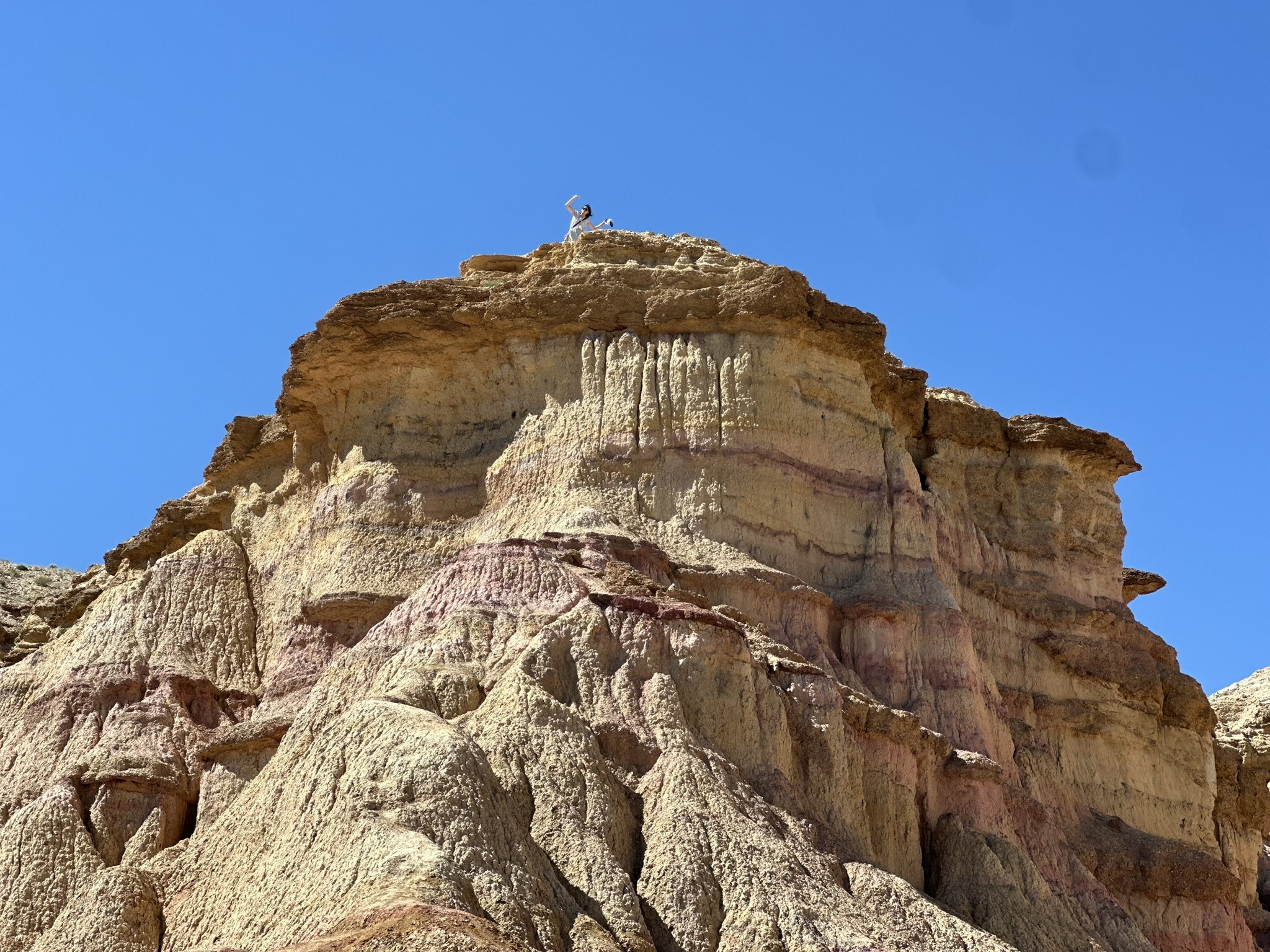
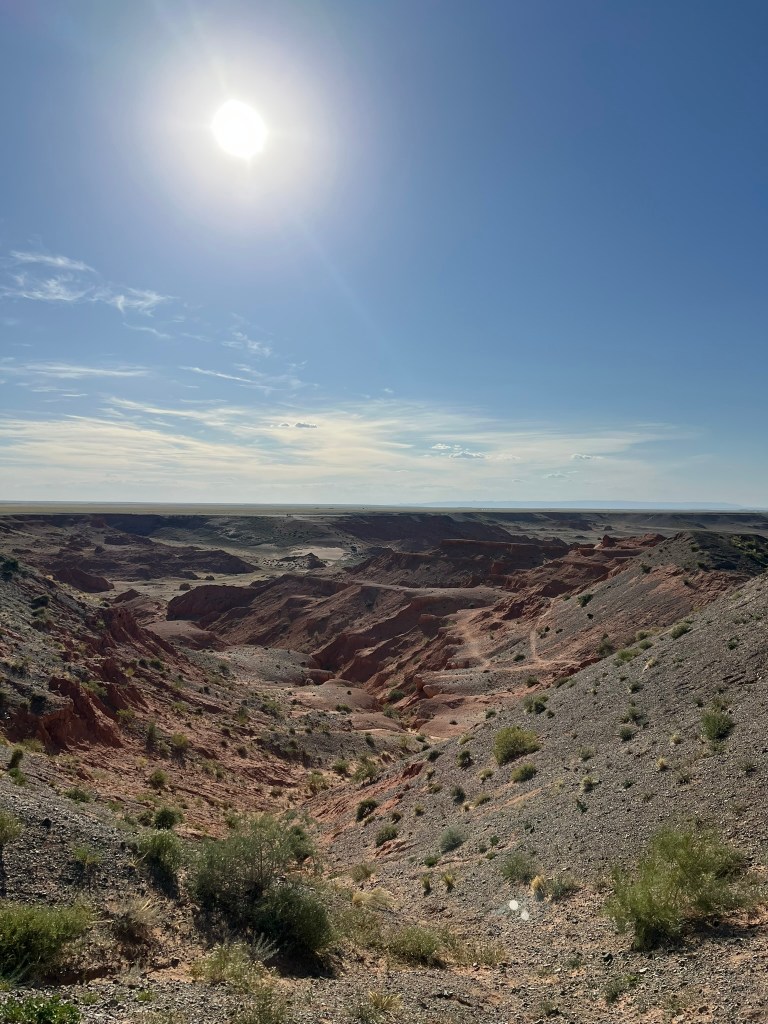
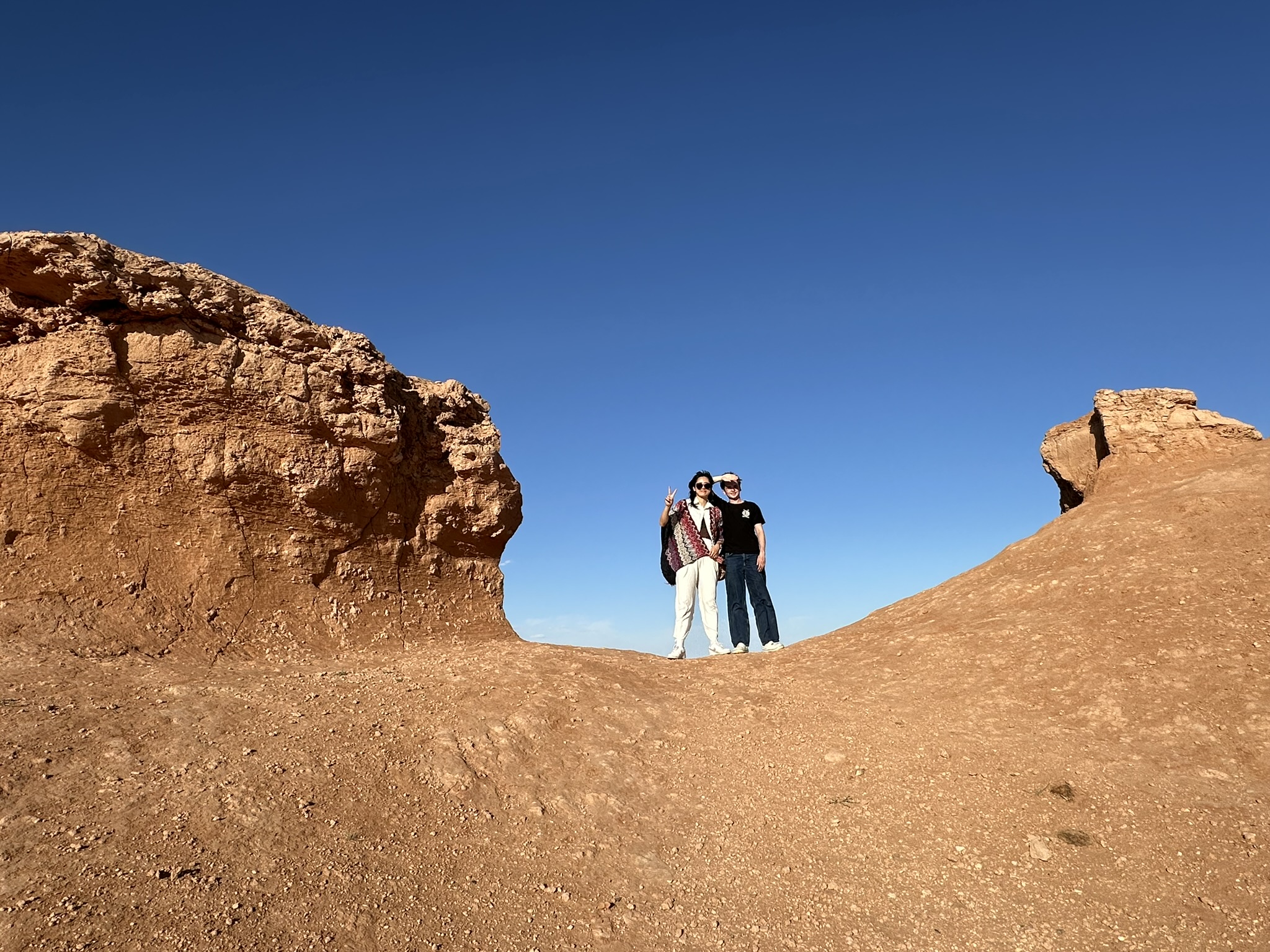
    Next stop is Flaming Cliffs.

    At this point I was starting to feel like I had a mild flu. It didn’t get any worse, but according to the guide “people who drink Mongolian water get sick at first.”

    It’s so windy, I feel like I’m going to fly off the cliff.

    The last day is a really long drive, so our guide tells us that we have to get up early.

    But if we are pressed for time… why are we stopping at your friends house to hang out and buy dried camel milk for your sister?

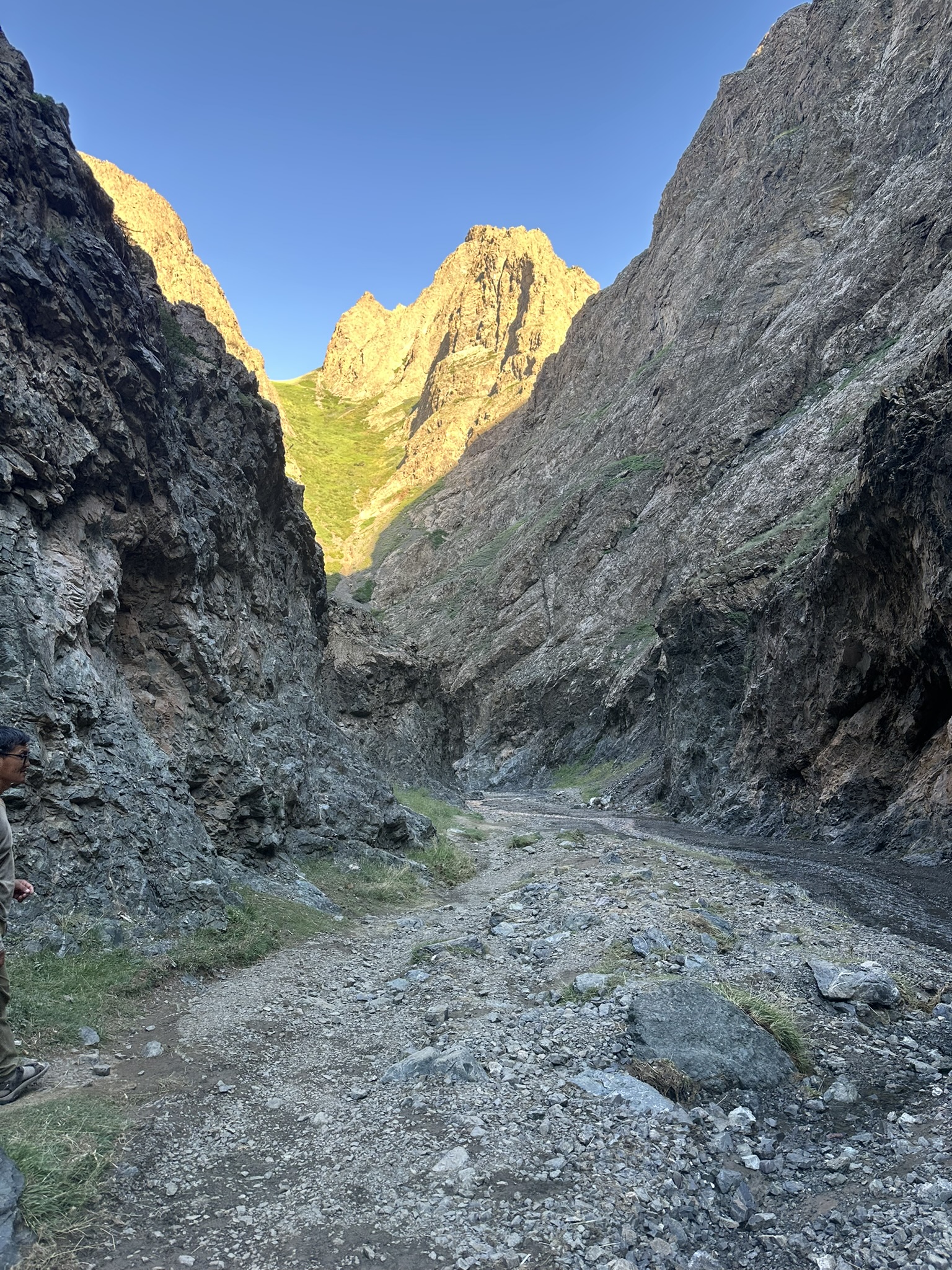
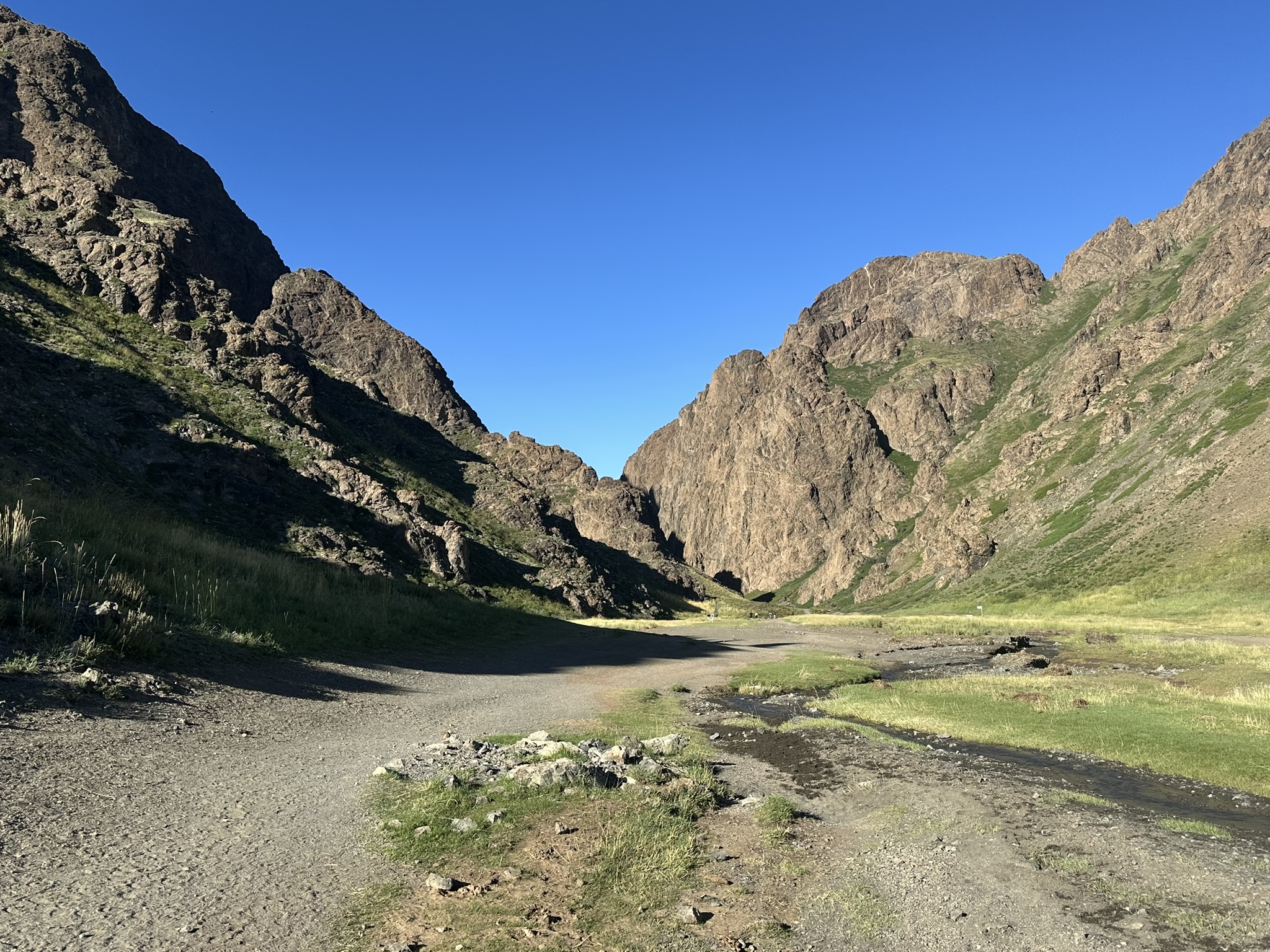
    Finally, the last day. There aren’t as many people coming to see this area, but I really liked it.

    And then, the next day, after much driving, we are back to the city.

    In part 2, I’m going to Khuvsgul!

    By the way, I will never use AI to write a blog. Even if you are a mediocre writer, or putting in little effort, you are still a better writer than AI, and you are still putting in more effort than AI.

    Thanks for reading!

  • Lately, I have been really into cycling… I don’t think there is a form of exercise more fun than cycling, especially in Korea.

    Korea has great infrastructure for long distance biking, especially compared to the US and Japan, which both have some combination of qualities including dangerous, boring, or too difficult. The government built a series of bike trails all around the country which, for the most part, are not anywhere near cars and have great scenery.

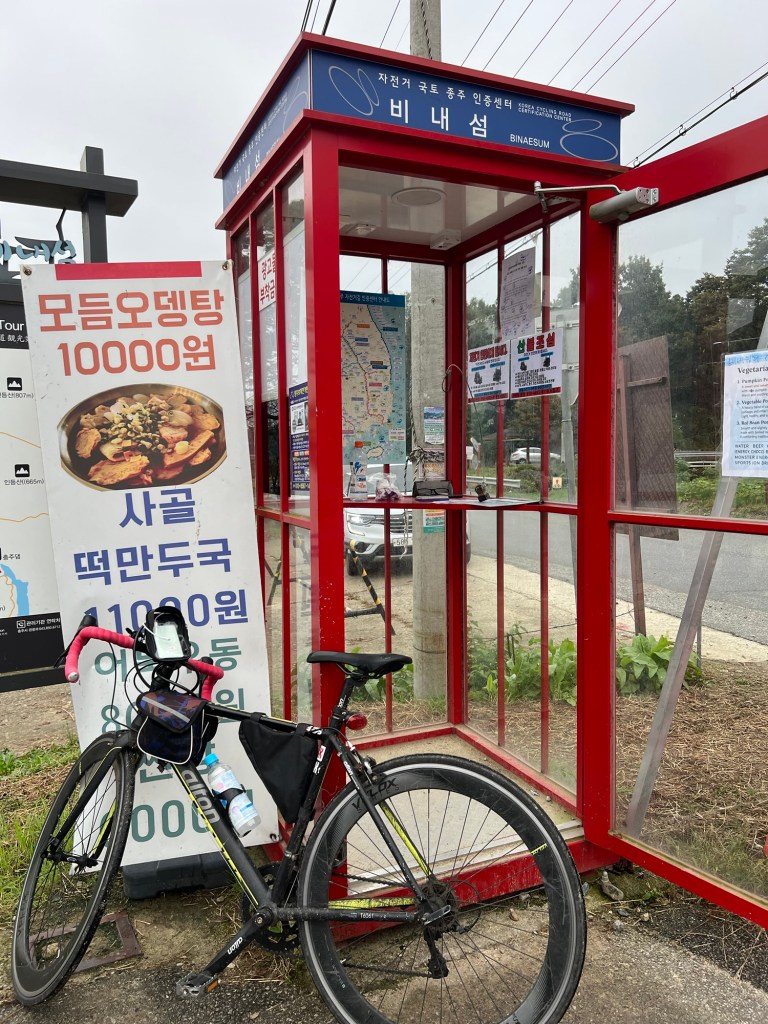
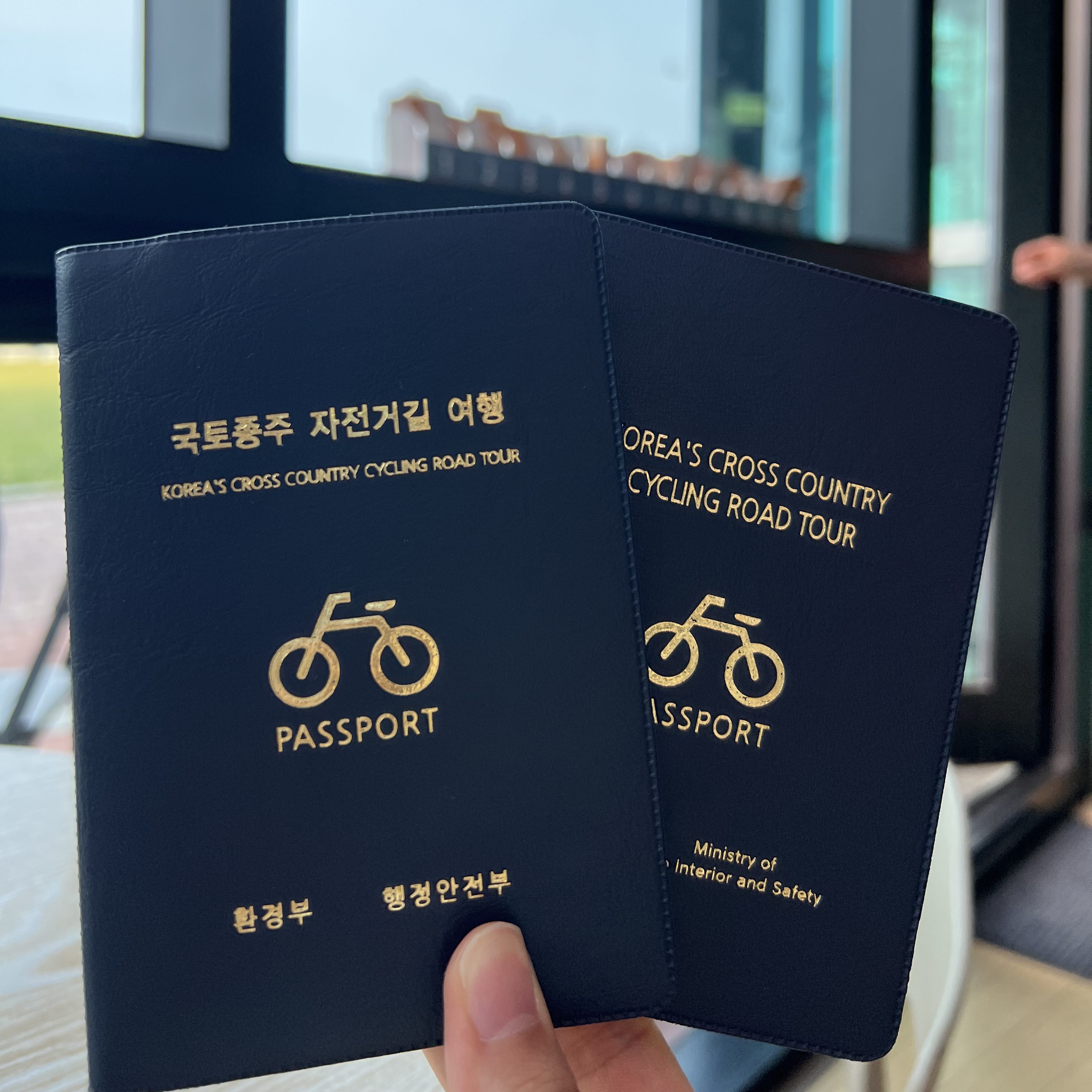
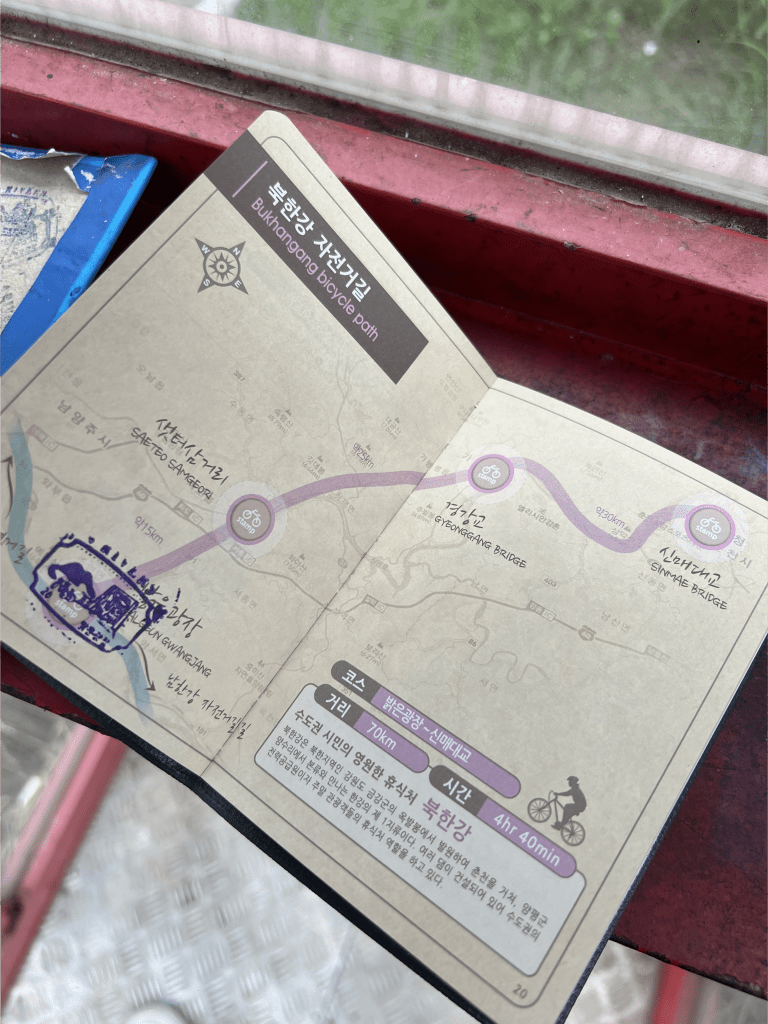
    Along with this, you can receive a “bike passport” for about 4000 won (about 3 dollars), which lets you track your progress on the paths using certification centers. When you finish a route, you can get a medal.

    I live in Yangpyeong, so one 20 minute train ride on Gyeongi-jungang line towards the city center and I can go to the Bukhangang bicycle path.

    In Chinese characters, buk( 북 北 ) means north, han ( 한 韓 ) means great, and gan ( 강 川 ) means river. So the bike path is the North Great River or North Han River. So it mainly follows the river north.

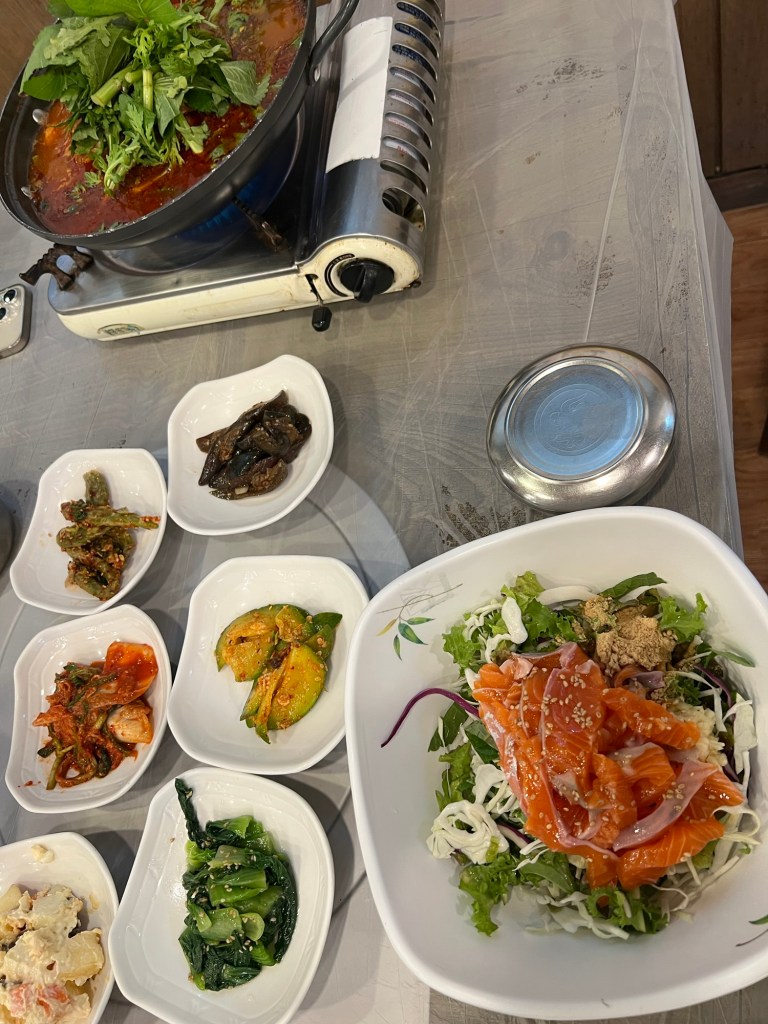
    I have to get some food before we leave, and I don’t want to be bombarded by my students so I wanted to eat by the station we get off at rather than Yangpyeong station.

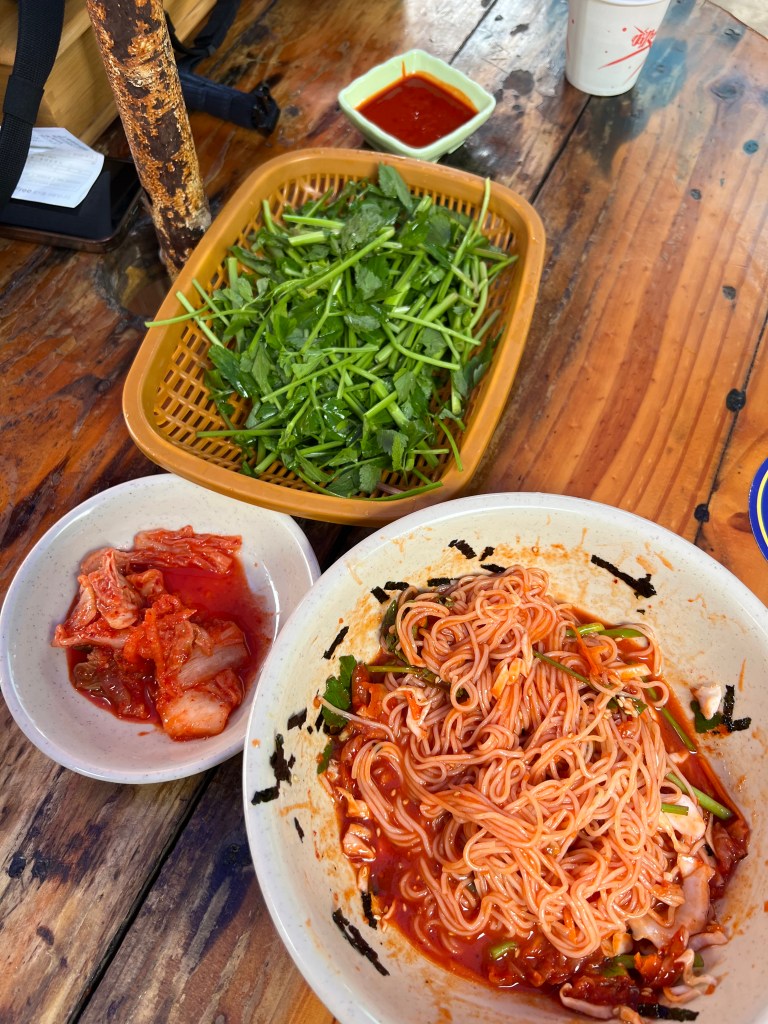
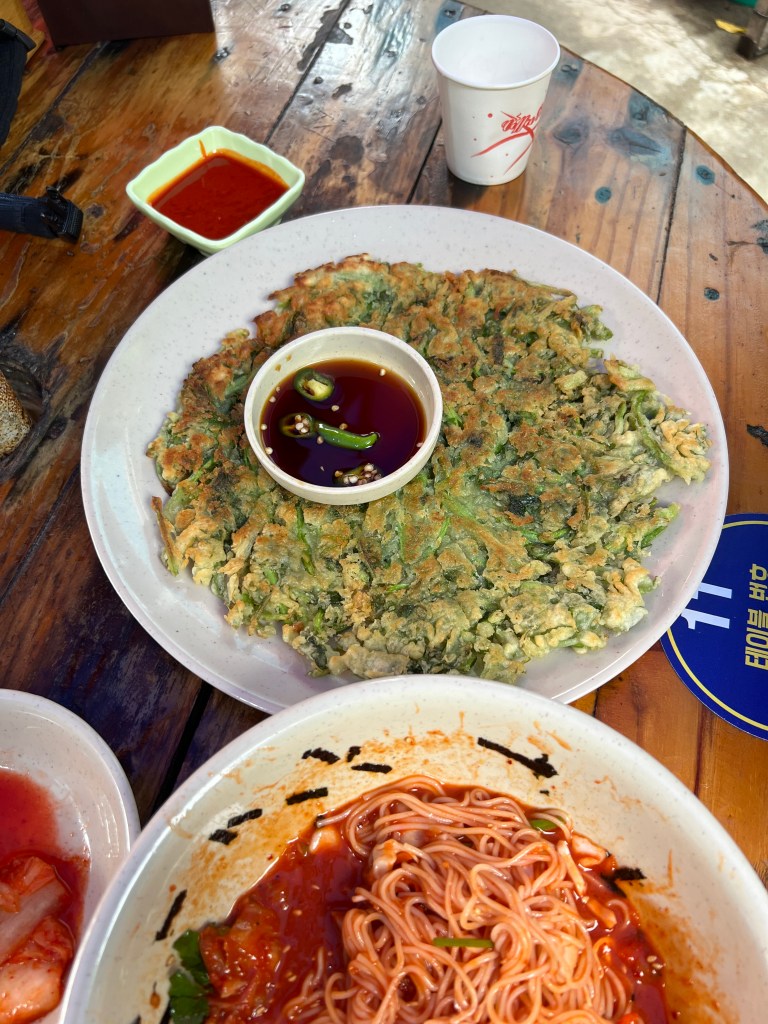
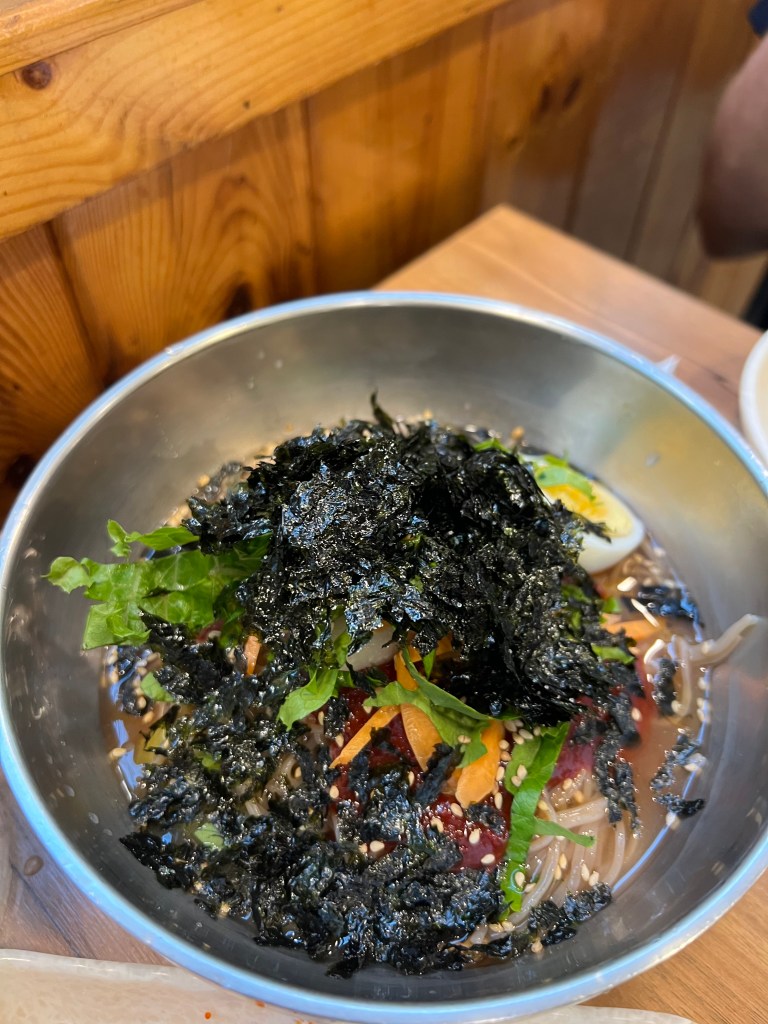
    But for some reason, the only thing the restaurants sell is eel…? But eventually I found a restaurant that sells water dropwort (minari) pancakes and cold noodles (guksu). It’s called 돌미나리집 (Minari house)

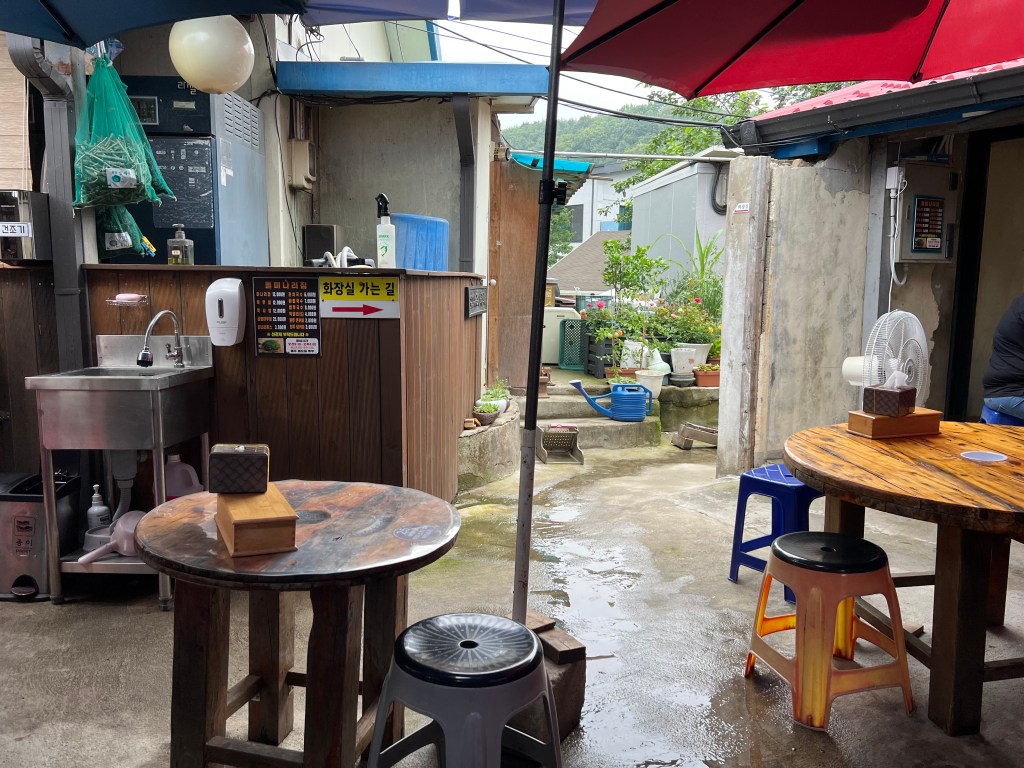
    The atmosphere is really old and there are almost no seats available. It’s for a good reason, because the price is very fair and they use fresh ingredients. I heard that minari is a bit expensive normally, but you get it as a side dish.

    I ended up starting later than I anticipated, at like 1 o’clock… I was very worried there would not be enough time to get to our destination comfortably. The course takes about 4 and a half hours.

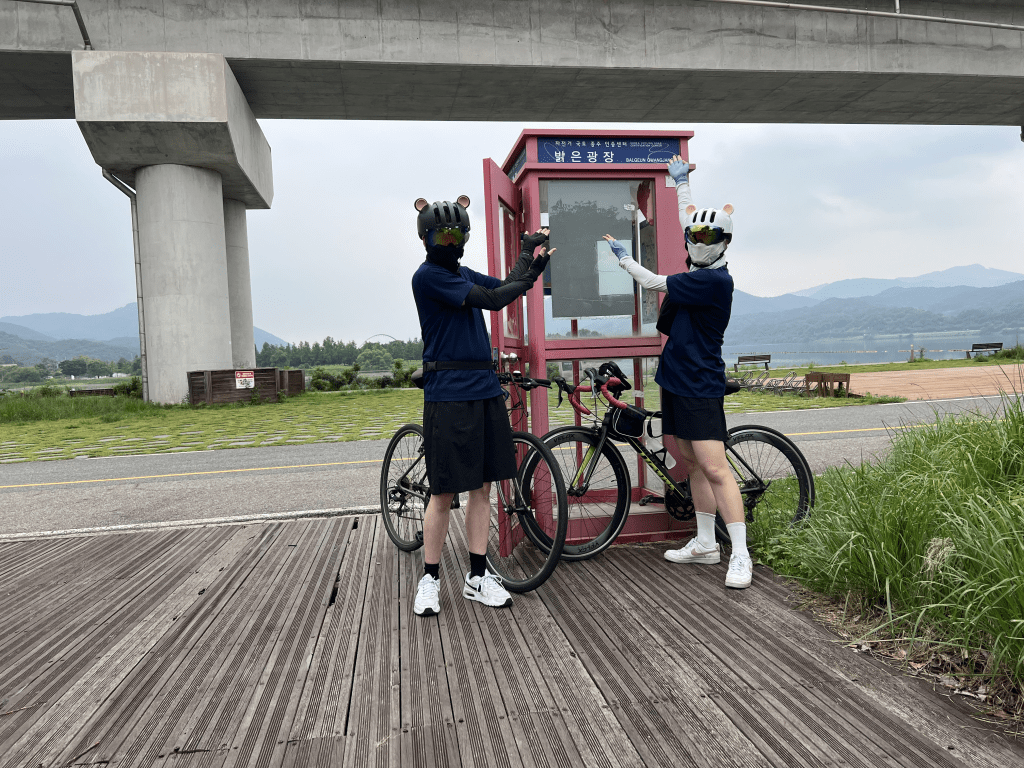
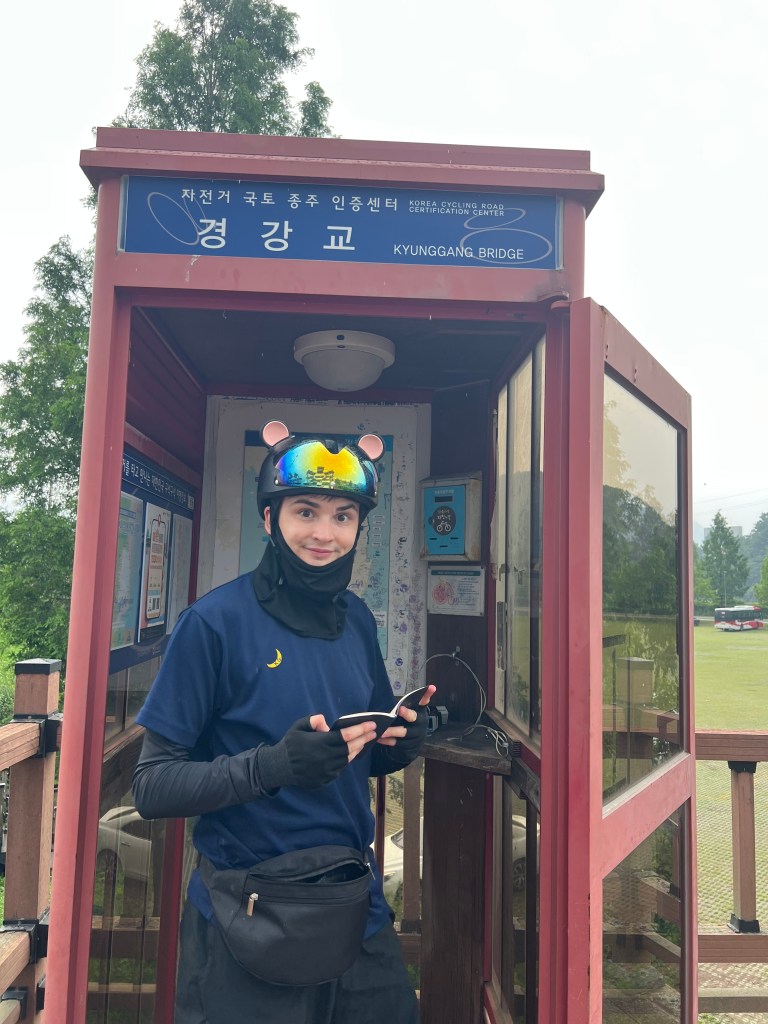
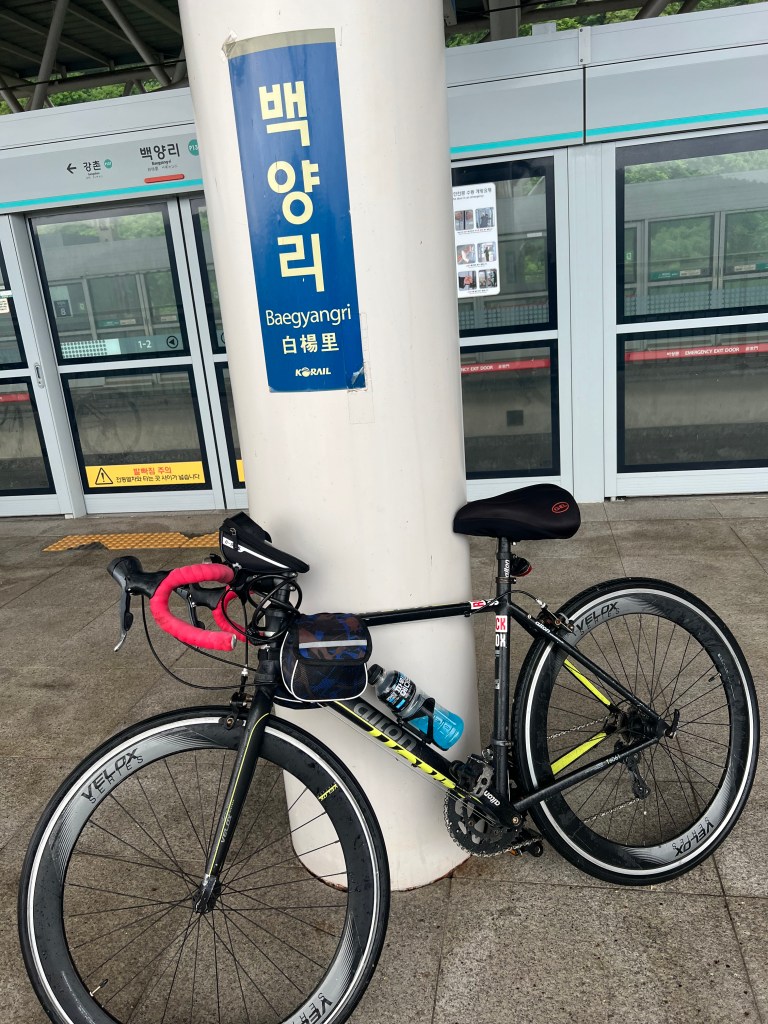
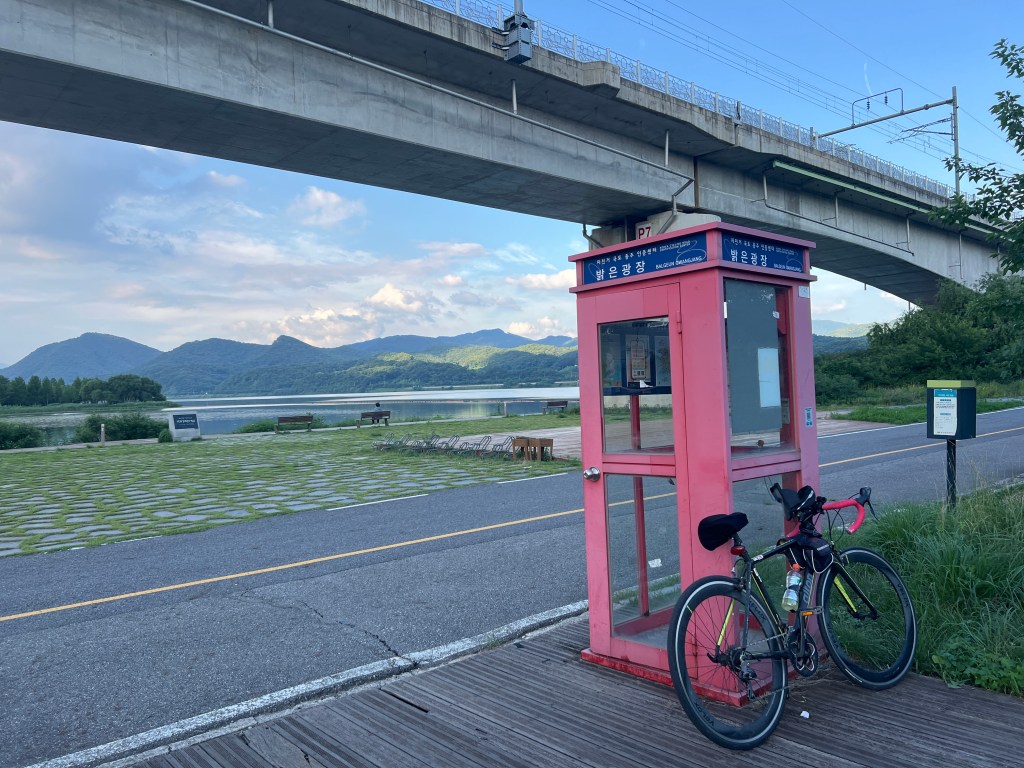
    This certification center is first… It’s called Balgeun Gwangjang which means something like, “the clean square”.

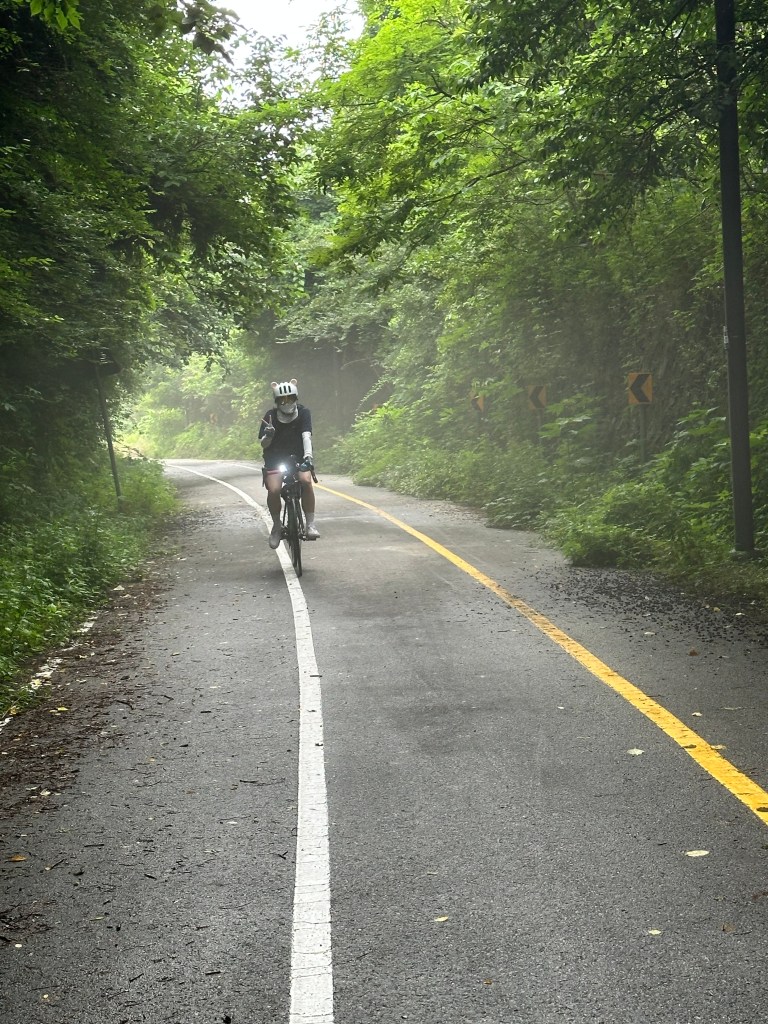
    After a while, the path becomes a lot more rural, but you will never go hungry or thirsty with the amount of biker cafés and convenience stores.

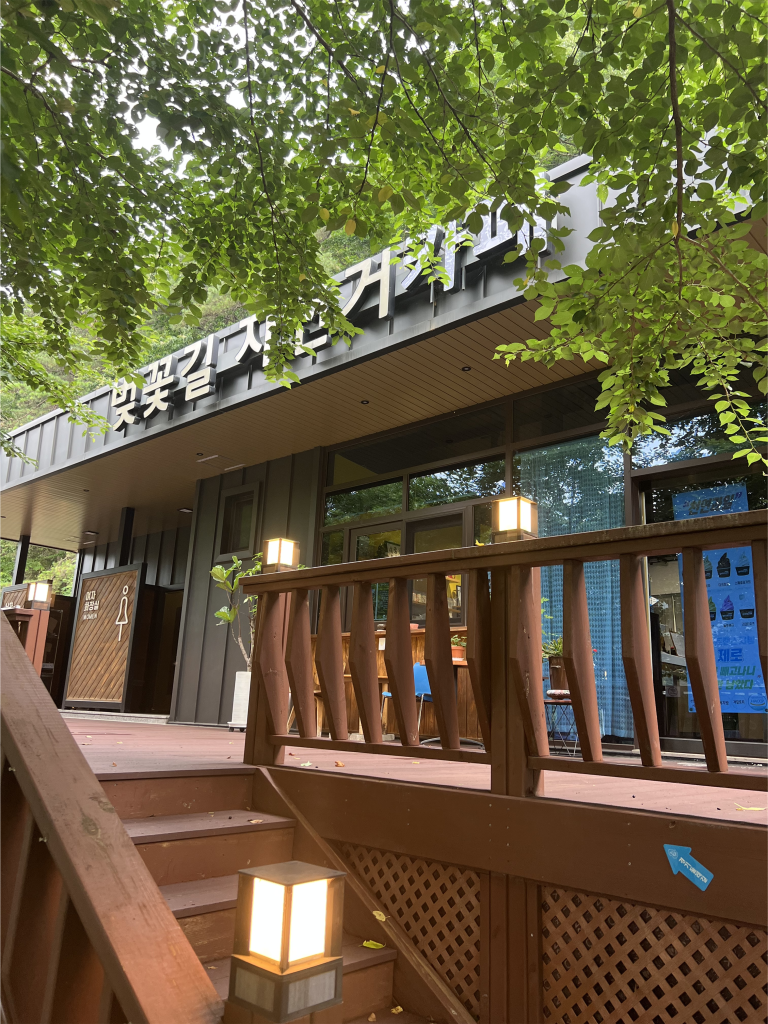
    The first rest stop is this café along the bike path.

    They sell different flavors of ice cream, coffee, and juices. The owner seemed to be listening to English radio, so I wondered if she was an Anglophile, but she didn’t talk to me in English. Anyways, I’m not from England.

    Outside the café, there’s a Sakura tree. It’s not in bloom anymore because it’s June, but I noticed the berries on the tree.

    It turns out you can eat the berries on a Sakura tree. They’re edible, but they don’t taste very good. They are a little bitter and sour.

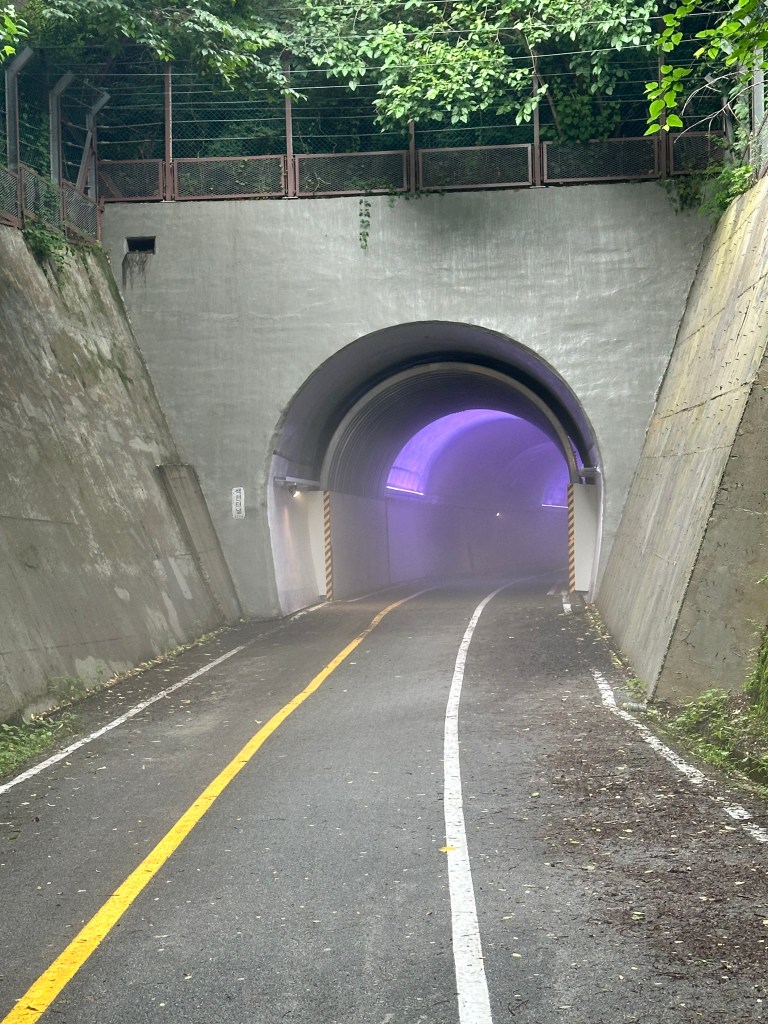
    There are a lot of tunnels through the mountains on the bike paths in Korea. It’s always my favorite part, because they are super cool, both in terms of temperature and atmosphere.

    I forgot to take a picture of the second certification center, so let’s skip to the third.

    I look excited, but actually things are about to go downhill. I only have 1 certification center to go, but it’s the furthest, about 30 km away.

    June and July in Korea is the rainy season, which means sometimes it will rain on and off for days or even weeks.

    Actually, I’m ok with a little rain, but it can get dangerous. Right after I got to this certification center, it started to rain a little bit…

    It’s probably going to stop soon, so I thought we should just carry on. It’s just 30 km left, so maybe an hour and a half left.

    The rain is going on and off, and if you look at the radar, we can hurry and get there before it starts to hit fully.

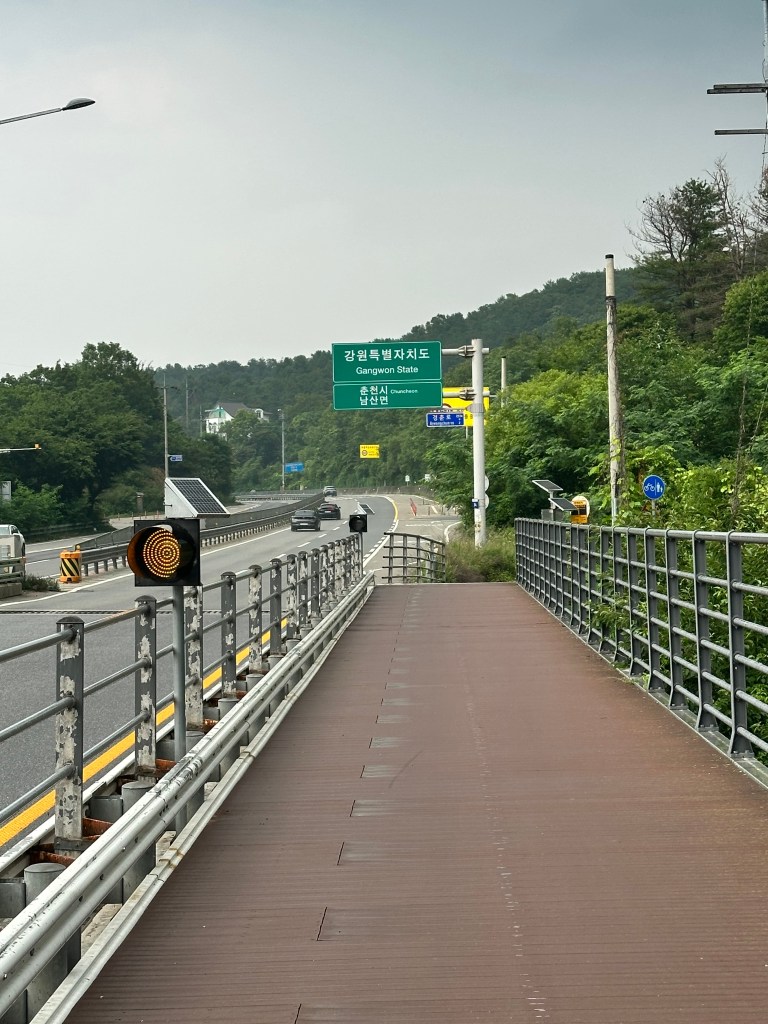
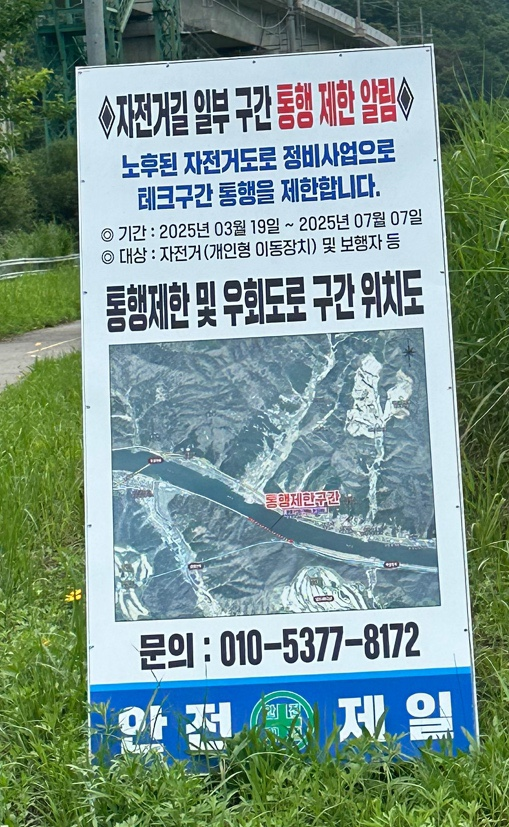
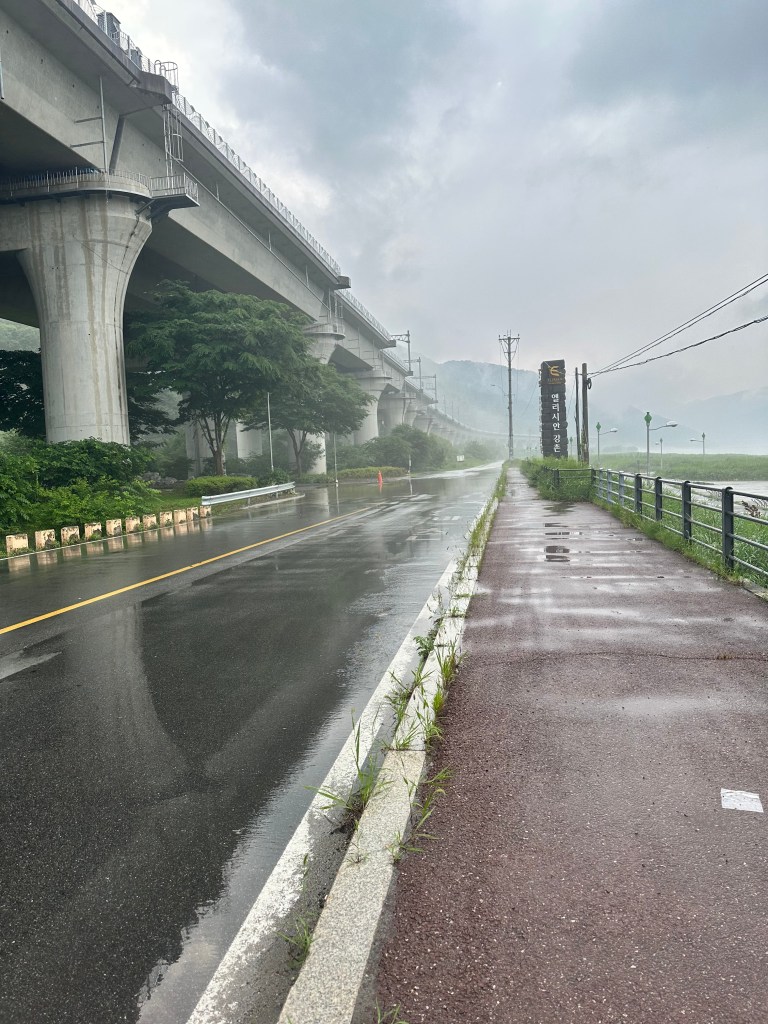
    But the bike path is under construction.. So we have to go on the highway. And the highway is totally flooded…

    Luckily, there is a train station nearby.

    Actually, it’s unbelievable luck, because there aren’t always train stations near the bike path.

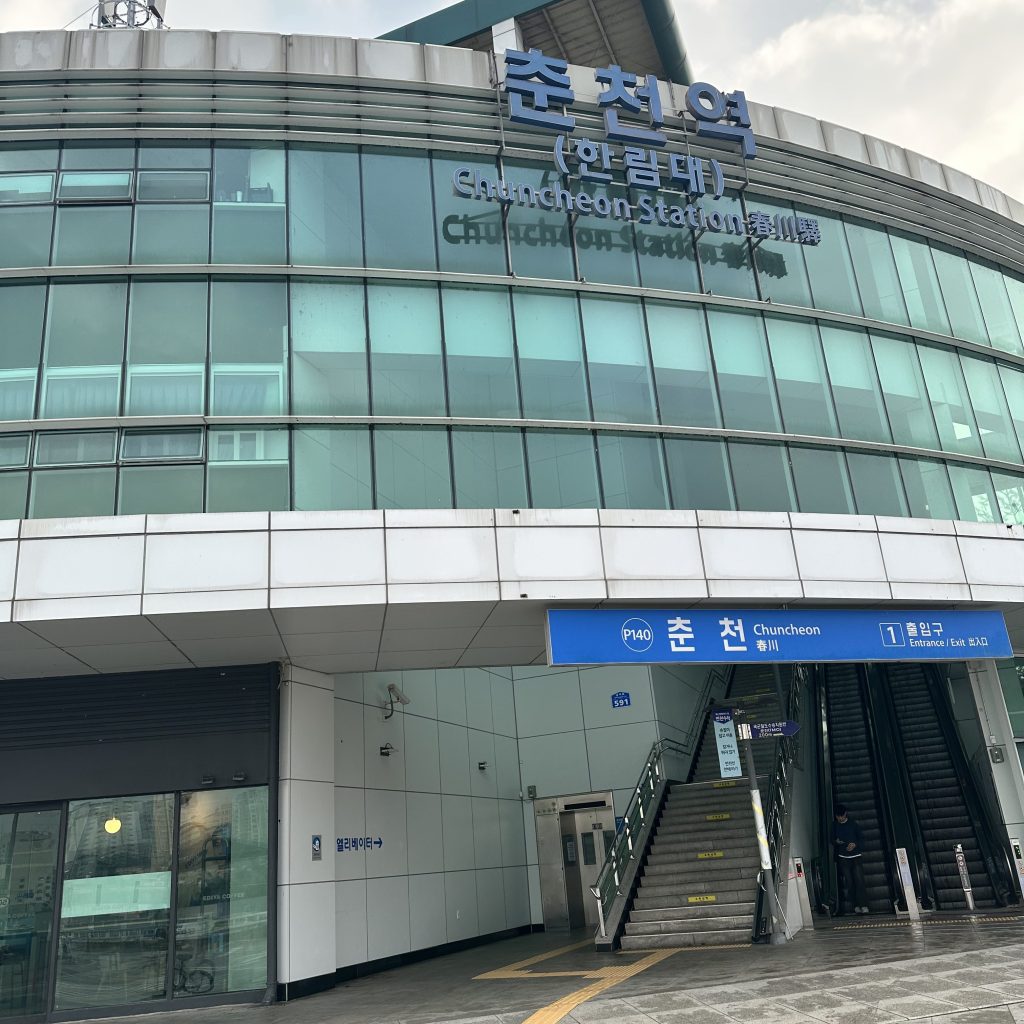
    So we gave up and took the train to our destination, Chuncheon. It’s ok, because we will bike the full path again tomorrow ㅠㅠ

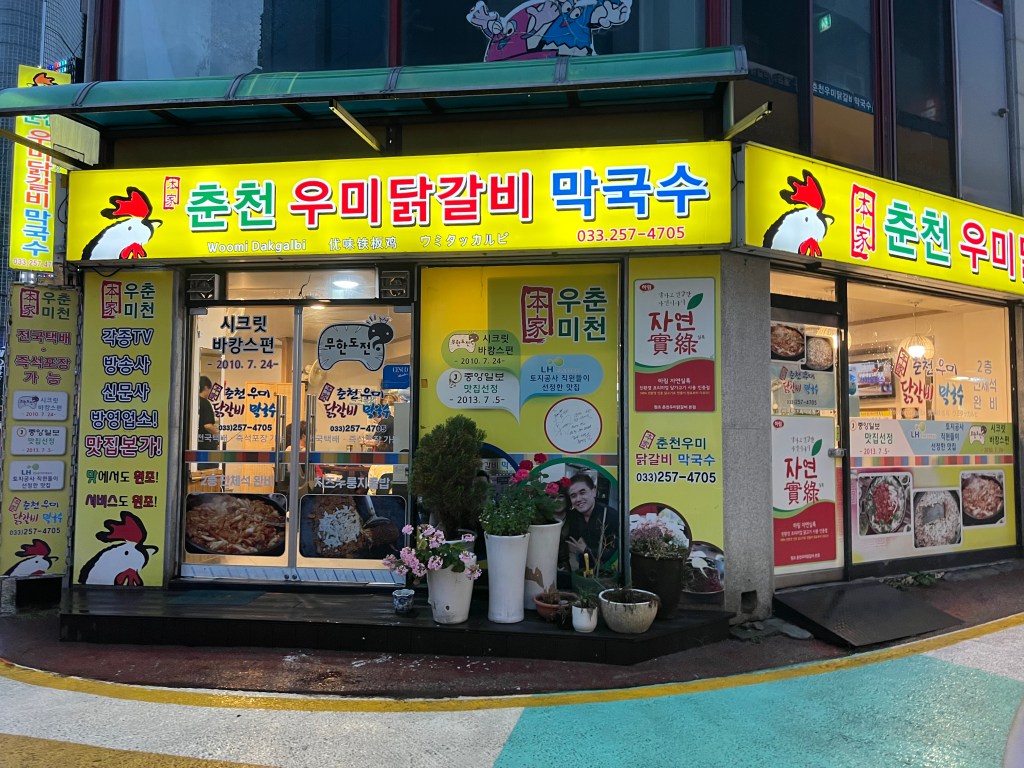
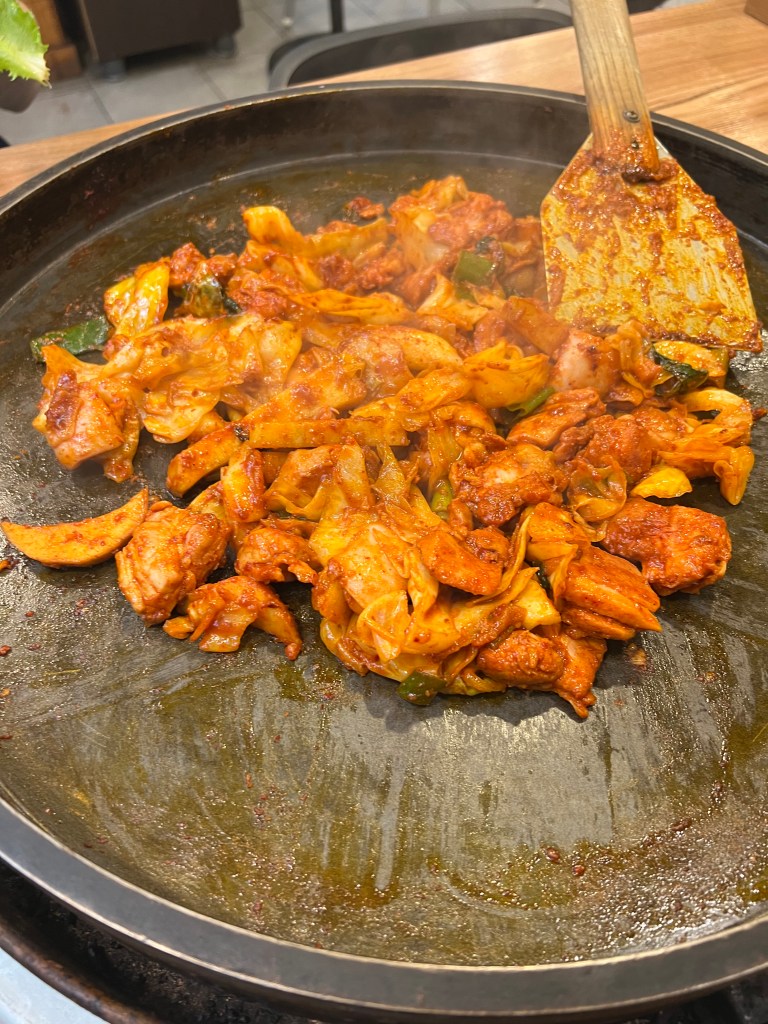
    Time to eat some dalkkalbi because it’s famous in Chuncheon.

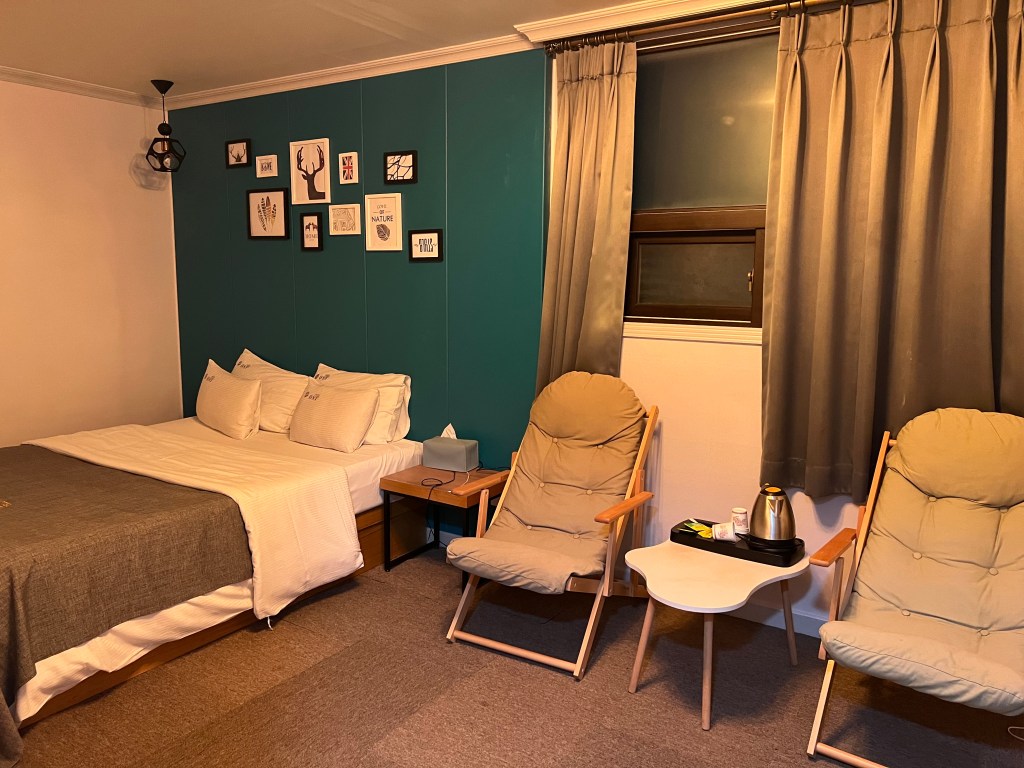
    And go to the motel. It’s just 50,000 won for a night, so I’m pleased.

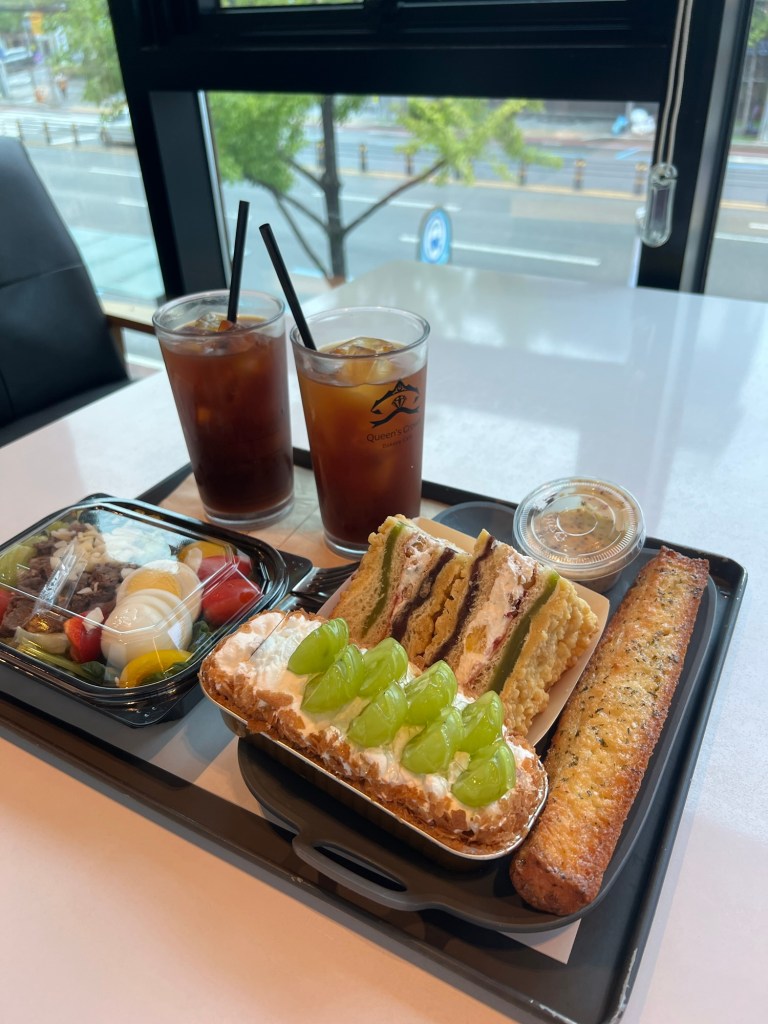
    Next day, we leave a little late and have breakfast at a café.

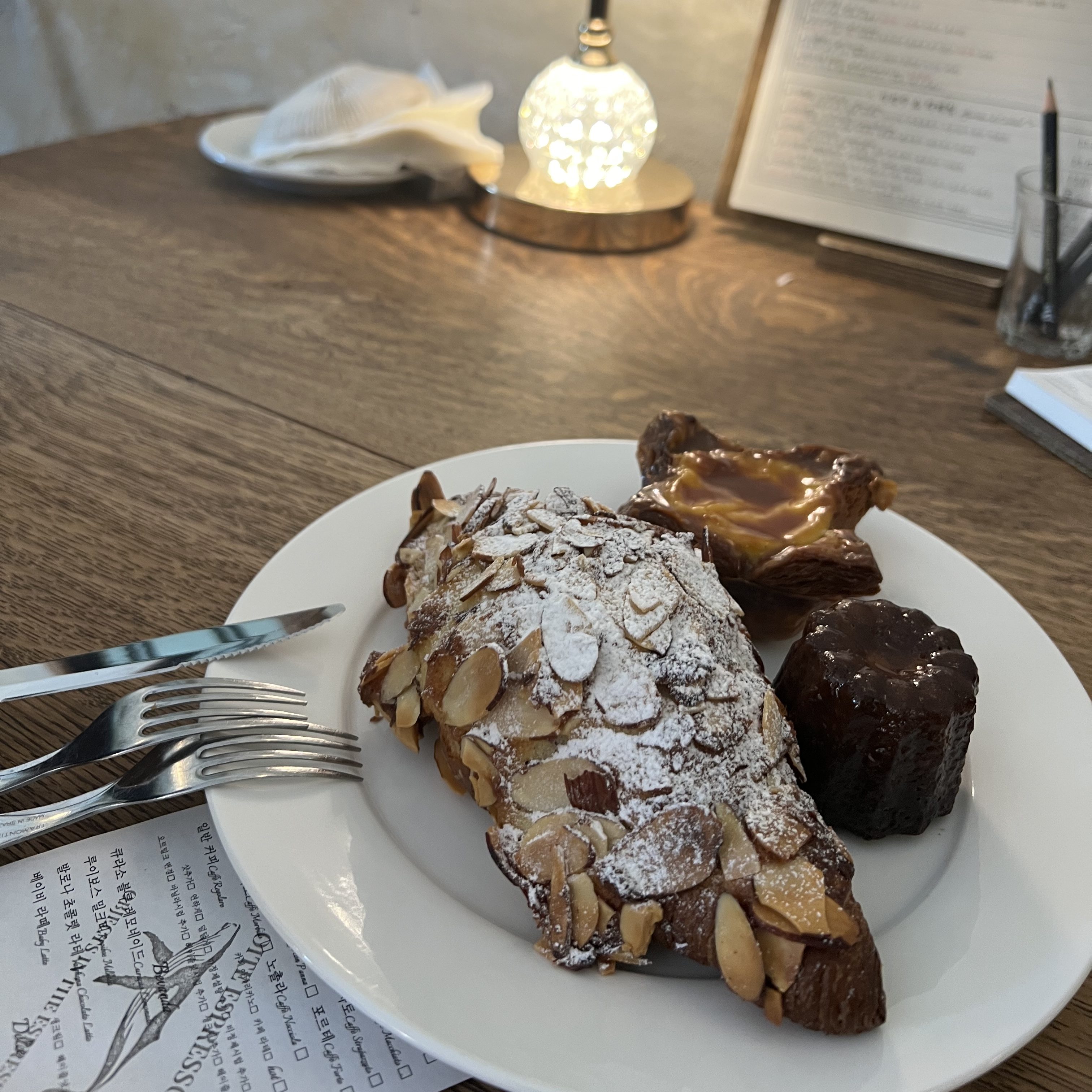
    Why do people in Korea treat it like a crime to eat a with your hands? It’s considered bad manners.

    But I think a European would consider it bad manners to cut a croissant with scissors like they do here.

    Anyways, it’s a little far to the first certification site when going home, because we have to go north.

    I think it’s about 7 km.

    But when we got there, Hyeonjeong realized she forgot her passport in the motel.

    I can imagine myself doing the same thing…

    And we have to take a taxi back to the motel. There’s not enough time to ride there and back.

    I realized it was a good idea to give up the first day. The distance from where we were to the finish is very far, and it doesn’t include the time to get back to the city.

    The scenery in Chuncheon is much more beautiful. There’s a lot of mountains along the river.

    And time for some lunch in Gangcheon.

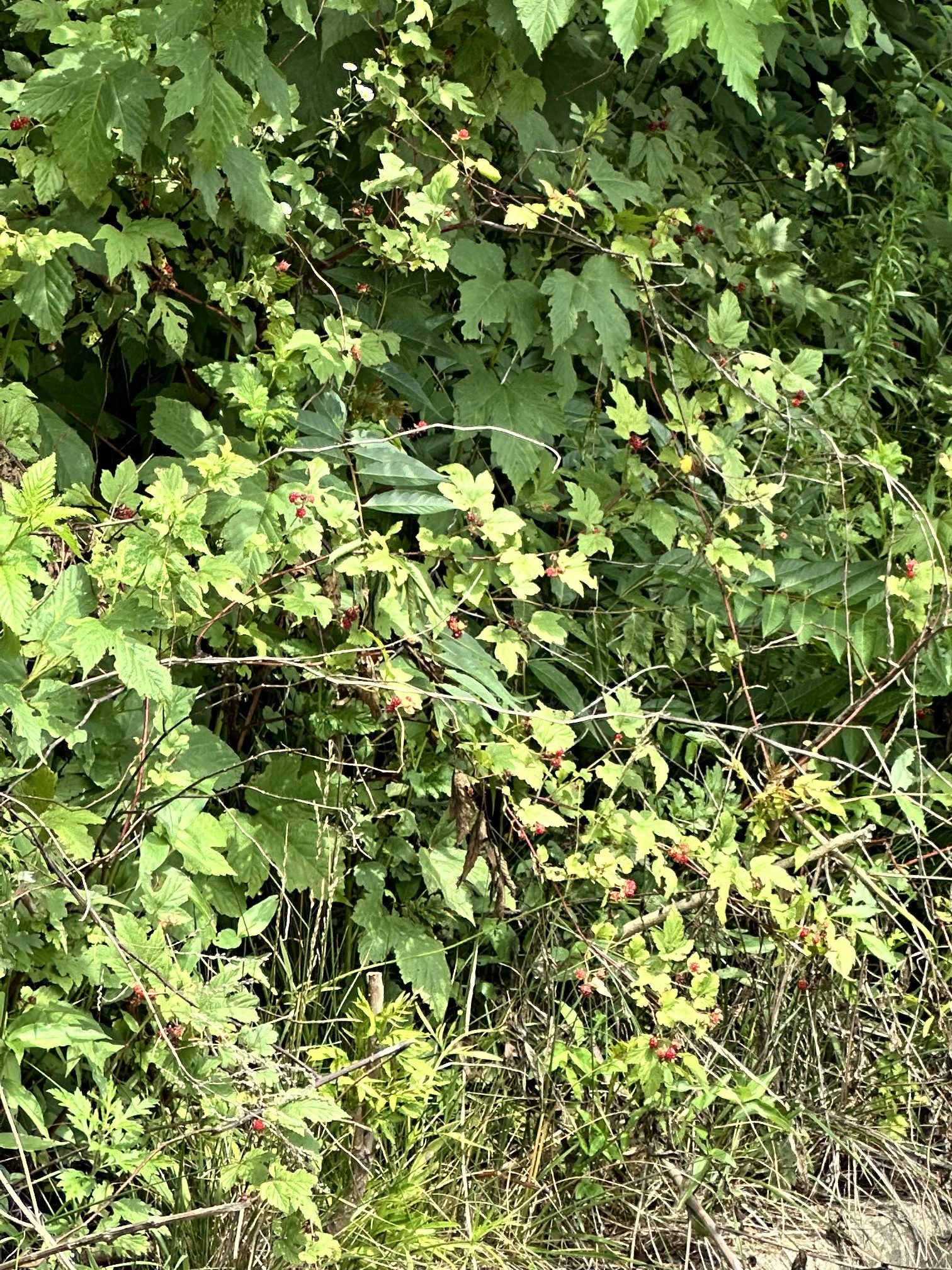
    I started paying attention to the foliage around and I realized there were a lot of wild wineberry plants on the side of the road.

    Wineberries native to East Asia are a lot like raspberries, but not as good as the European raspberries. You can look out for them if you come to Korea and try them.

    But after that, the last 15 km or so, I started to get some rough knee pain. It happened to me before, but the last time it happened, it was a lot sooner. I guess I’m building up endurance, but it’s frustrating. I finished the rest of the course in pain.

    By the time I got home I couldn’t walk up the stairs well because of the pain in my right knee, so I decided to call off work the next day.

    But the next day, It was painful, but I realized it was not bad enough to call off work. I felt guilty all day. I have only called off work once or twice and have come into work sick or often injured, so I think people thought it was something serious.

    And apparently my coteacher had told the other teachers that I got in a bike accident, even though I told her I had very bad pain from biking, so when I came back fairly normal it was kind of embarrassing.

    Anyways, don’t think I will call off work again after this.

  • The first place I ever went to in Korea was Busan. It just takes a couple hours by ferry from Fukuoka, so it was my first stop.

    But I felt like I didn’t have enough time. It was one of my favorite places but I never stayed a proper few days to enjoy it. So this weekend I went to Busan for 2 nights.

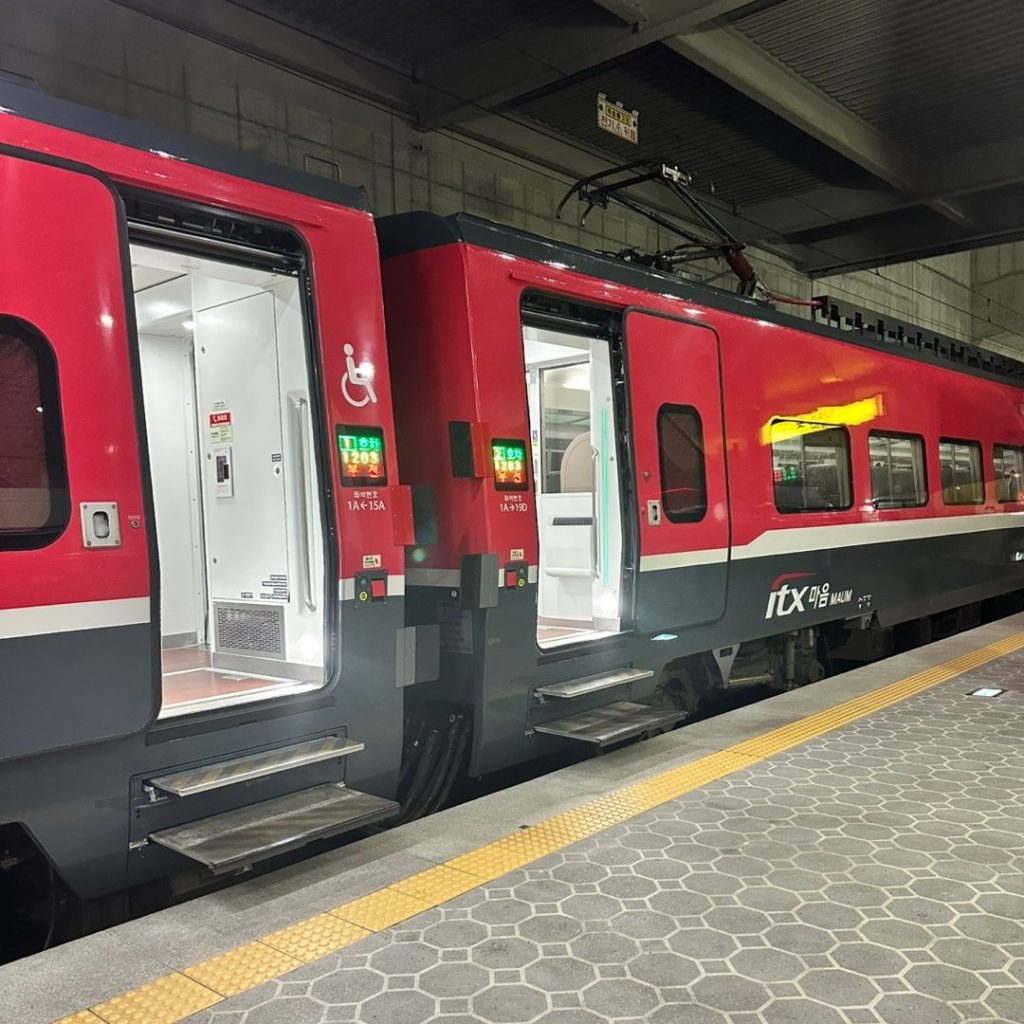
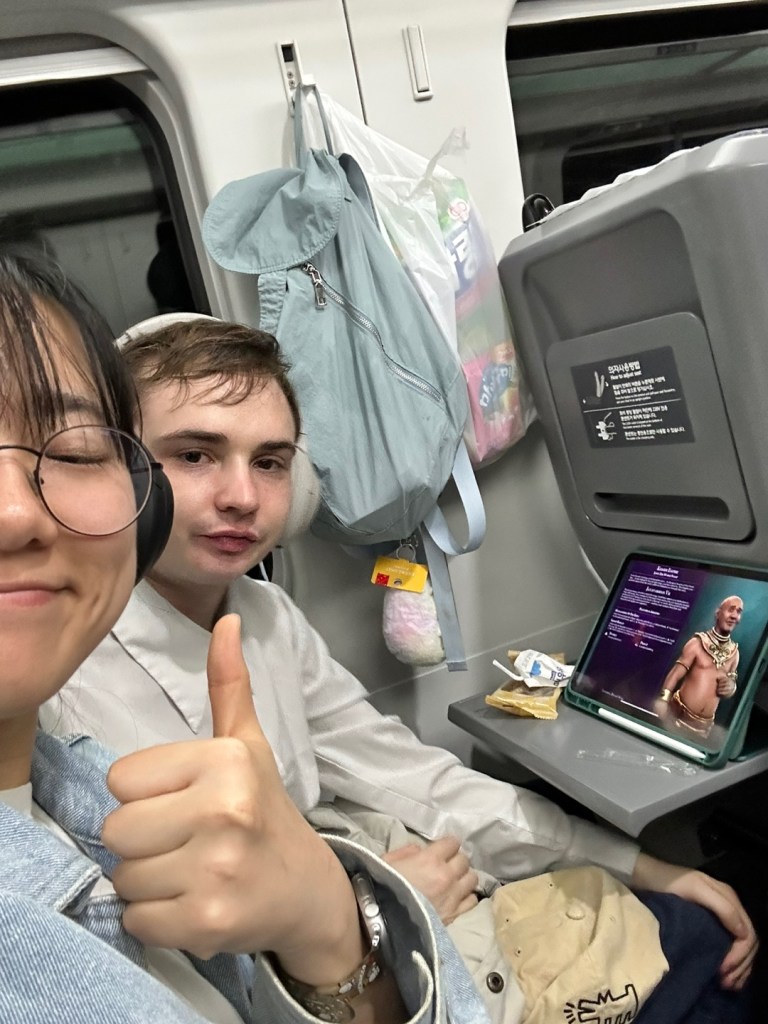
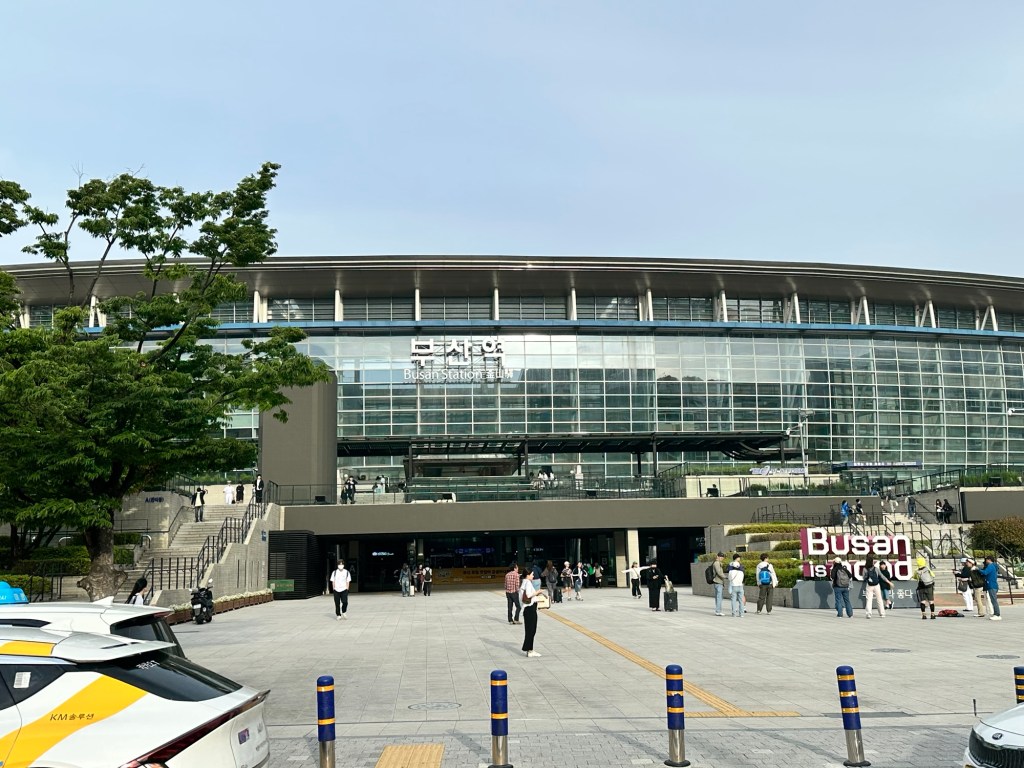
    There’s a new bullet train — ITX — that goes straight from my town in Gyeonggi-do to Busan without transfers, so I wanted to leave work a little early and try it out. But it took about 5 hours. I don’t really mind the long ride though, because travelling by train is a lot more comfortable than by car or plane.

    We tried to play CIV 6 together to pass the time, but the free wifi on the train is too slow, and I don’t want to drain my hotspot battery, so it didn’t end well. I’ll just look out the window and watch my beloved YouTuber ハヤトの野望.

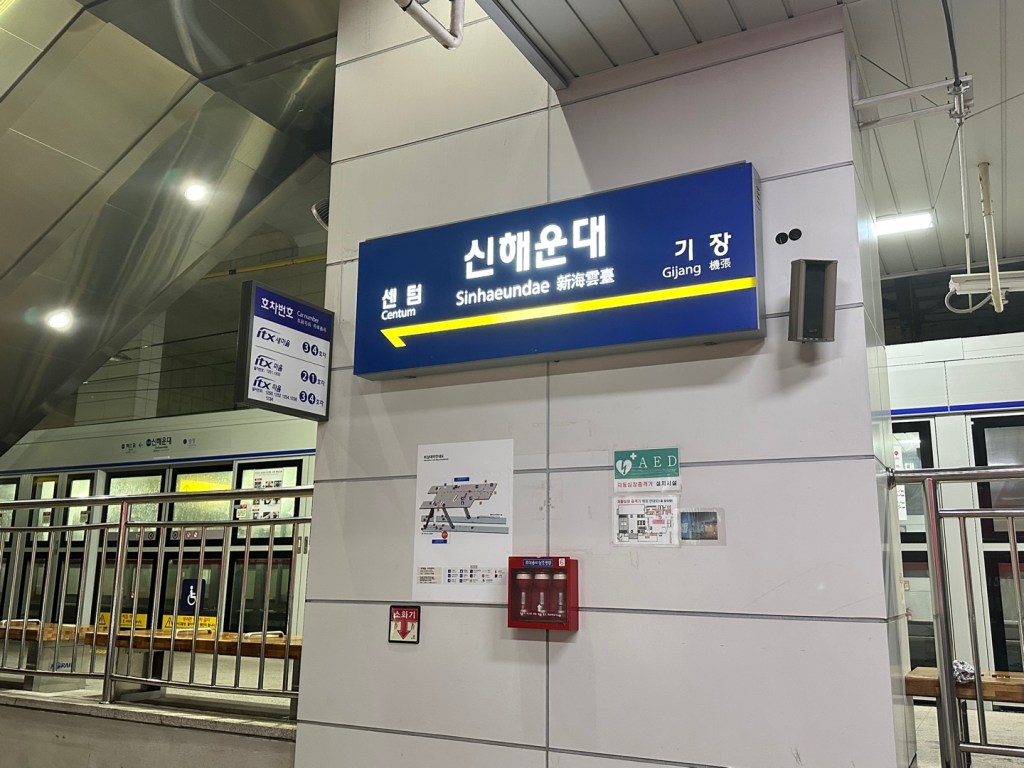
    Finally get to Sinhaeundae station at 8 pm… I don’t have the energy for anything, but the hotel is quite far, and it’s storming like crazy. I go out to the taxi stop and there is no taxi but one. He shouted at me as he ran inside to avoid the rain that there’s no taxi available here! But he ended up taking us anyways to our hotel.

    I realized pretty quickly listening to his older Busan man Korean that it was too difficult to understand. The accent is pretty strong, and I’m not adjusted to it. I felt the same way when I first went to Kansai… I wonder if this is how people feel when they learn British English and then go to Alabama or something.

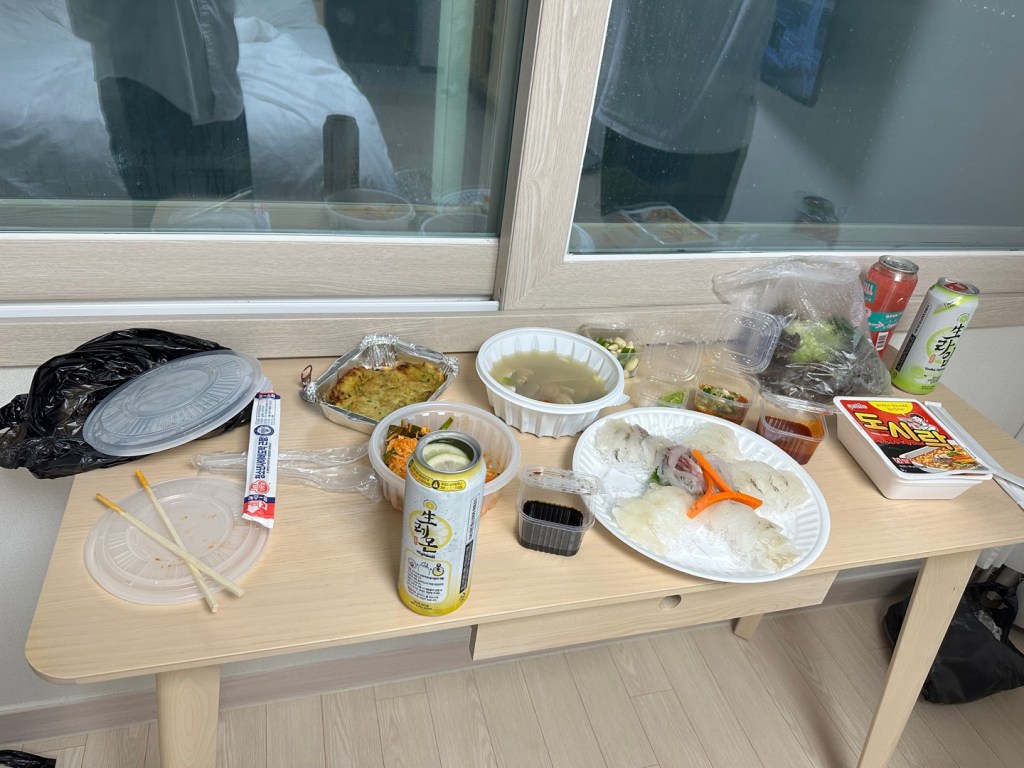
    I’m too tired, so we just ordered some raw fish to our door with Yogiyo. And I went to the convenience store to get one of my favorite alcoholic drinks in Korea, 生lemon. It’s called “raw lemon” because it has a real lemon that floats to the top when you drink it. But this time, I got an extremely rare can because it had TWO lemons!

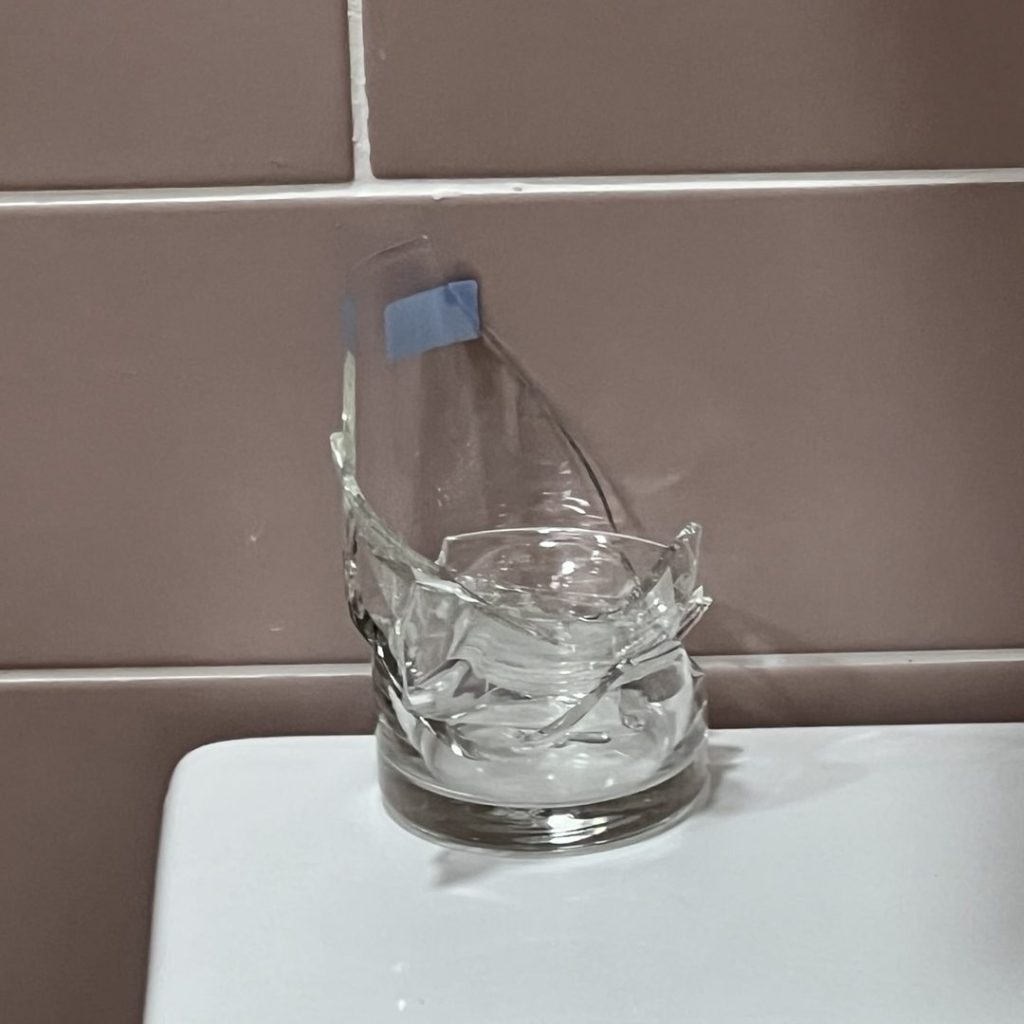
    And my girlfriend can’t finish her drink, so I have to drink it so it doesn’t go to waste. The 生lemon is really strong, so I think I drank a little bit too much and broke this cup in the bathroom when I was brushing my teeth. I’m going to hold off on the 生lemon for a few weeks.

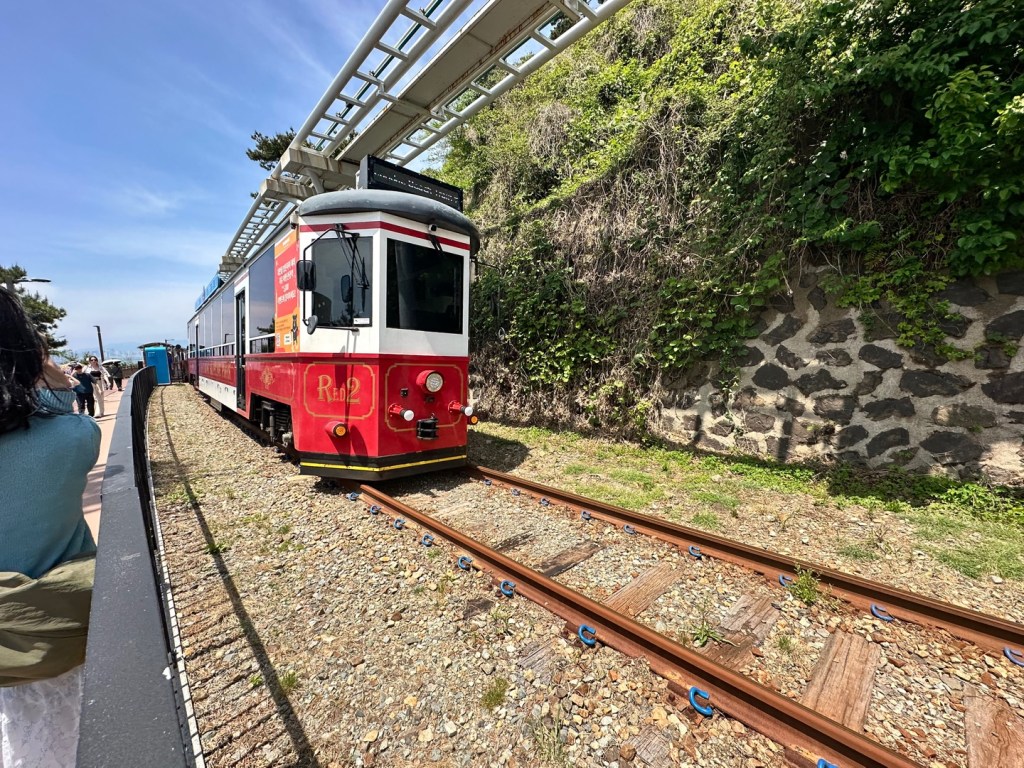
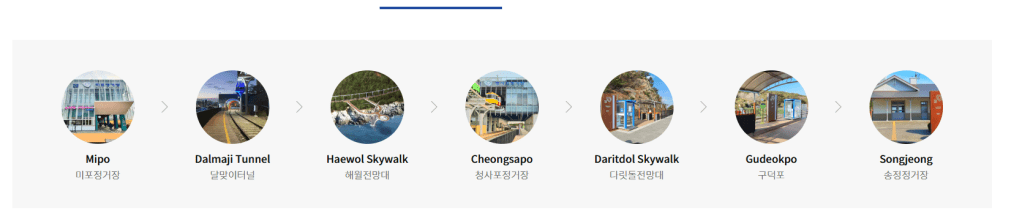
    The Busan Blue Line Park‘s first/final stop is a short walk from my hotel, by Songjeong, so we take it for a nice ocean view.

    An all access ticket that lets you get off at every station costed about 15,000 won.

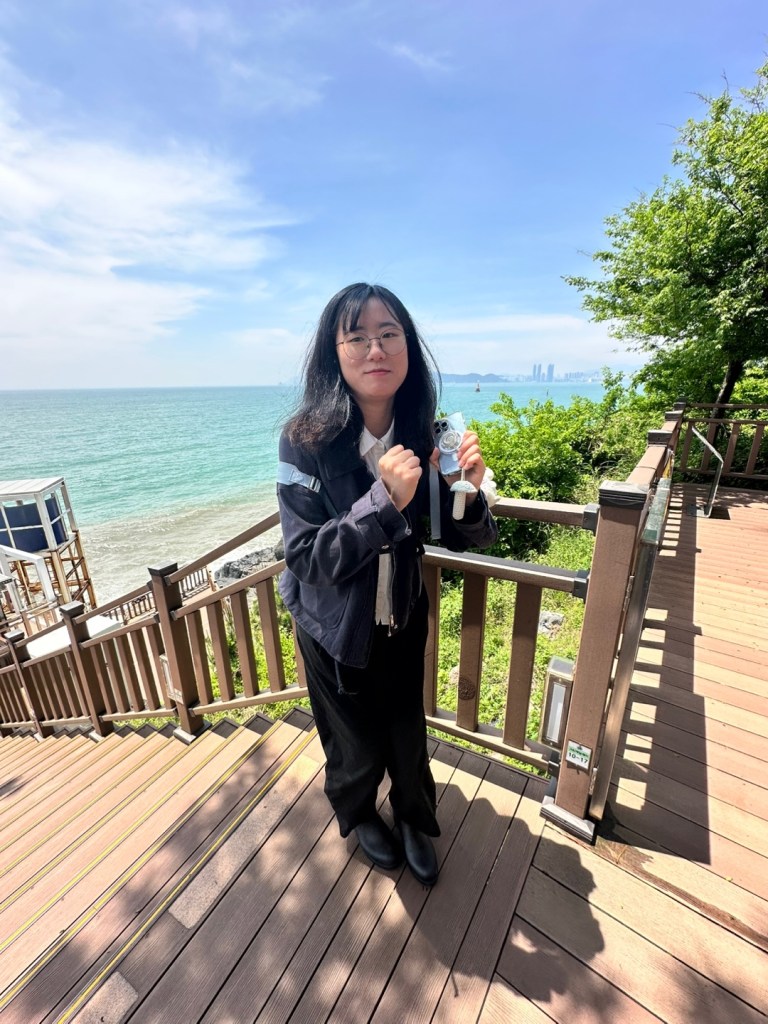
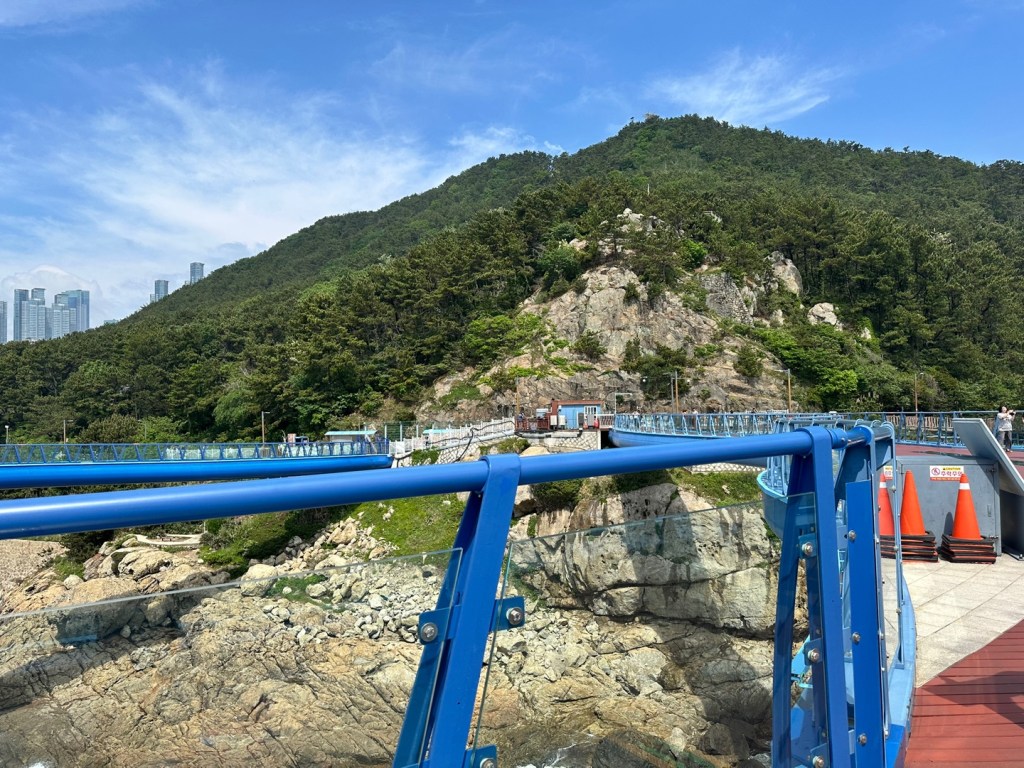
    We ended up stopping at Daridol Skywalk, Haewol, Dalmaji Tunnel, and Mipo.

    It was fun, but I think you can skip the tunnel. It can hardly even be called a tunnel, it was more like an arch.

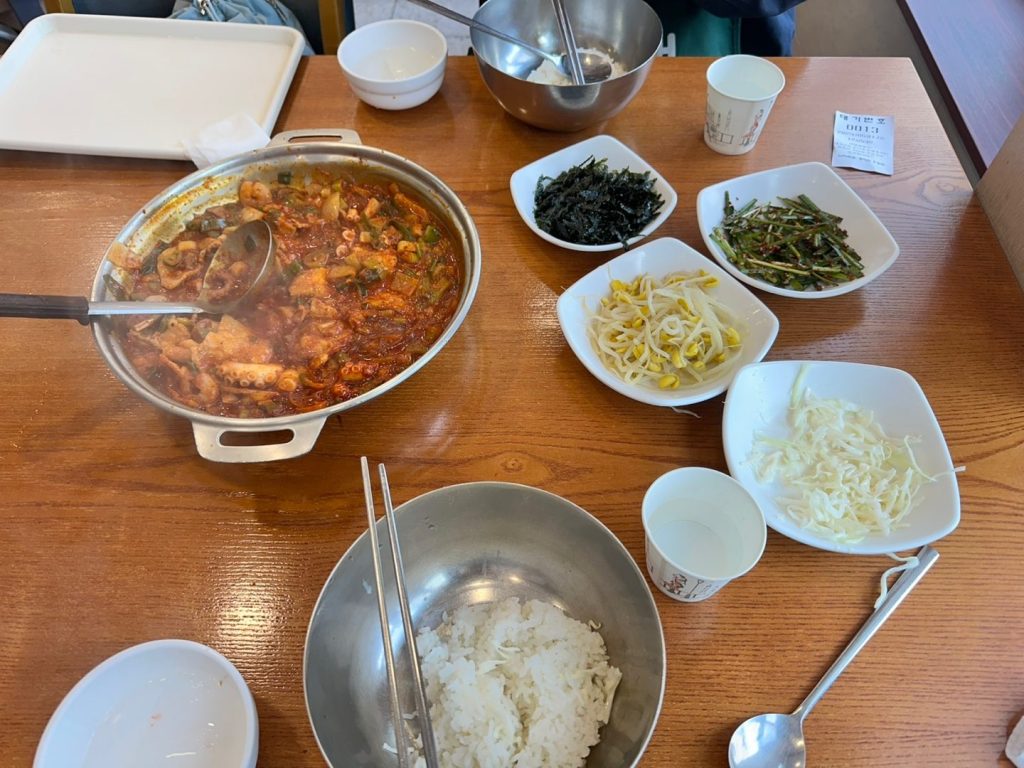
    We went to Gaemi-jip for lunch, which is a very famous restaurant for stir-fried octopus. It’s the first Korean food I had in Korea, so it was nostalgic.

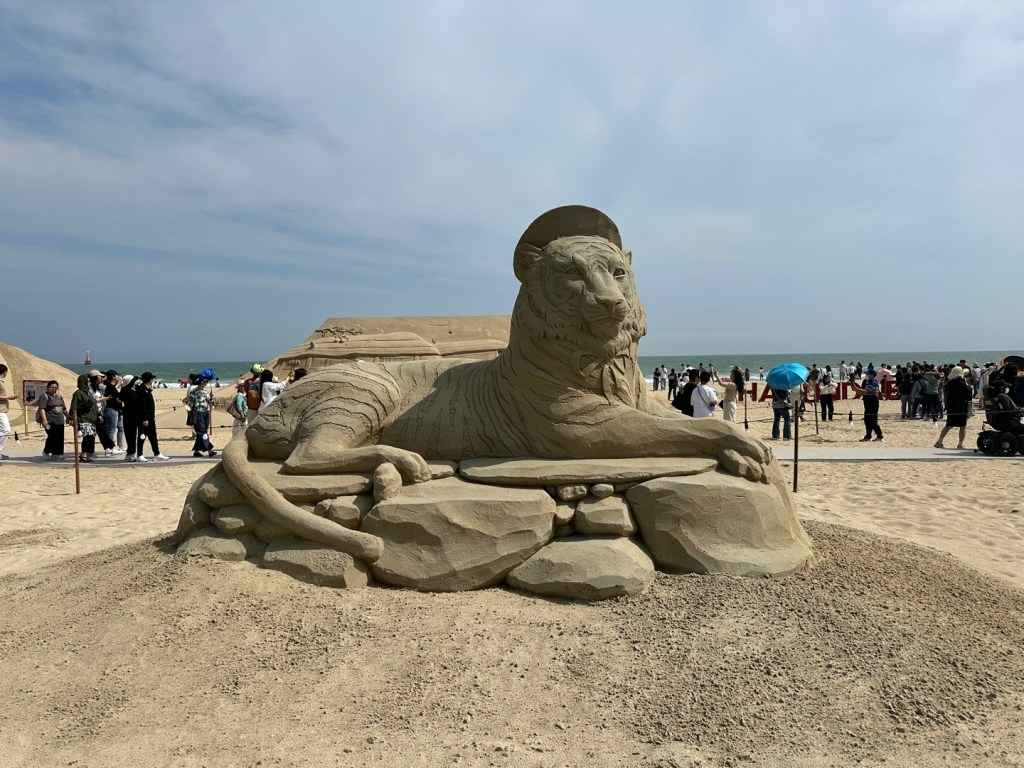
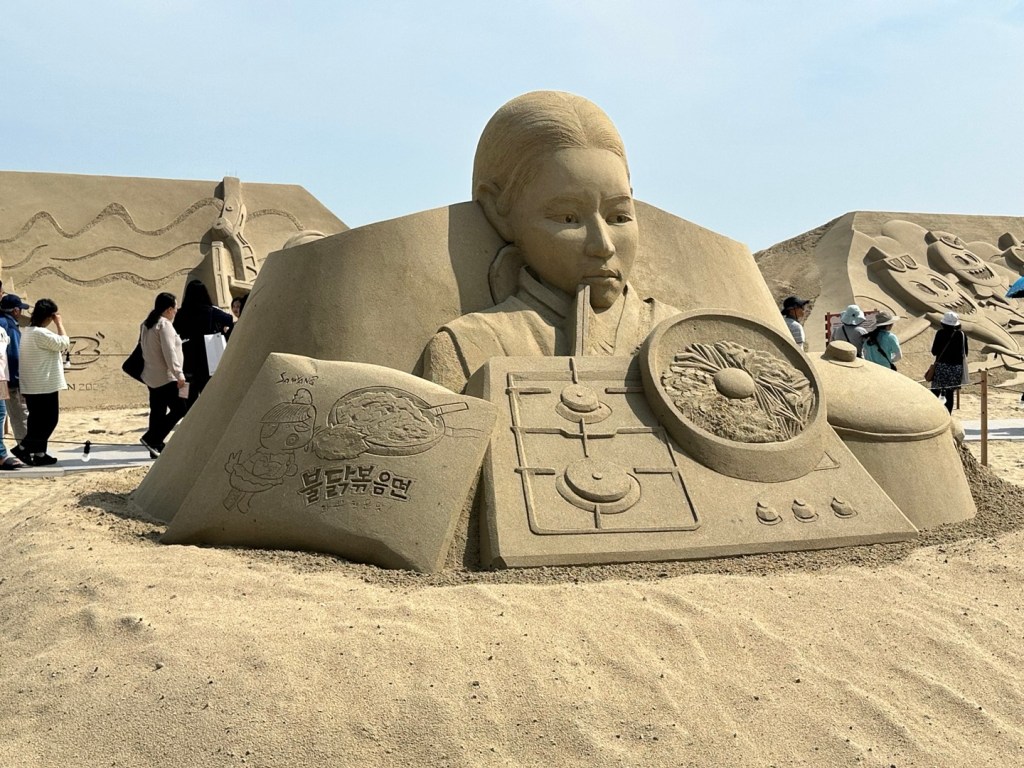
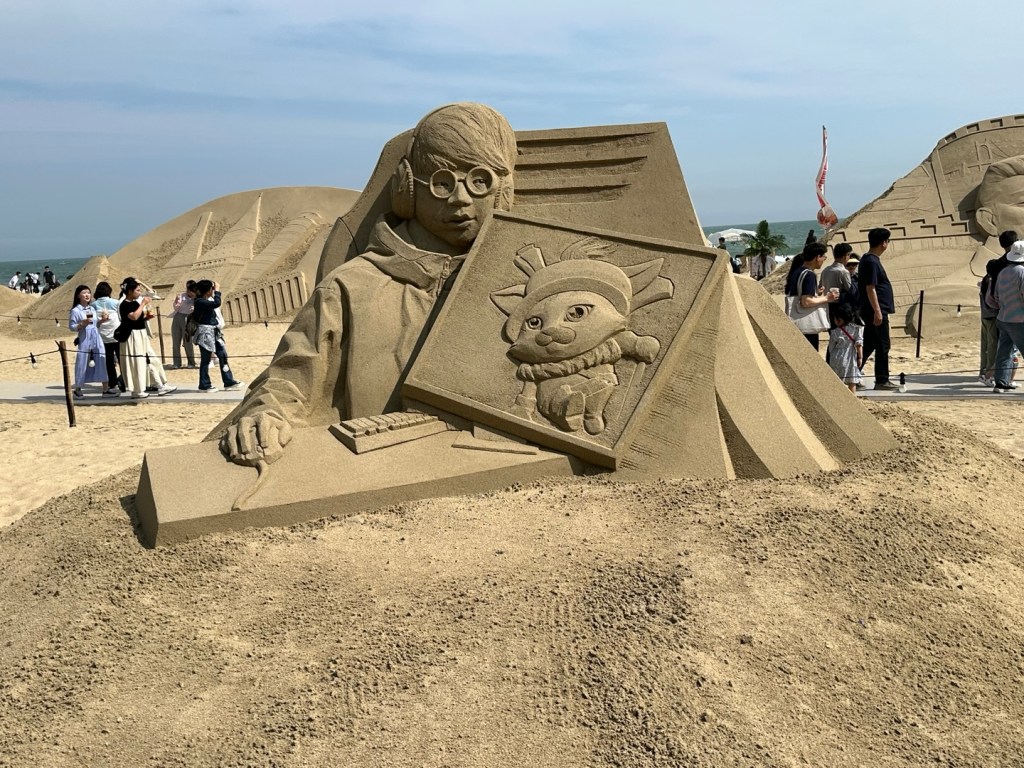
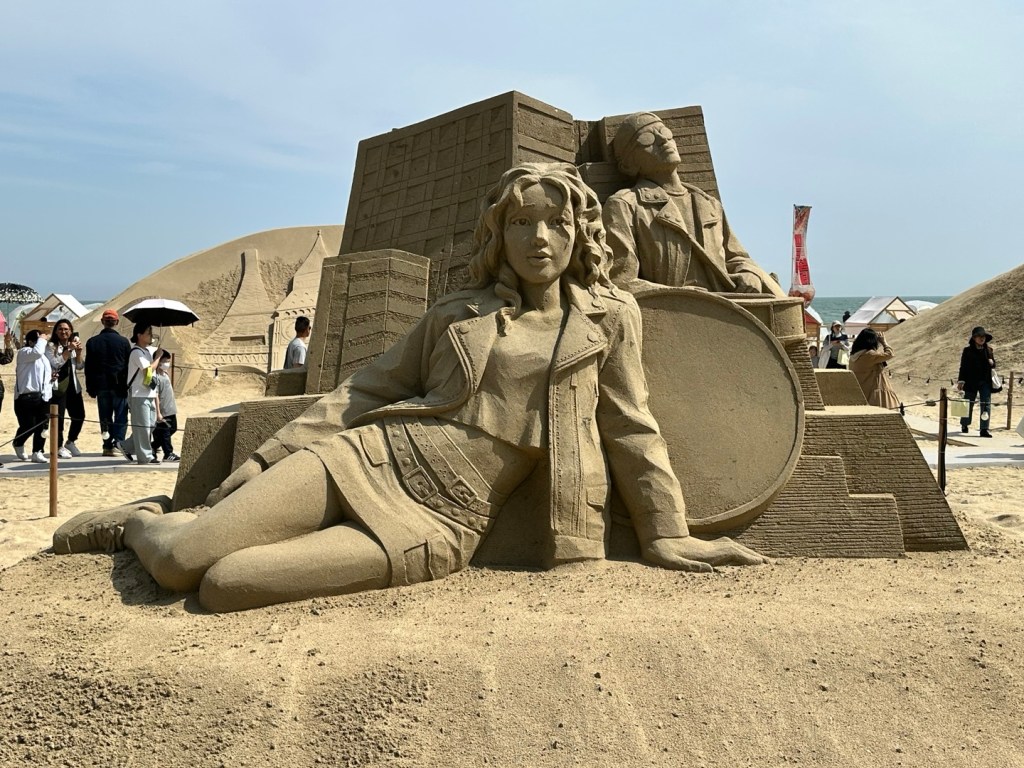
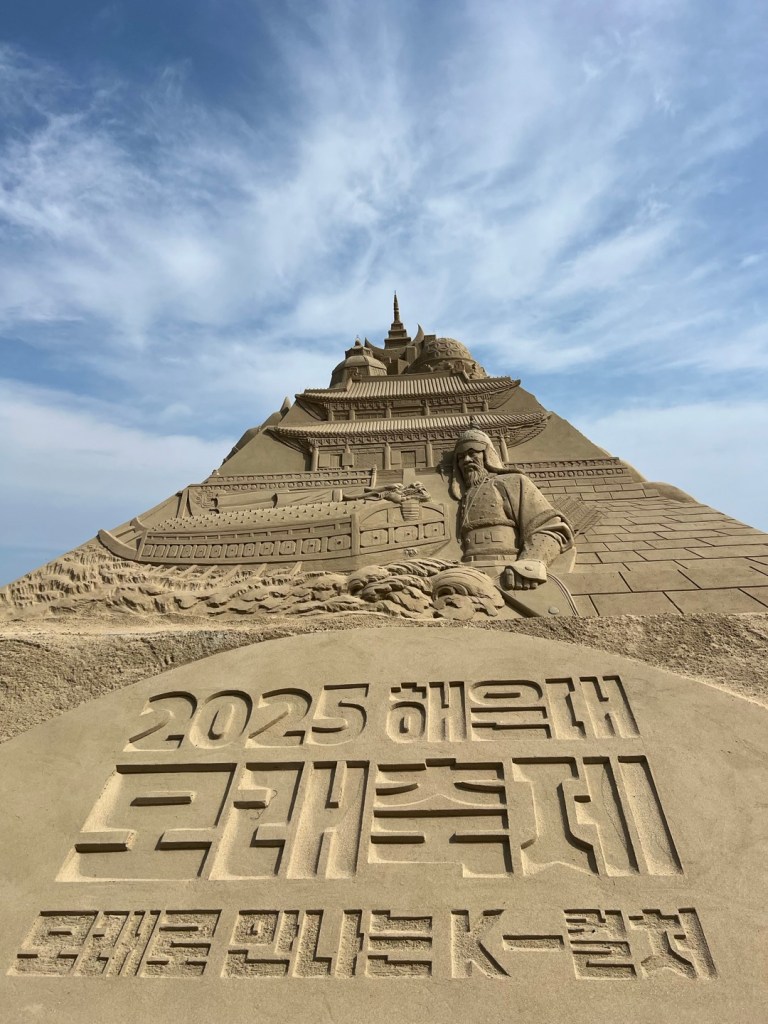
    I wandered around some more before going to the Haeundae sand festival. A lot of people gathered to see some impressive sculptures made of sand.

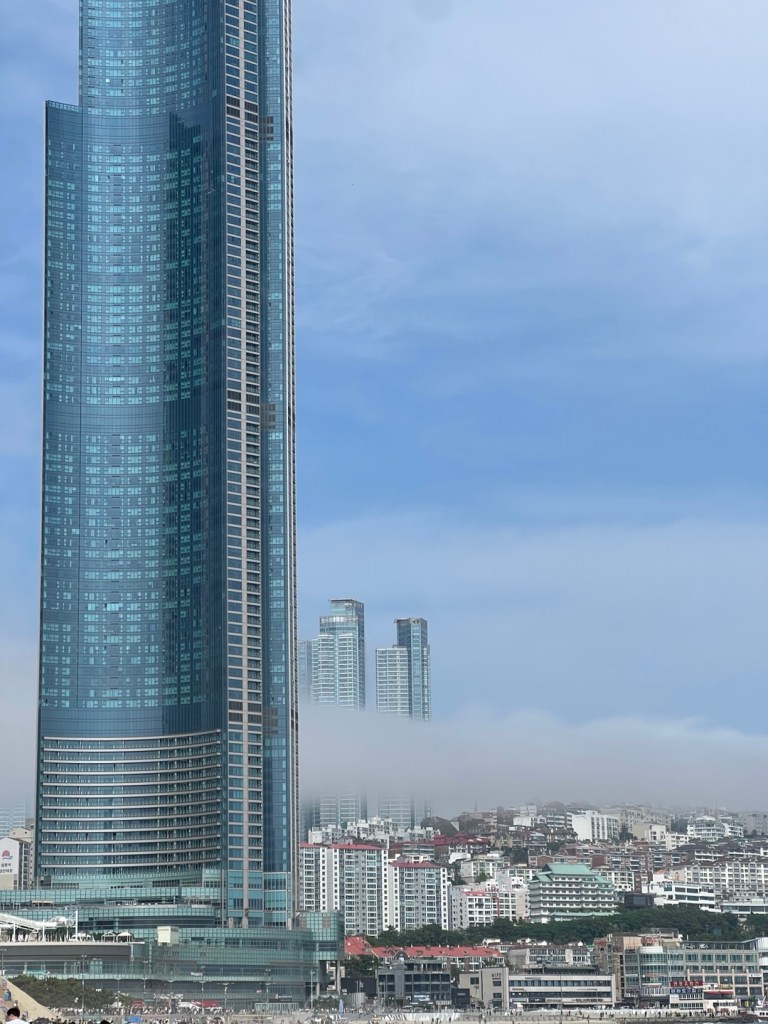
    The area around Haeundae beach is really pretty, but I saw some ominous low altitude clouds floating towards me.

    Anyways, we wanted to rest, so we went to a cafe across the street called Casa Busano. But it was one of the worst coffee’s I’ve ever had, even though it was about 7,000 won. I wouldn’t advise anyone to go there. And I don’t know if they realize that their word sounds extremely close to a slur for Cuban Americans…. hahahah

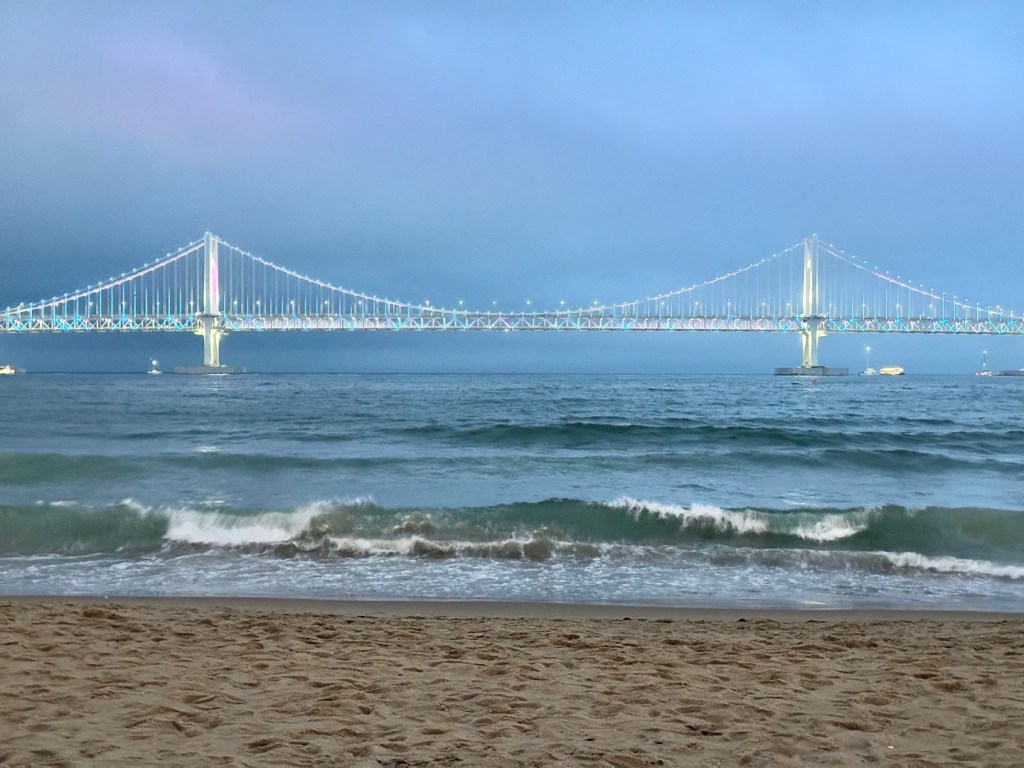
    After some much needed rest, we headed towards Gwangalli Beach. It’s just a beach with a lot of people, but it was really peaceful watching everyone play at the beach. There was a street performer playing guitar and singing Radiohead songs. It’s amazing that he can remember all those songs in English!

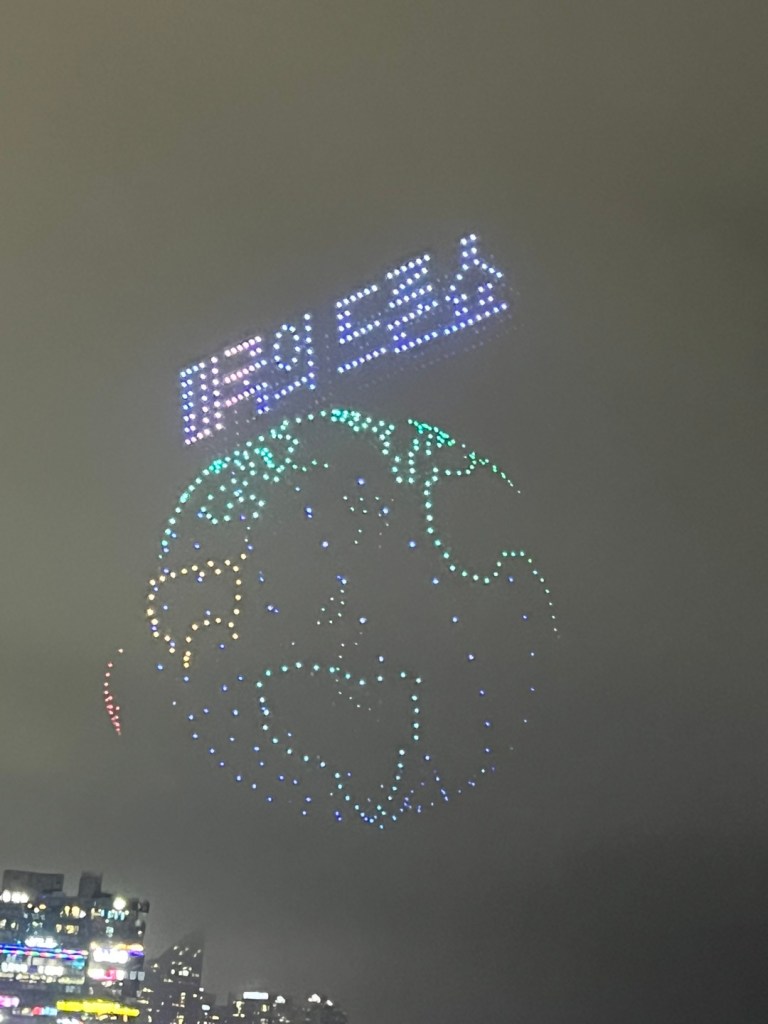
    We had to wait until 8pm for a drone show that takes place at the beach every week. The theme changes every week and this time it was “America”.

    The weather wasn’t great so it was hard to see. It was mostly American football and hip hop images.

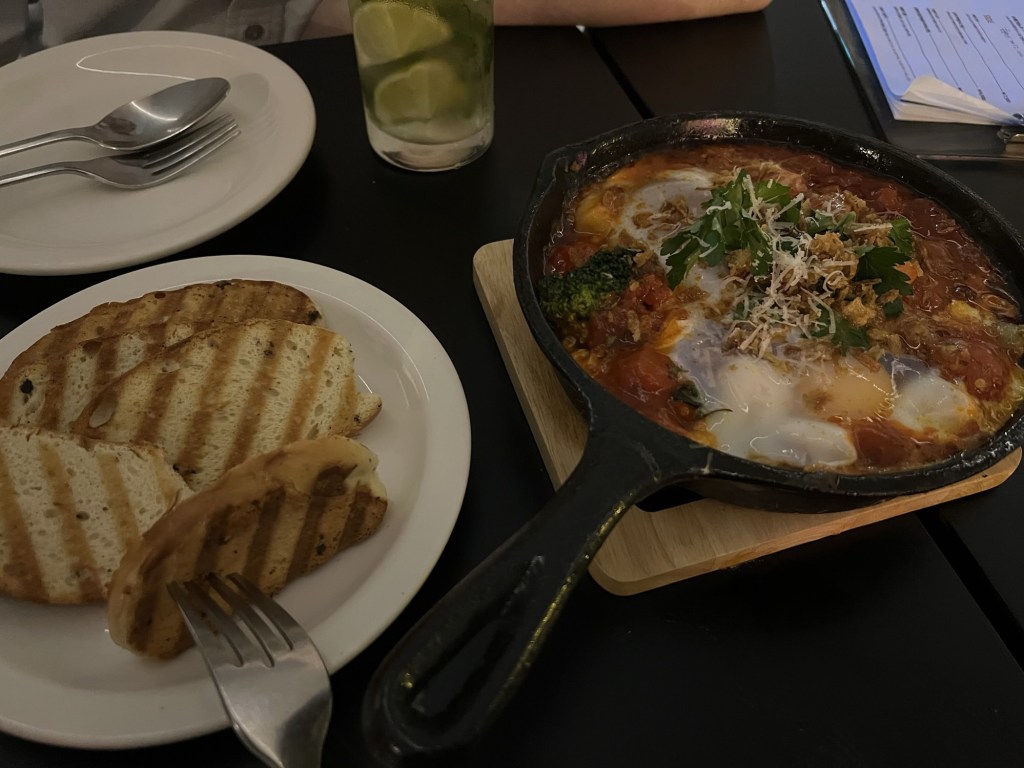
    We finally got back to our hotel and ate dinner around 9 pm… At a fancy Western restaurant called “just chilling.”

    The next day we stayed in a little late and had milmyeong for lunch. It’s a specialty in Busan and involves some kind of aged fish in the sauce.

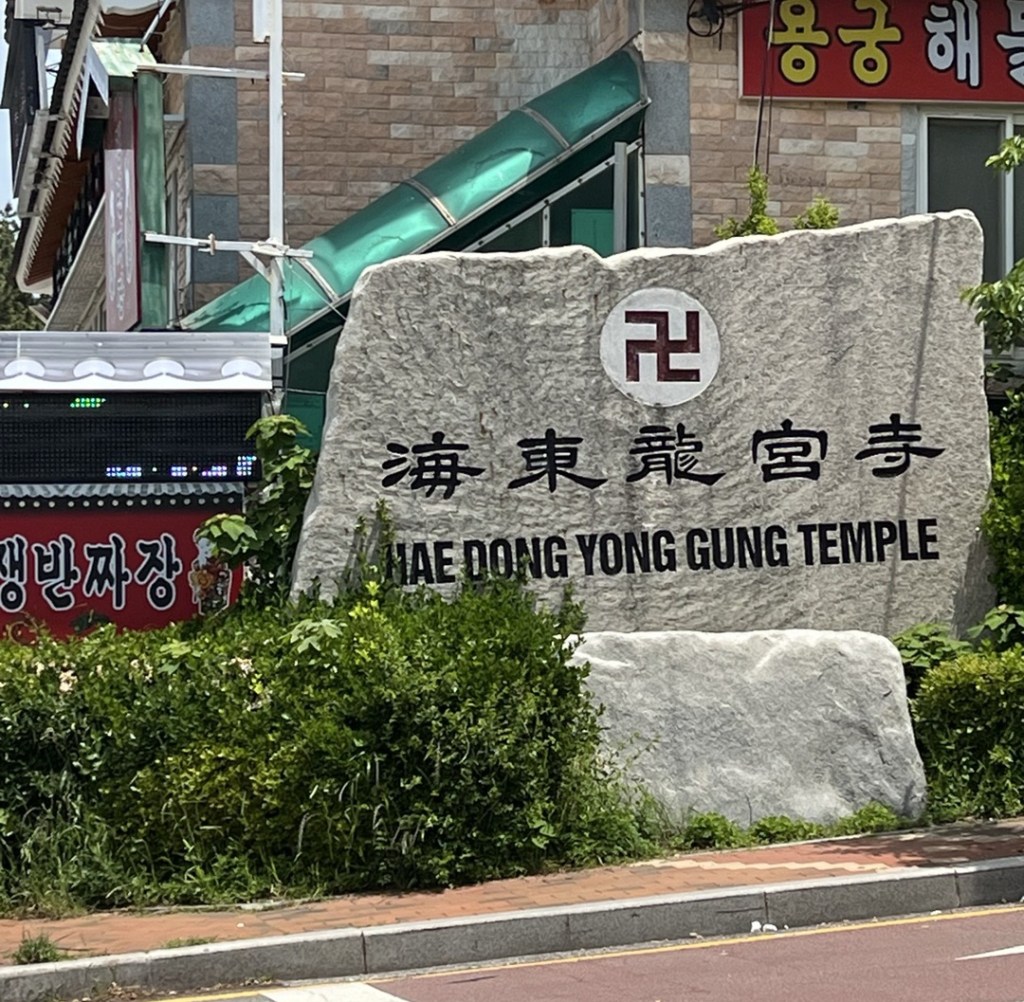
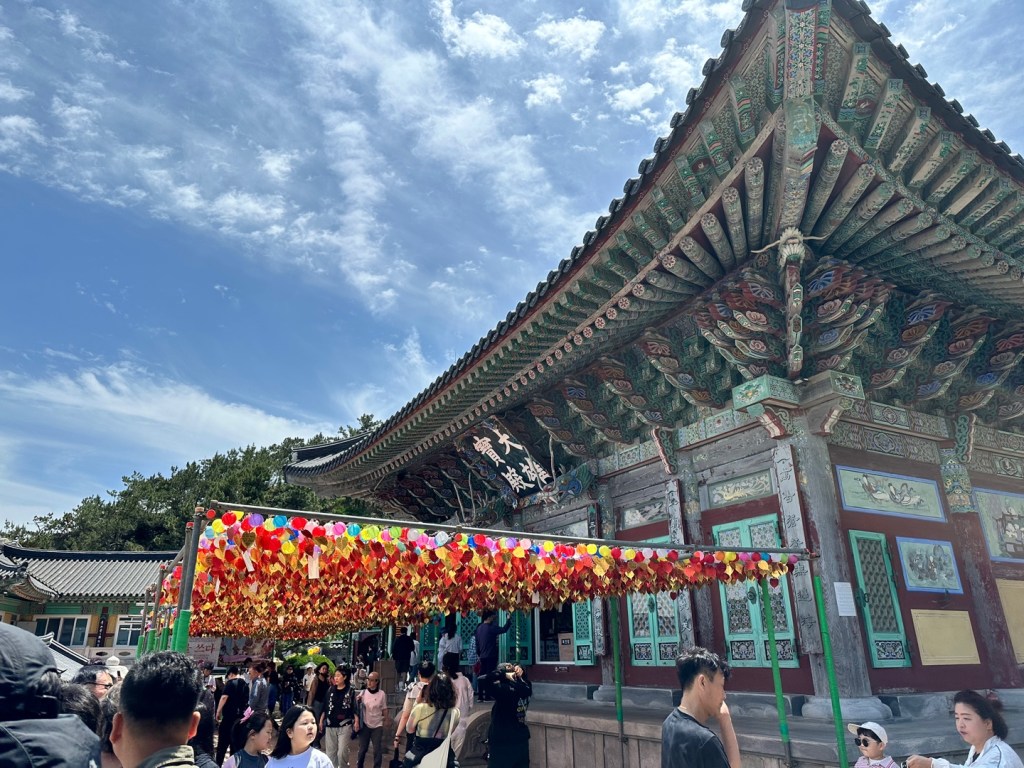
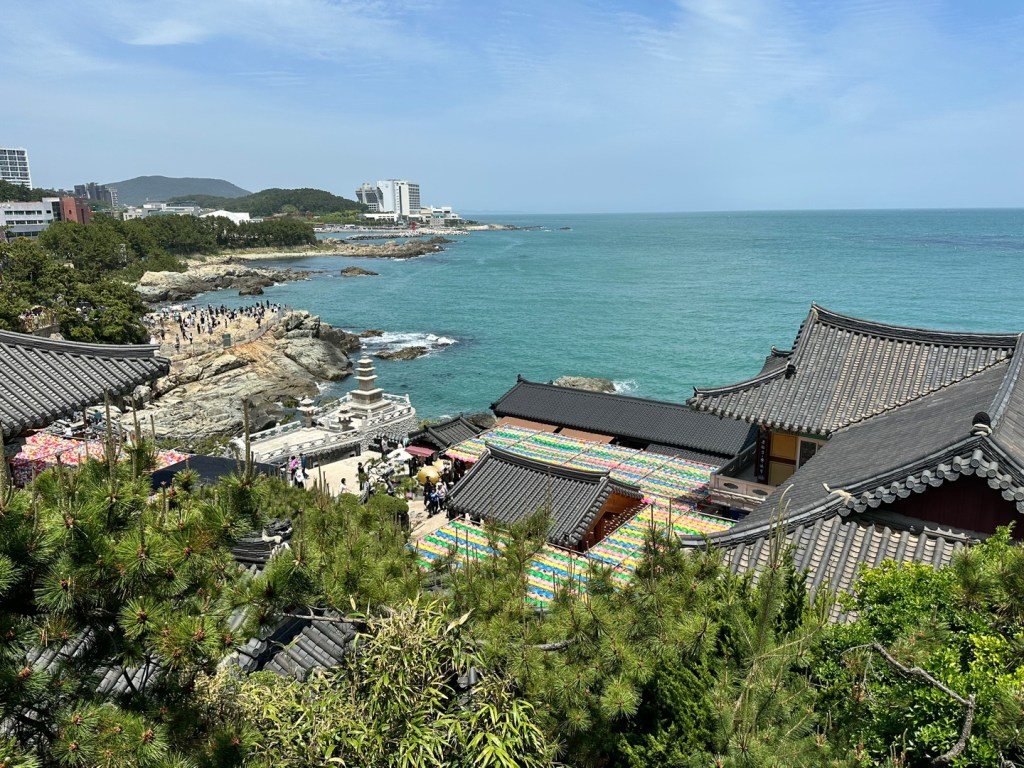
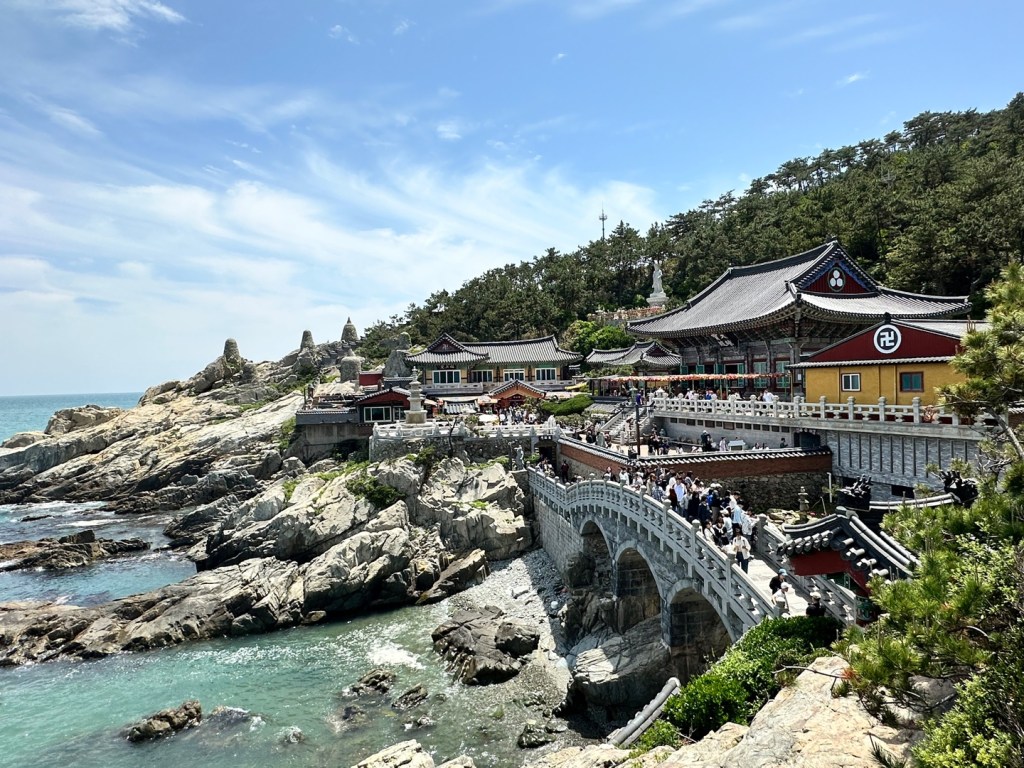
    Today we are going to Haedongyonggung temple. It’s said to be the most beautiful temple in Korea.

    Actually, I didn’t want to go that much because it’s supposed to be always packed with people. Being really loud and busy ruins the atmosphere for me, but it’s great for the temple which gets to make a lot of money ^ ^

    But despite there being a lot of people, I’m glad I went, because it is certainly very pretty.

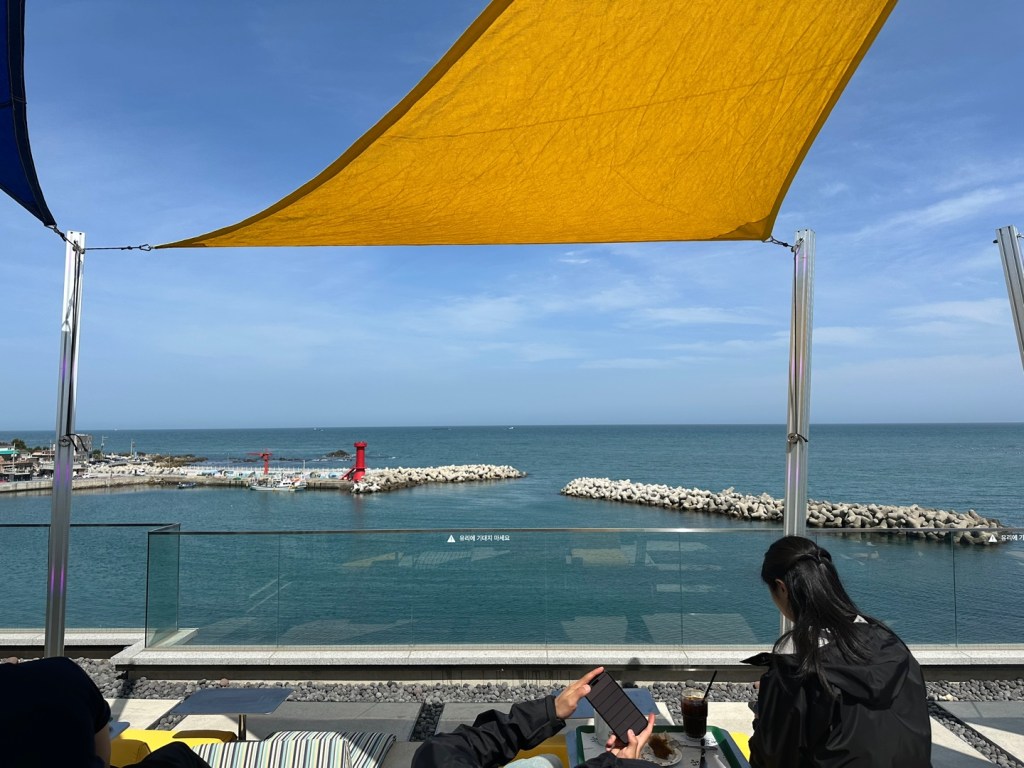
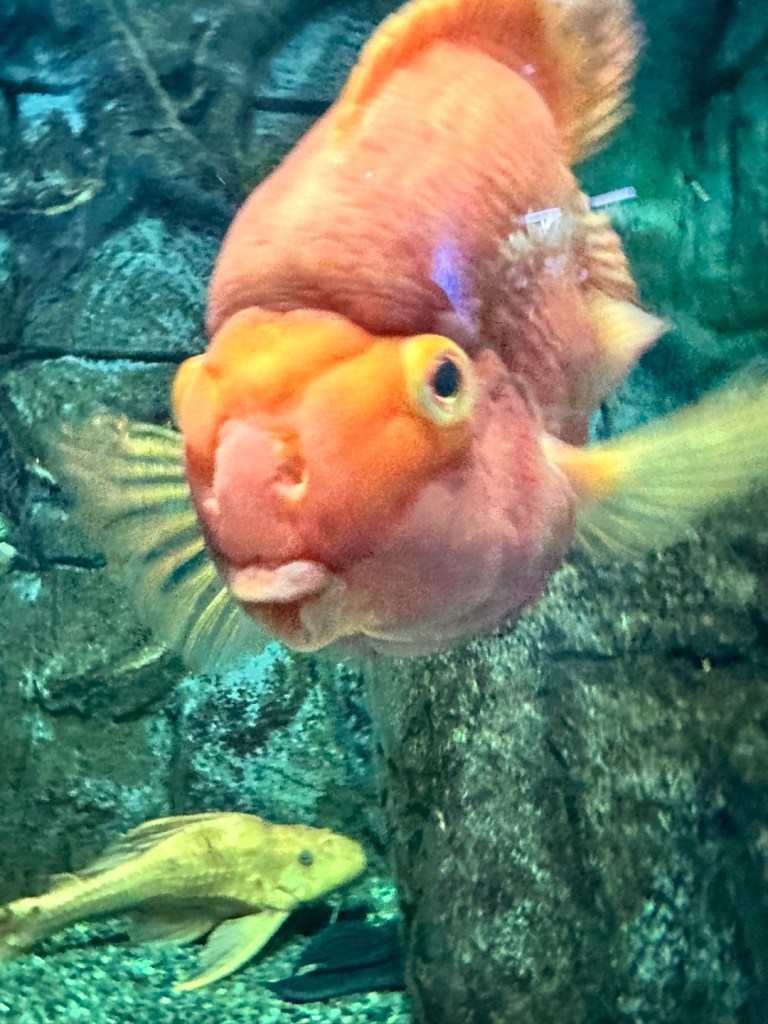
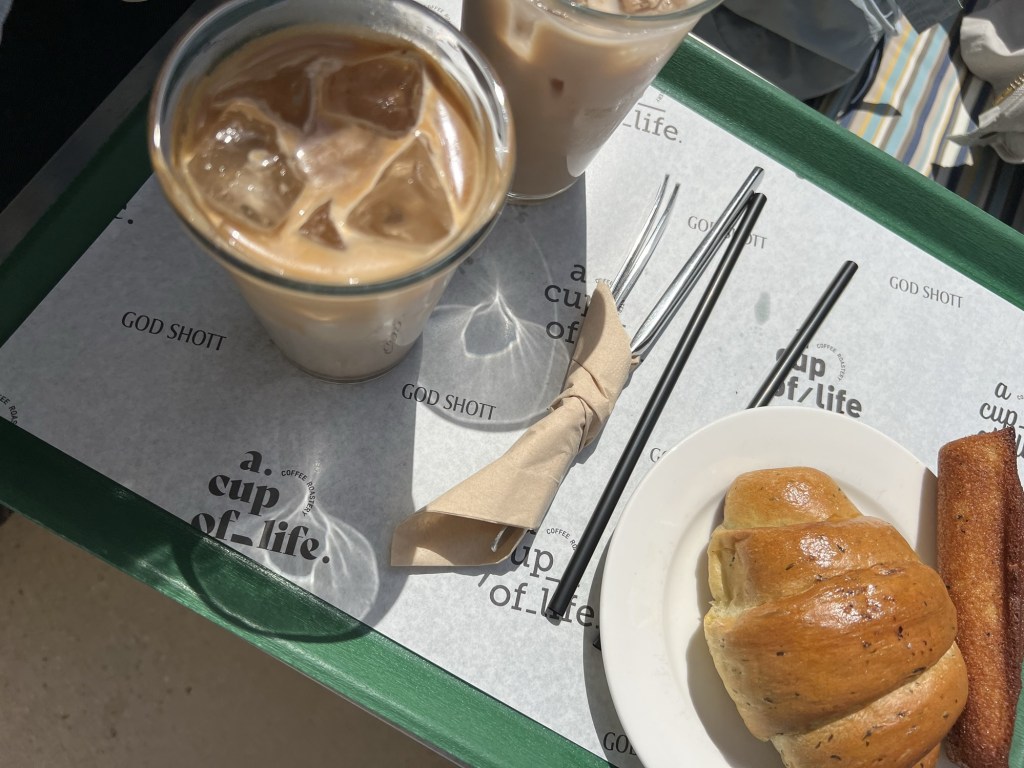
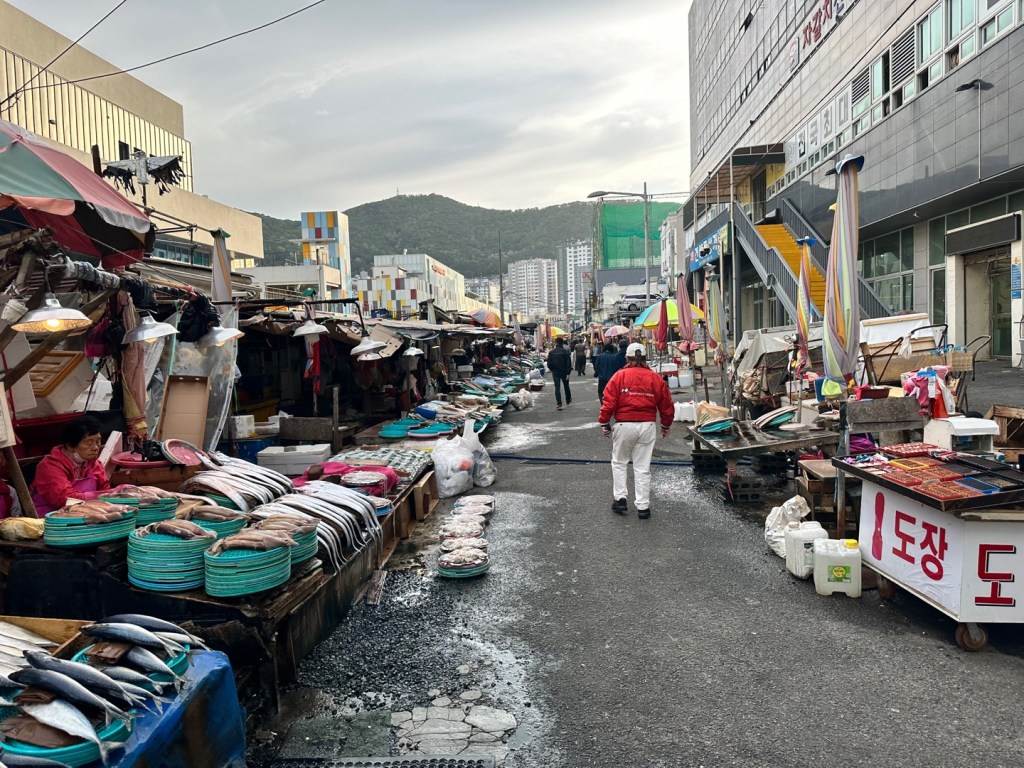
    We made a stop at a fishery museum and a rooftop cafe before going to our last stop, Jalgalchi market.

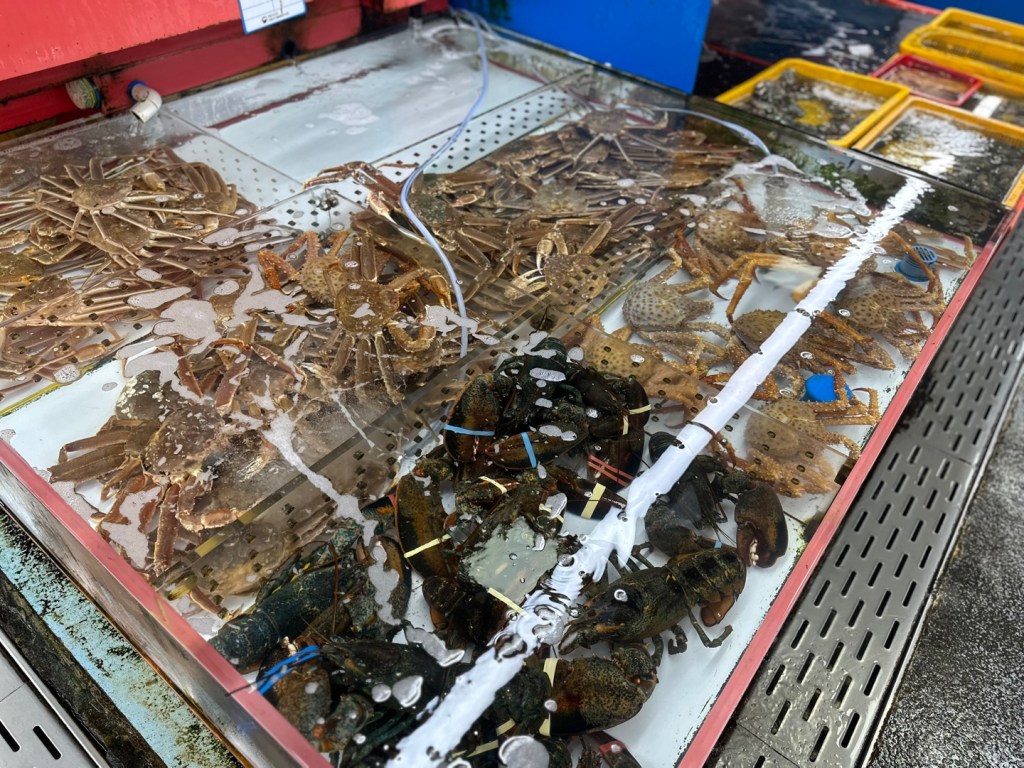
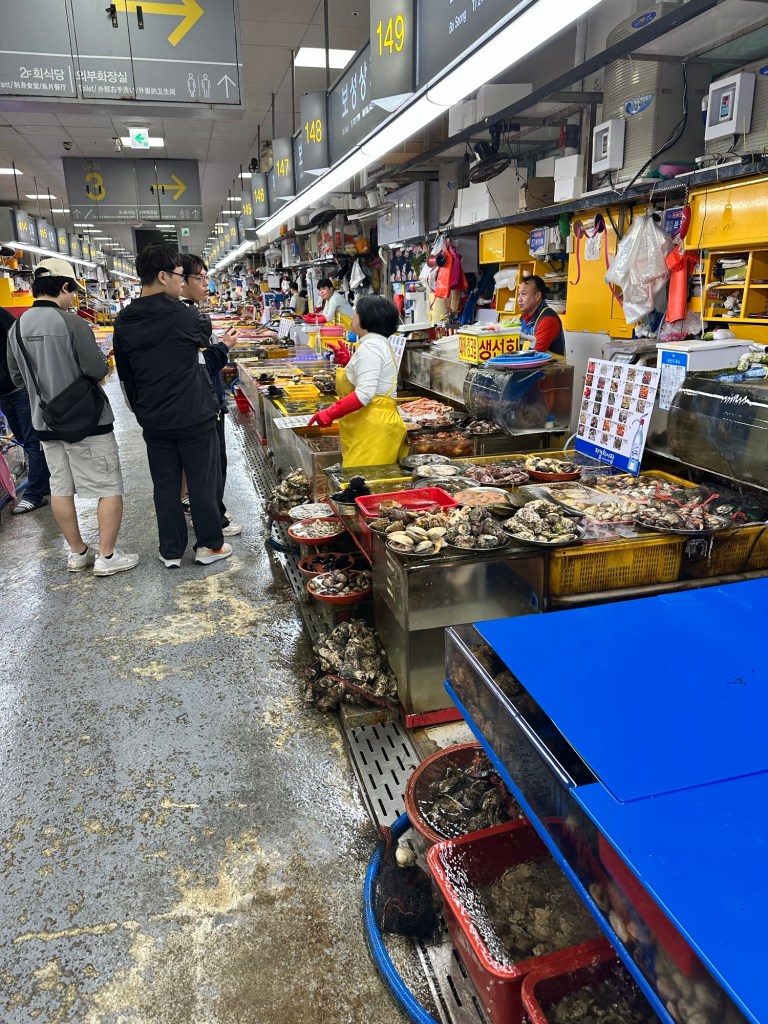
    You can buy fish, usually for eating raw very fresh at the market. They slaughter it right after you pay for it so it’s good for eating raw.

    I don’t know why it’s just the fish market, but if you’ve ever been to one you know how aggressive the salespeople are. They will shout at you as you pass to come and buy from them.

    But at Jalgalchi, they are less aggressive because they know I’m a tourist and probably won’t buy it.

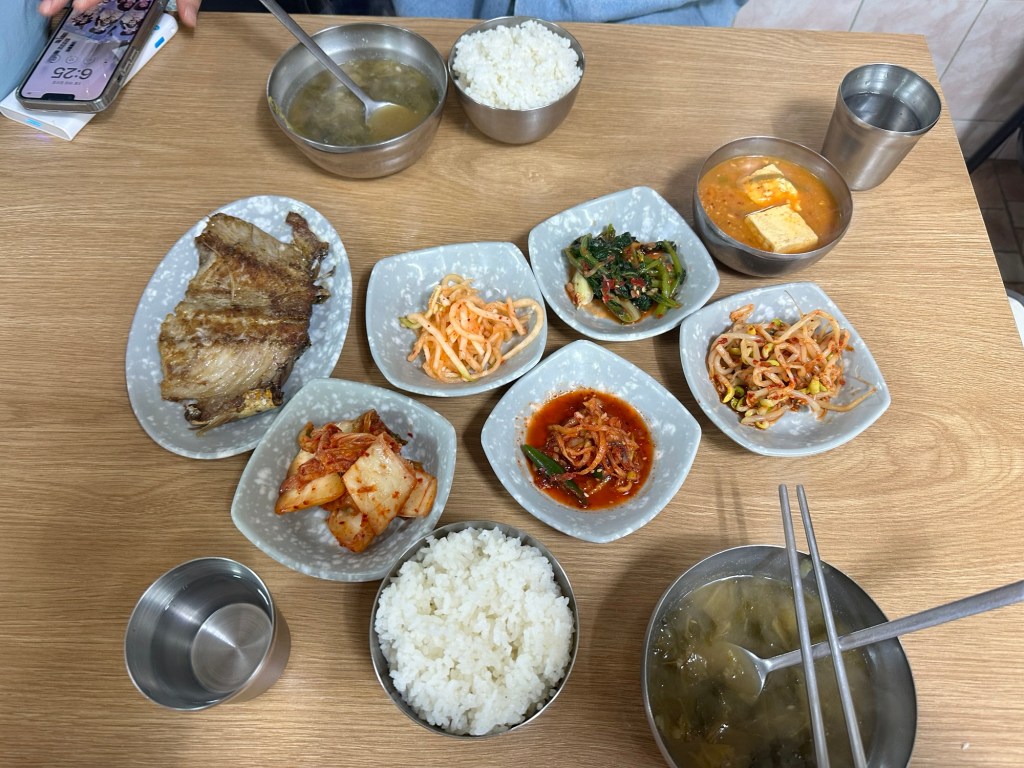
    Finally for dinner we had Godeungo (?) in Korean or Saba in Japanese. It was great! And the older guy sitting next to me was very interested in me.

    Koreans like to compliment as small talk and one of the common compliments is “You eat well.”

    I think a lot of foreigners in Korea are picky, so they are happy to see a foreigner eating normally.

    But actually, Saba is hard for me to eat because you have to separate it with chopsticks and there’s small bones, so he showed me how.

    Anyways, after that it was time to go home ㅠㅠ

    Time to go home!

    After a long train ride, finally home at 11pm… And off to work the next day.

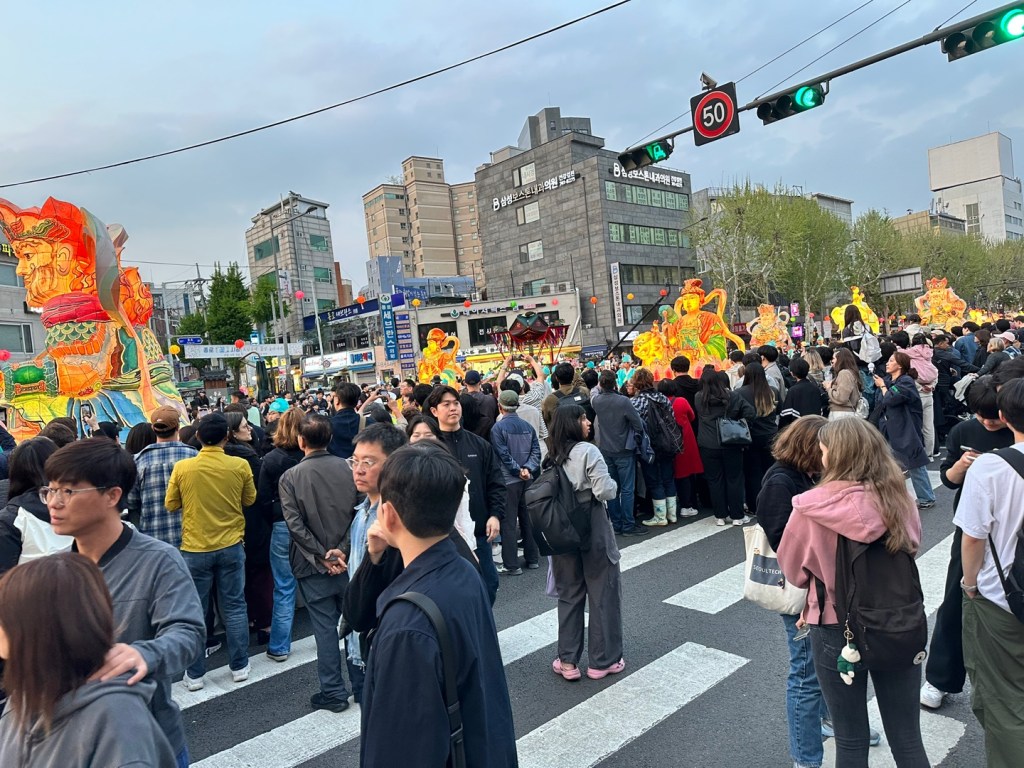
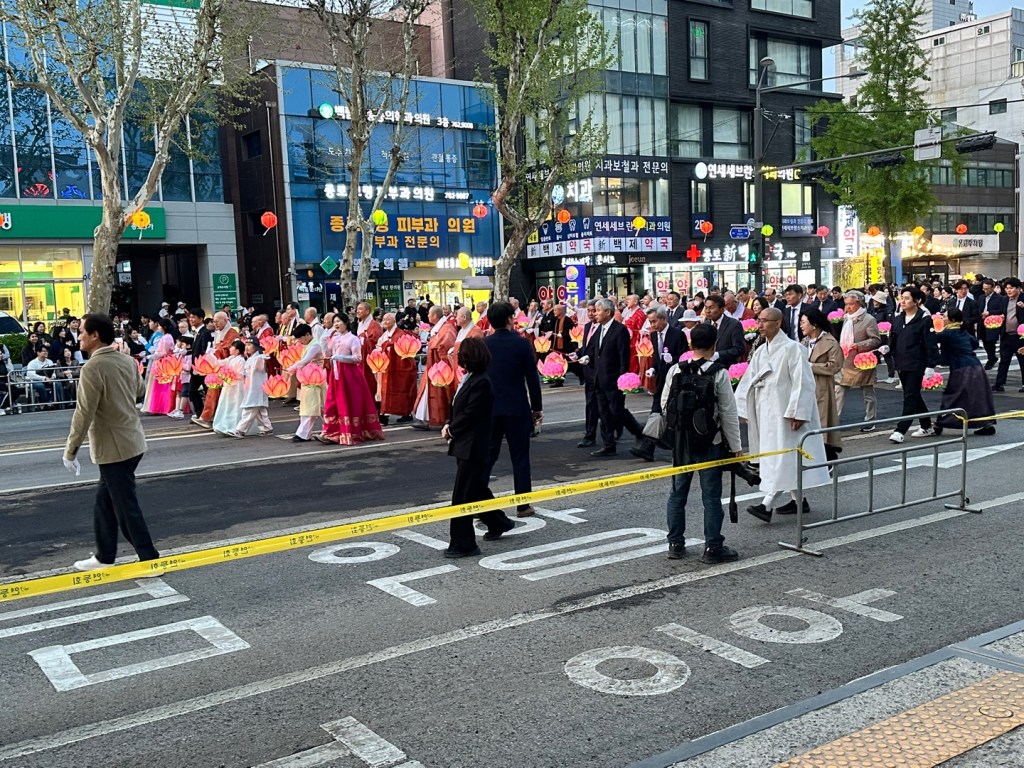
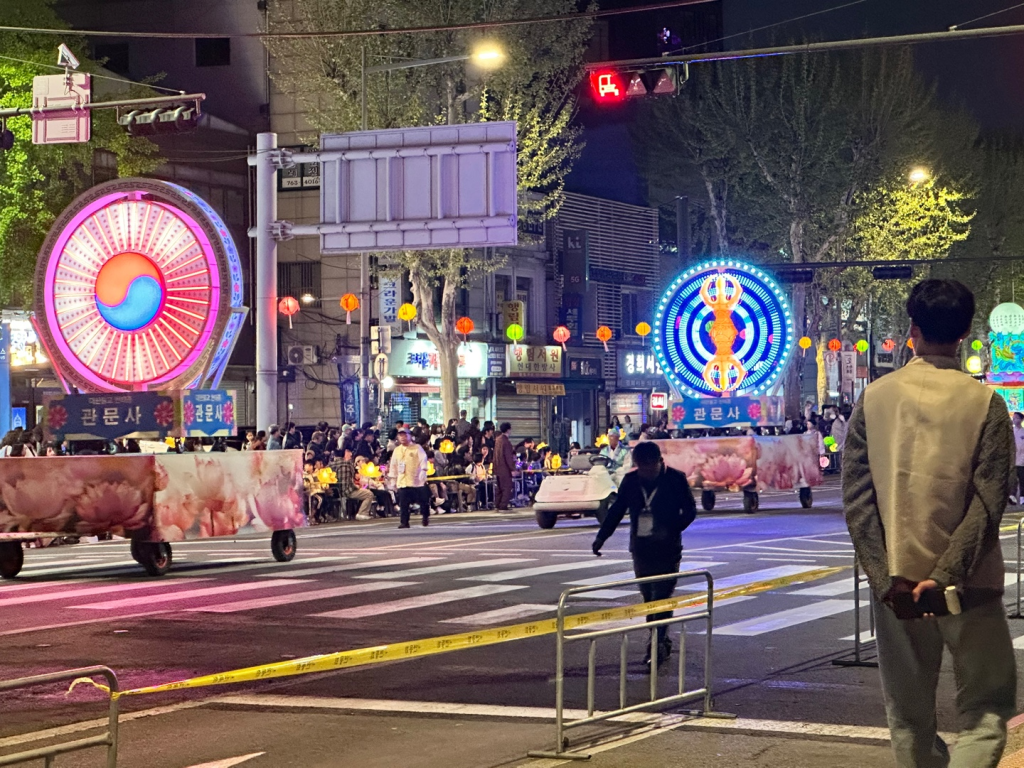
  • With Buddha’s birthday getting closer, towns everywhere around Korea are putting up lanterns. One of the biggest festivals for Buddha’s birthday is the Lotus Lantern Festival. Yeondeunghoe is a popular Buddhist festival that takes place in Seoul every year. The festival has been held every year for over 1000 years!

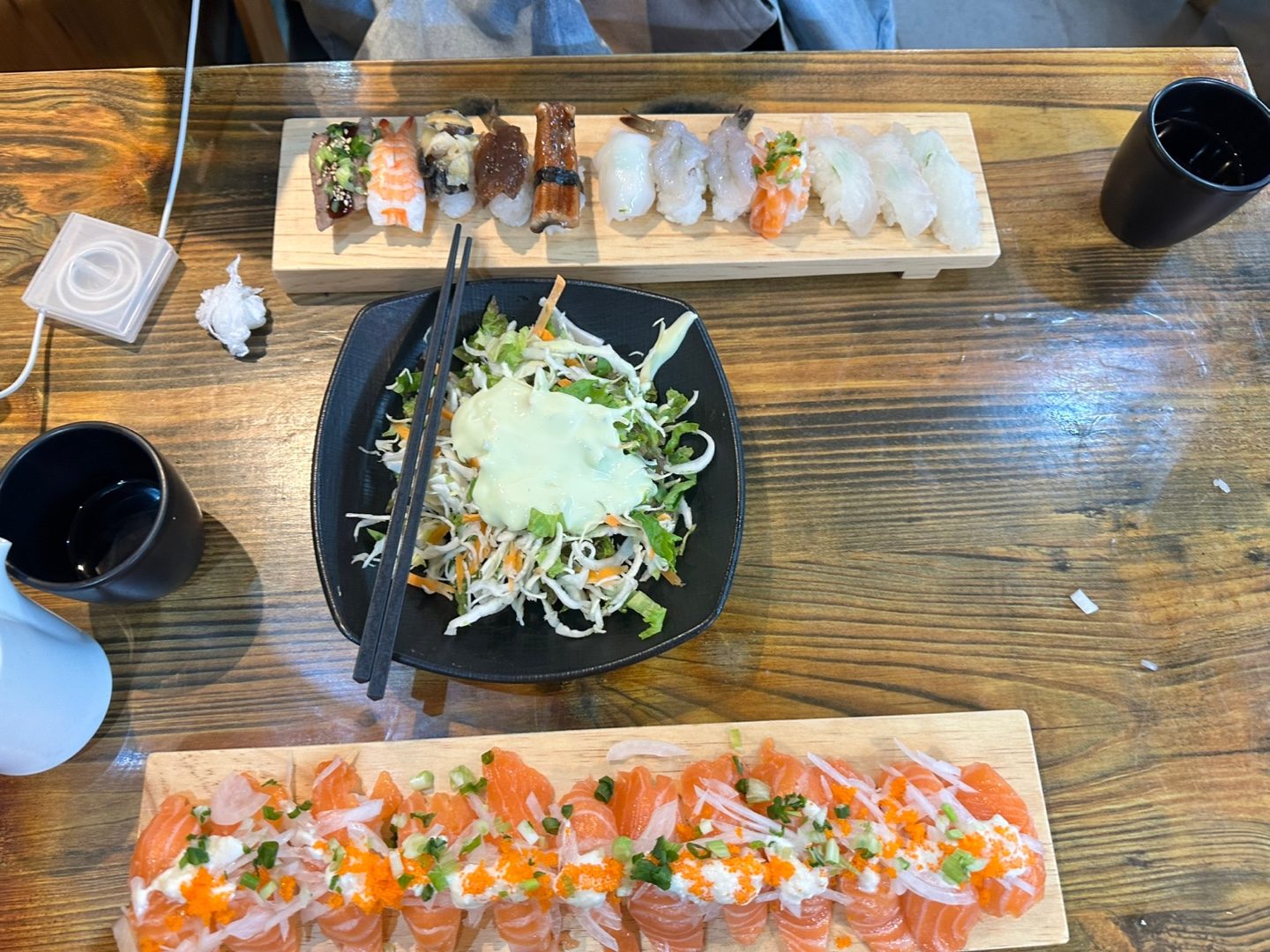
    I have to take the train to Seoul in the early afternoon from my town to get there. I’m scared of the food prices in Seoul, but since it’s a special day, I decided to eat some sushi right outside the parade before it started.

    I have to eat quickly to get there before the parade starts at 7:00… And everyone is already lined up so it’s hard to see. But if you go down the road for a while, there is enough space for everyone. It’s right next to the Seoul East Gate, Dongaemun.

    There’s too many people to see… So you should go down a little further.

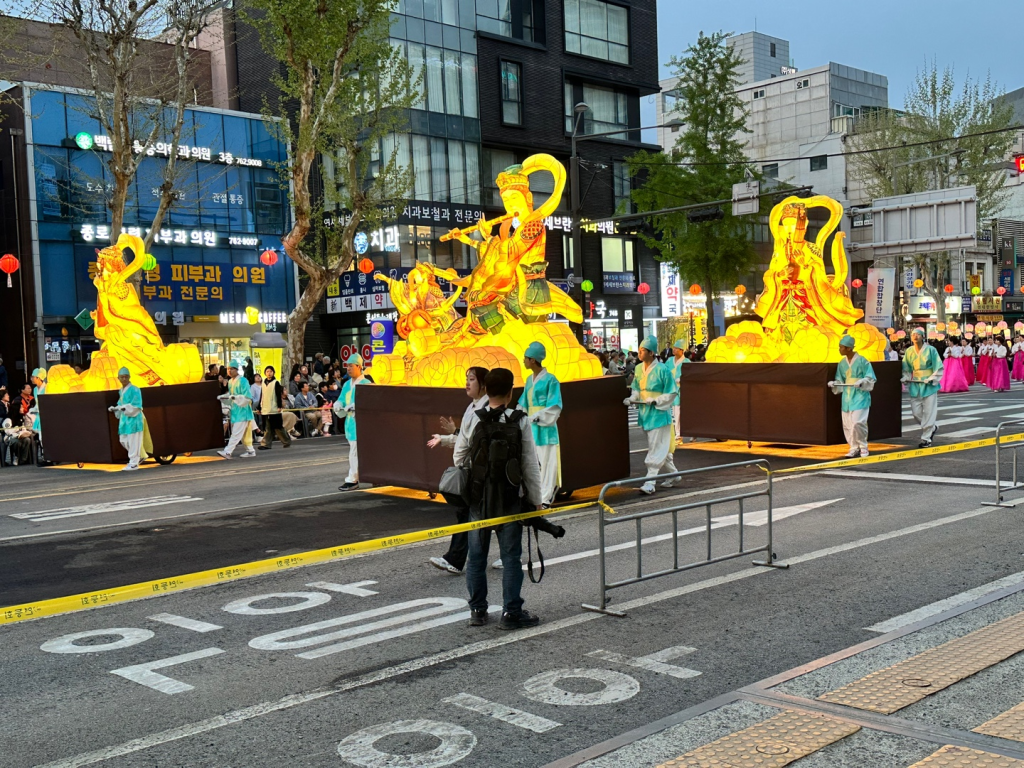
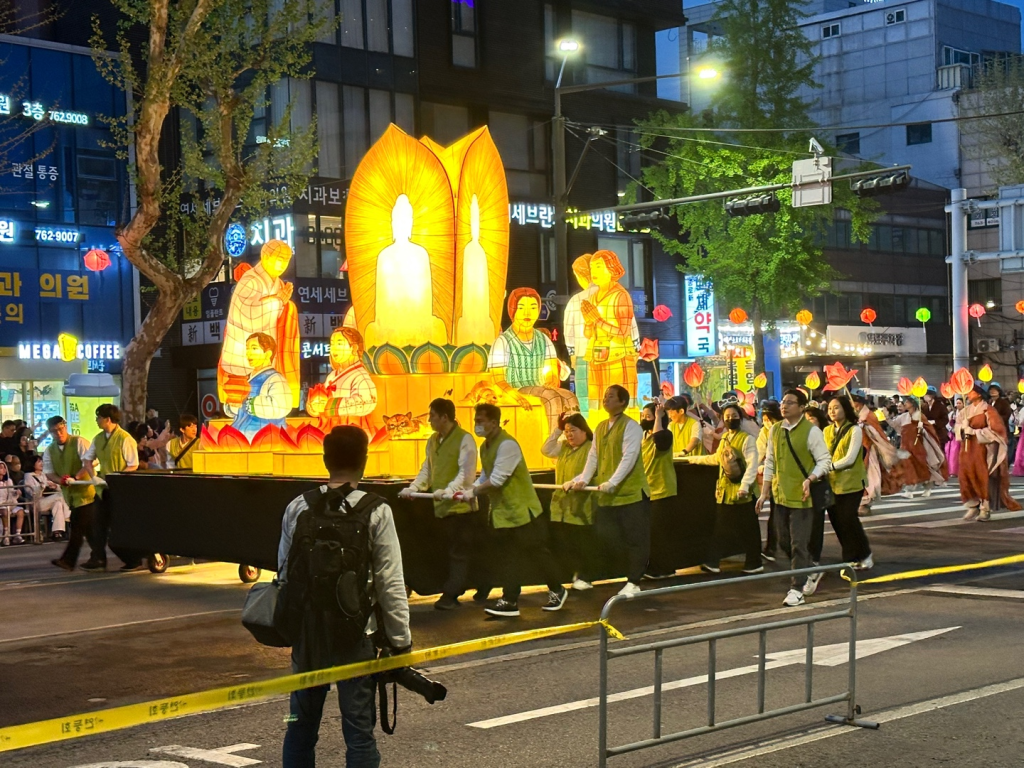
    Once it starts to get a little darker out, people thin out and the floats are very beautful.

    Actually, I’m a very poor photographer, and it’s hard to take good pictures in the dark, suffice to say it looks a lot better in person.

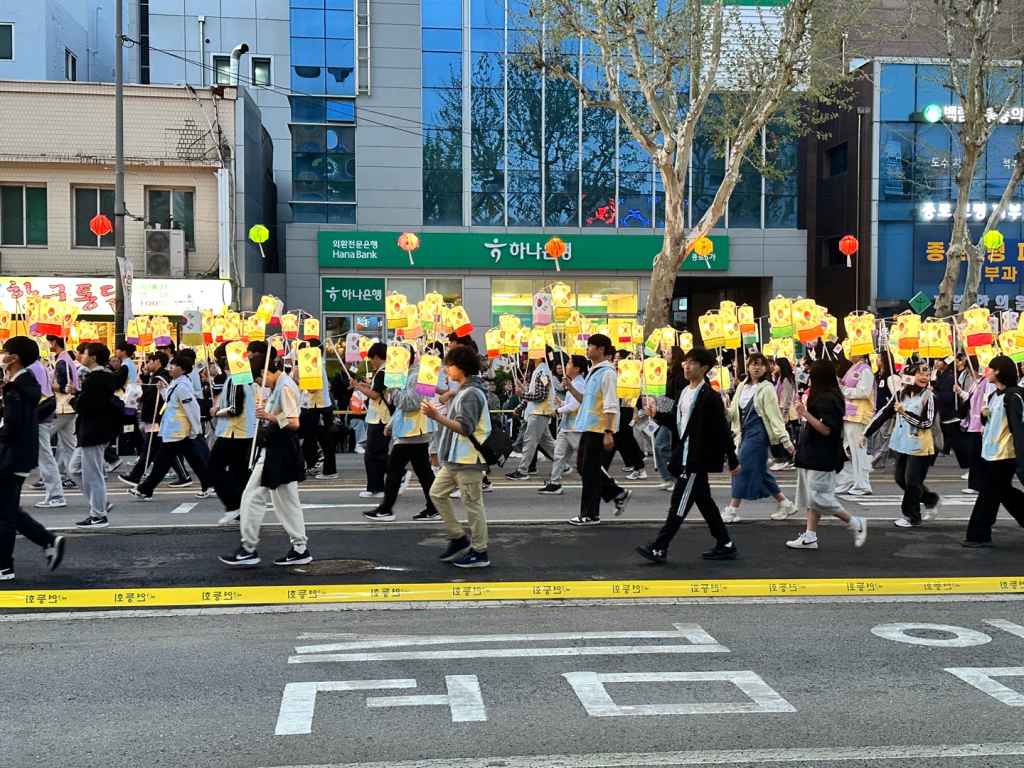
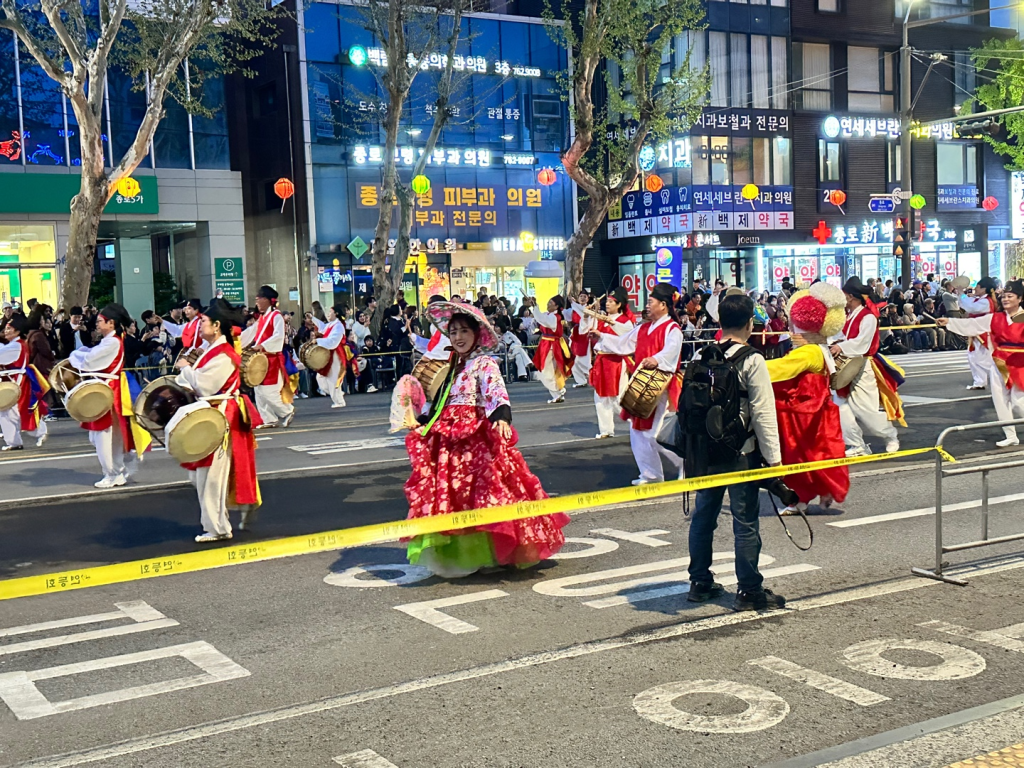
    Mainly, the floats are organized by individual temples. The main temple in charge of organizing the event is Jogyesa, so they have a lot of floats. The monks from the temples walk down the road carrying lanterns or pulling the floats. They all seem very excited.

    Also some Buddhist schools and colleges organize a float. A lot of the kids like to shout English phrases at me.

    I had to go to a wedding far away the next day, so being out late and getting up early the next day was pretty exhausting.

    Anyways, there’s not much else to say about this parade. Of course, there is more than just the parade, but I don’t know very much about it.

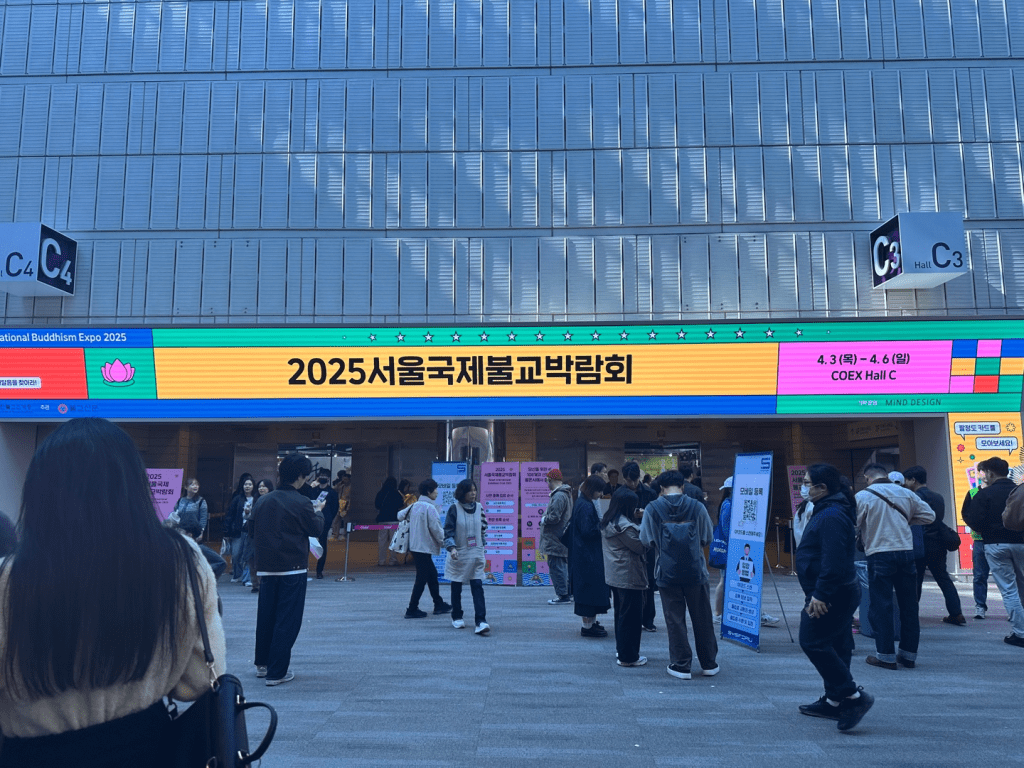
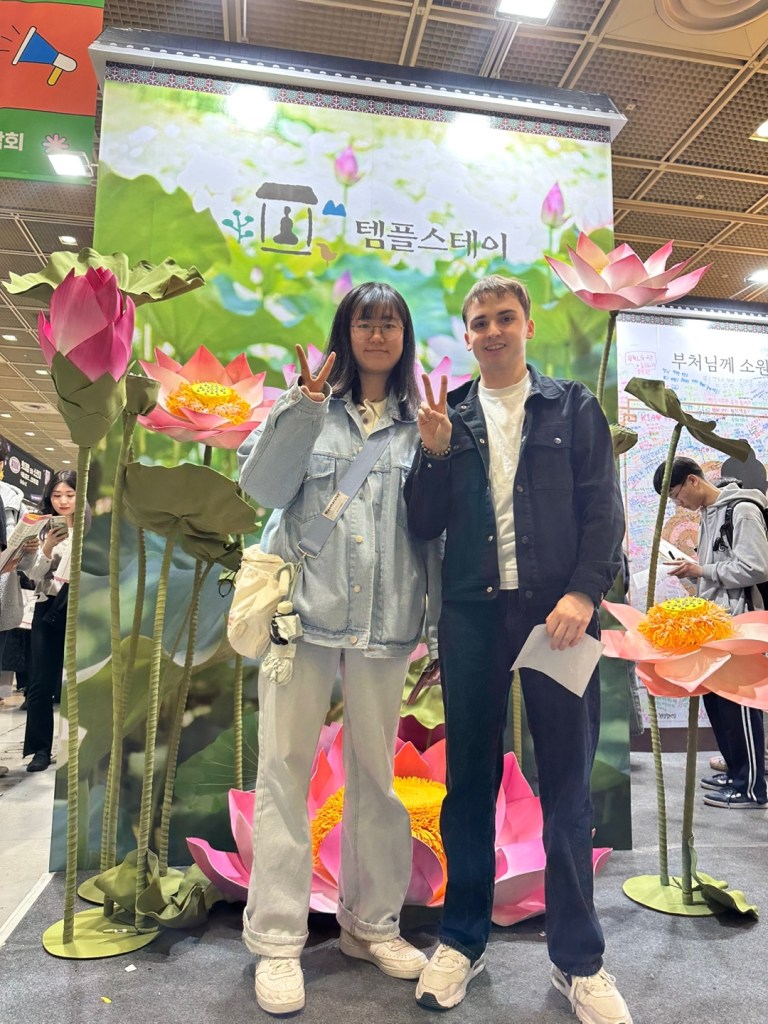
  • In 2024, I went to the International Buddhism Expo after it suddenly became very popular. From its marketing, it seems like an effort to get younger people interested in practicing Buddhism. This year, the expo was from April 3rd to April 6. It was next to the Starfield Coex library. Instead of going to look at a bunch of fake books, you should come to the Buddhism expo.

    Actually, one of my majors in college was religious studies, so I didn’t want to miss it this year.

    The venue is a lot bigger than last time. Before, there were so many people that the line circled around the entire building. This year, I just had to wait about 10 minutes to get in, and it costed 10,000 won per person.

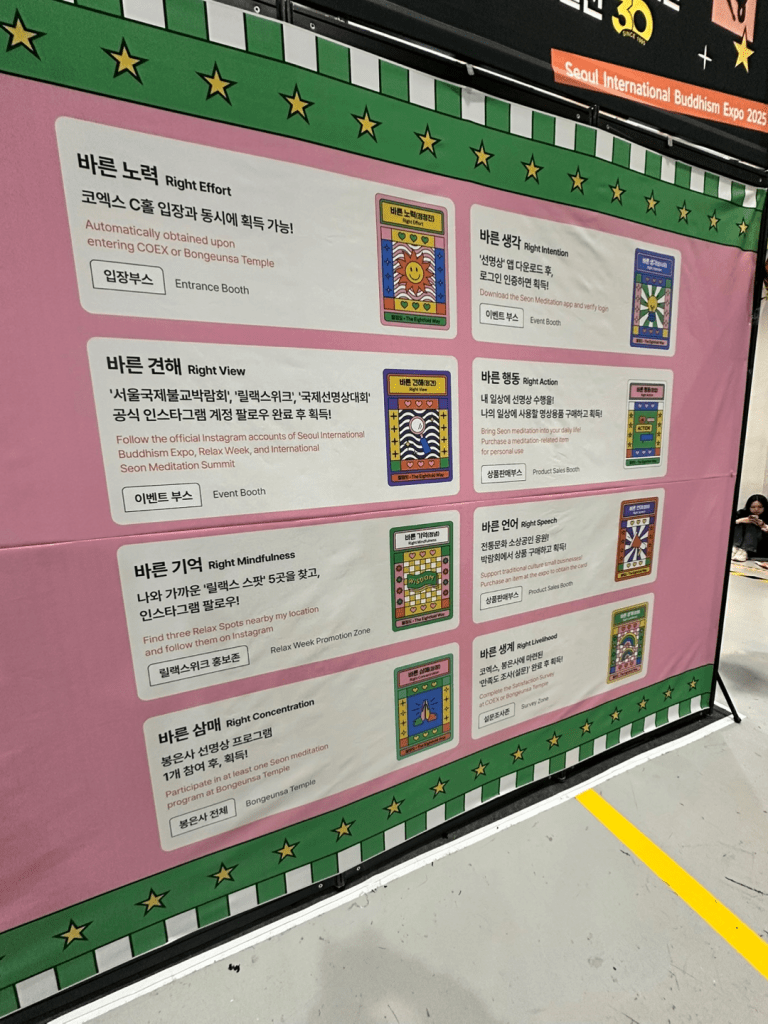
    This year they were doing a campaign to help people remember the elements of the Noble Eightfold Path. You can collect cards and different spots, and trade them in at the end. I wasn’t able to get all of them, but they just gave me the missing cards anyways.

    Then there was a quiz on Buddhism. I got a 75% on it, but it was kind of hard to read. We got some information about templestay around Korea, which we were planning on going to anyways this year.

    Even if you aren’t Buddhist, it’s good to go to a templestay to support the monk’s way of life and to learn about something new.

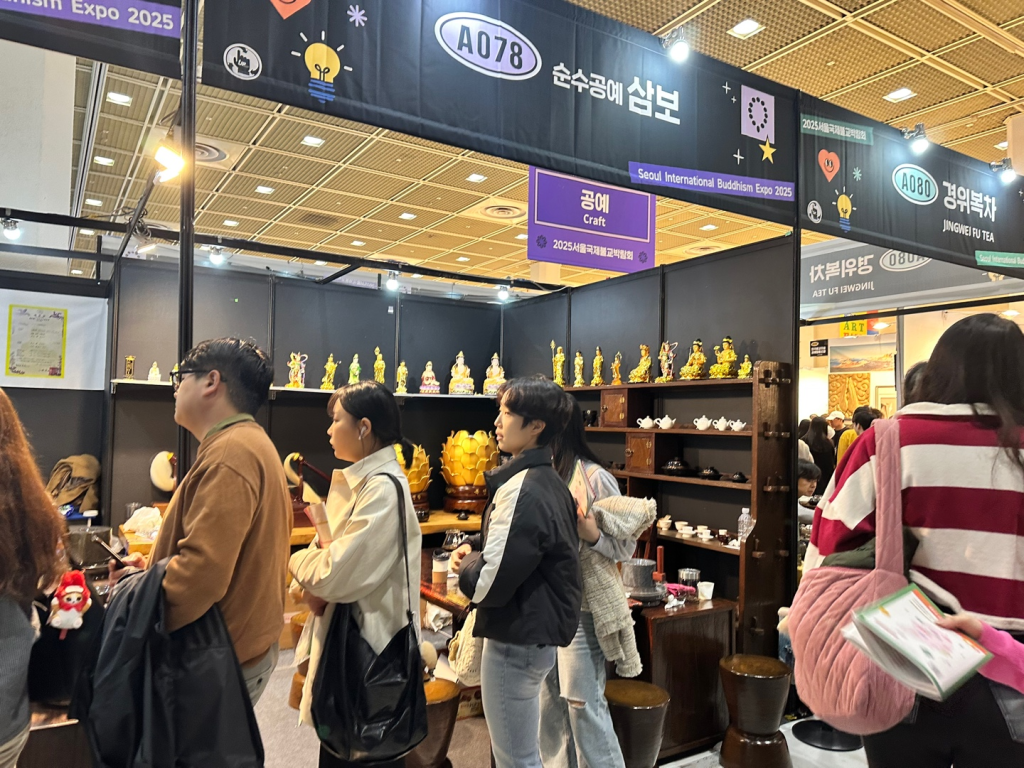
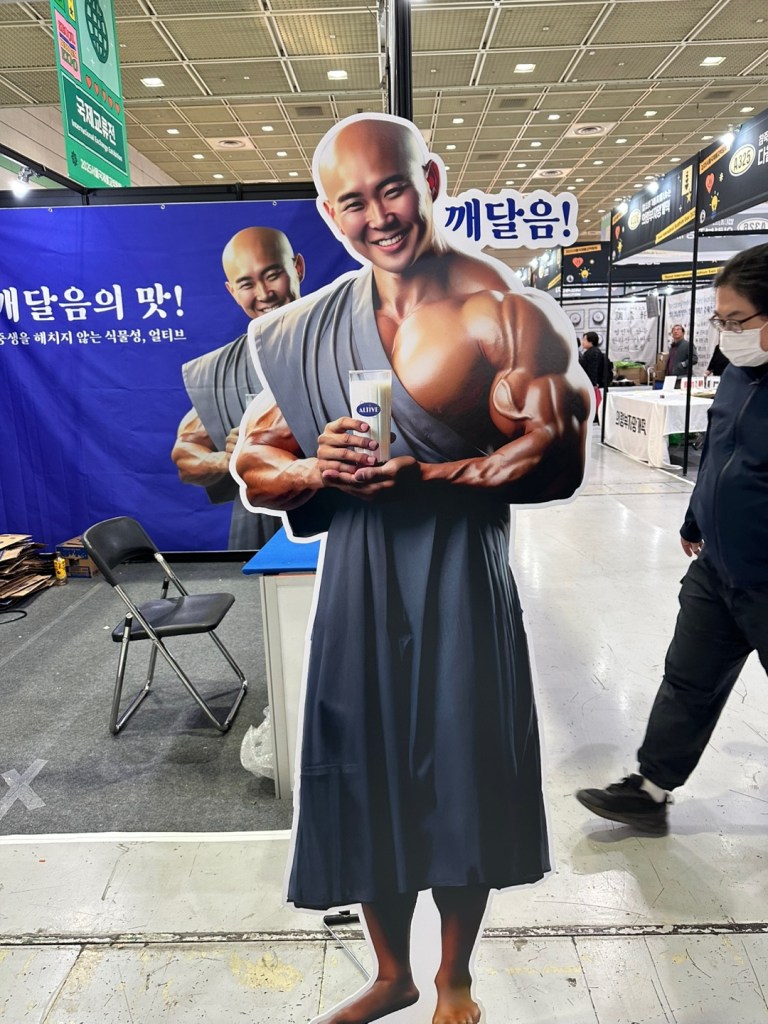
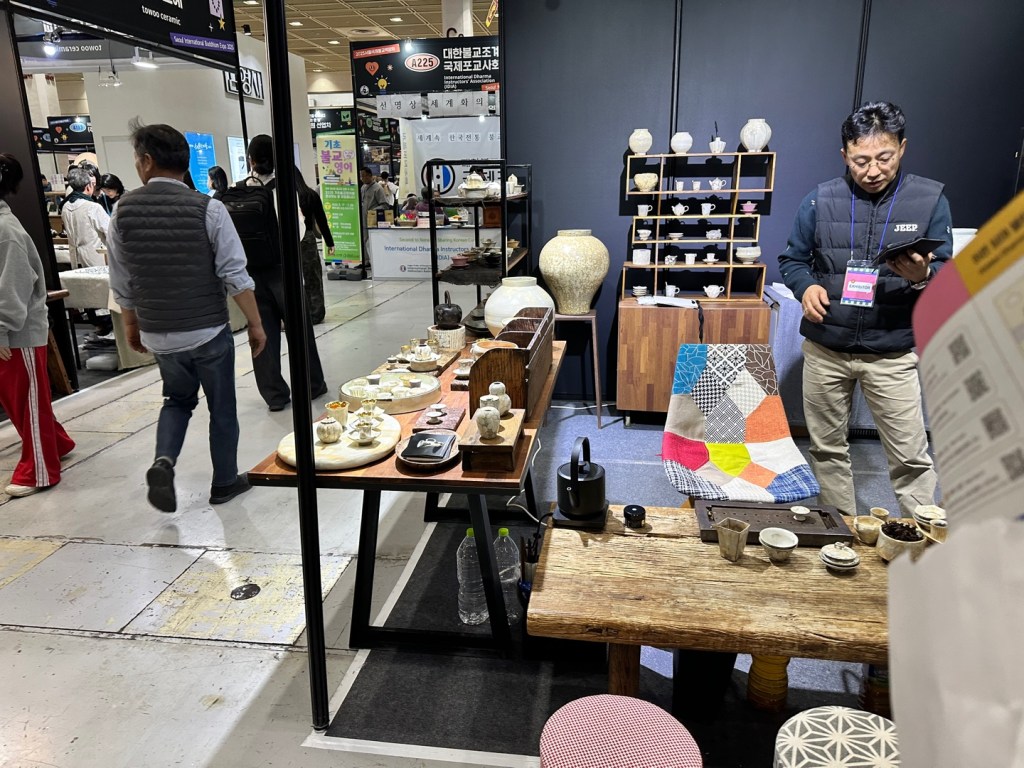
    There were a lot more booths this year compared to last year. There were a lot of younger people as well. And there were many monks as guests that seemed to be having a fun time. They can buy new monk clothes or different Buddhist products.

    Actually, many laymen wanted to come to buy some of the monk’s clothes. I wanted to buy one too, but they were sold out of my size.

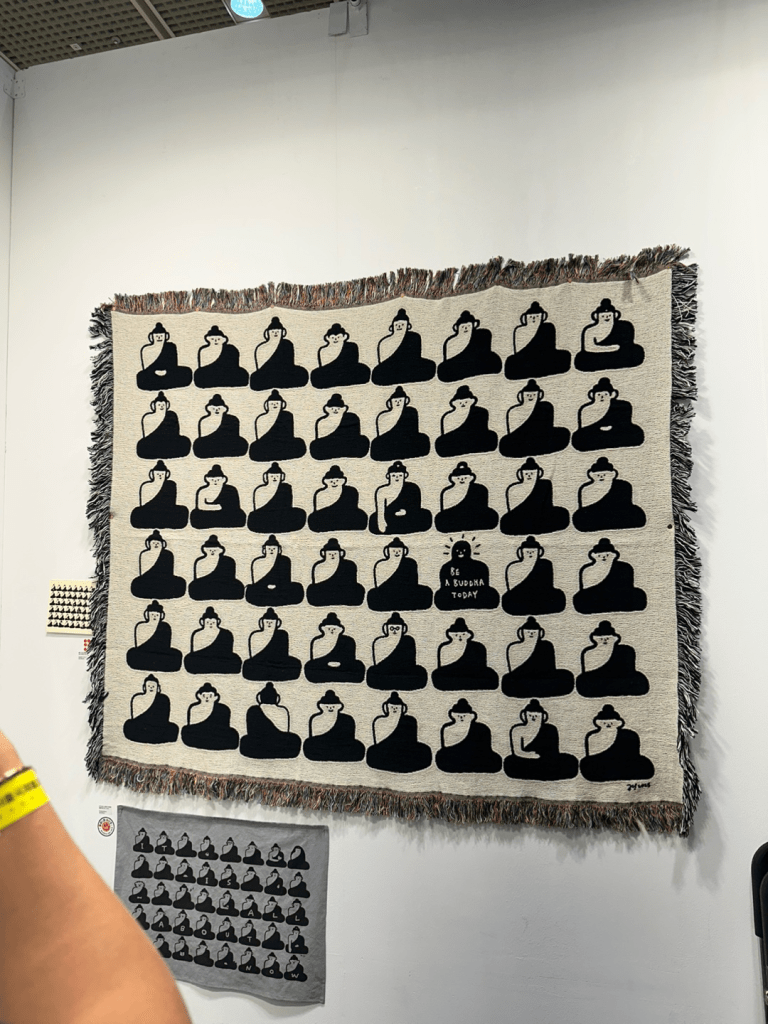
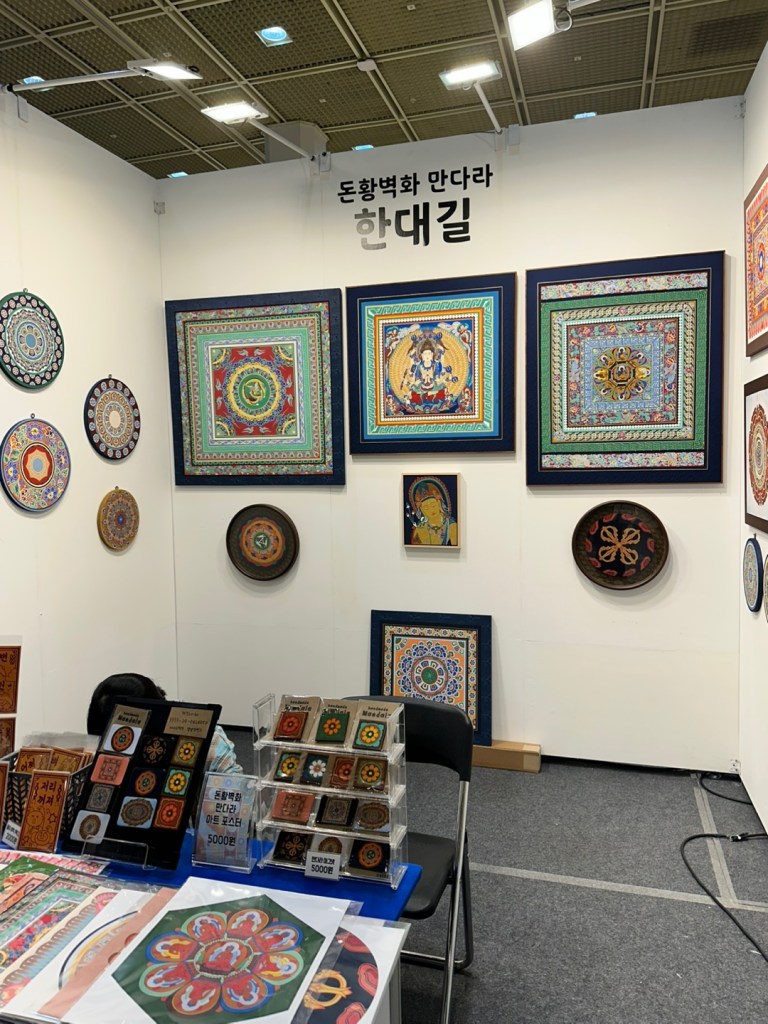
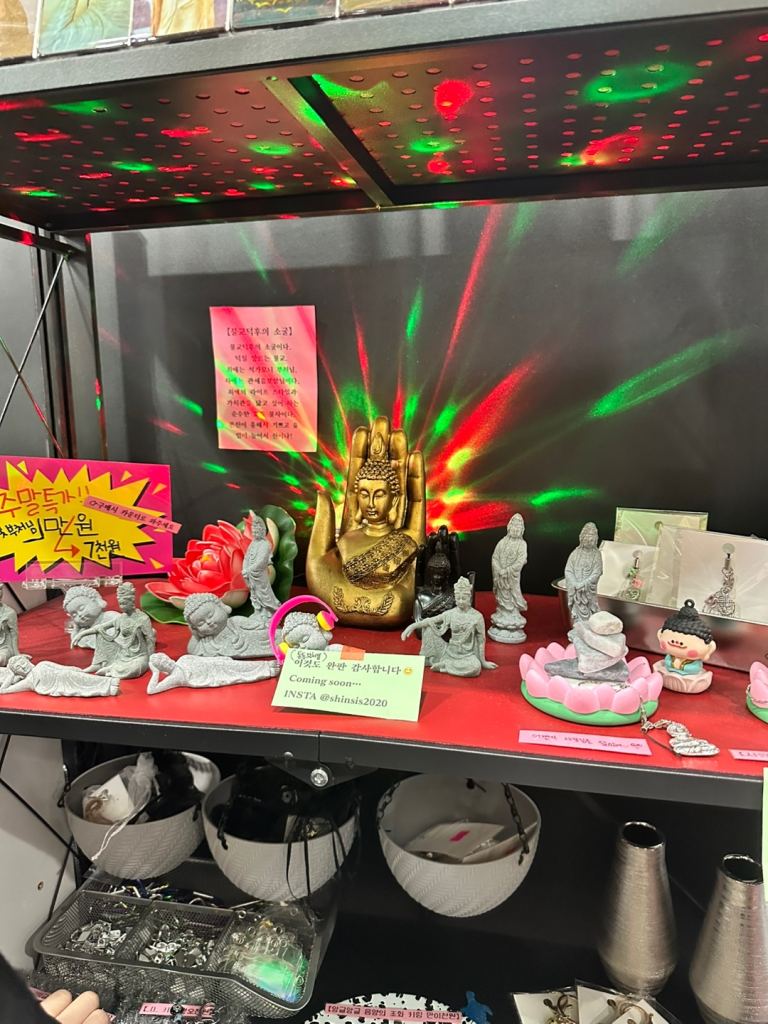
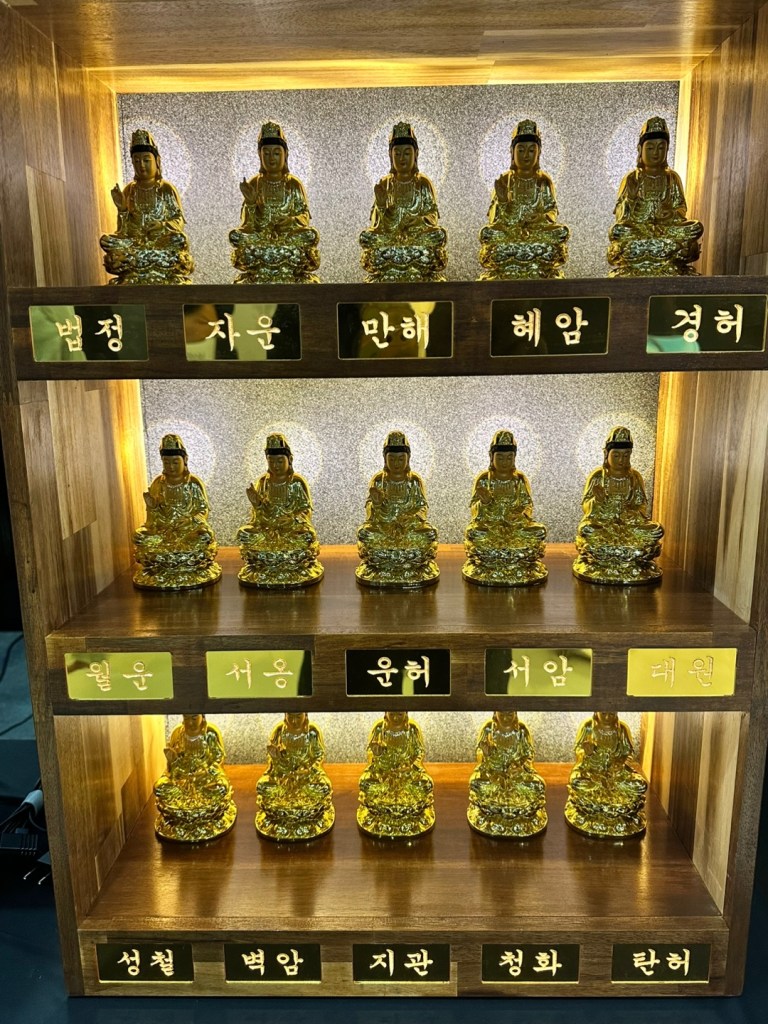
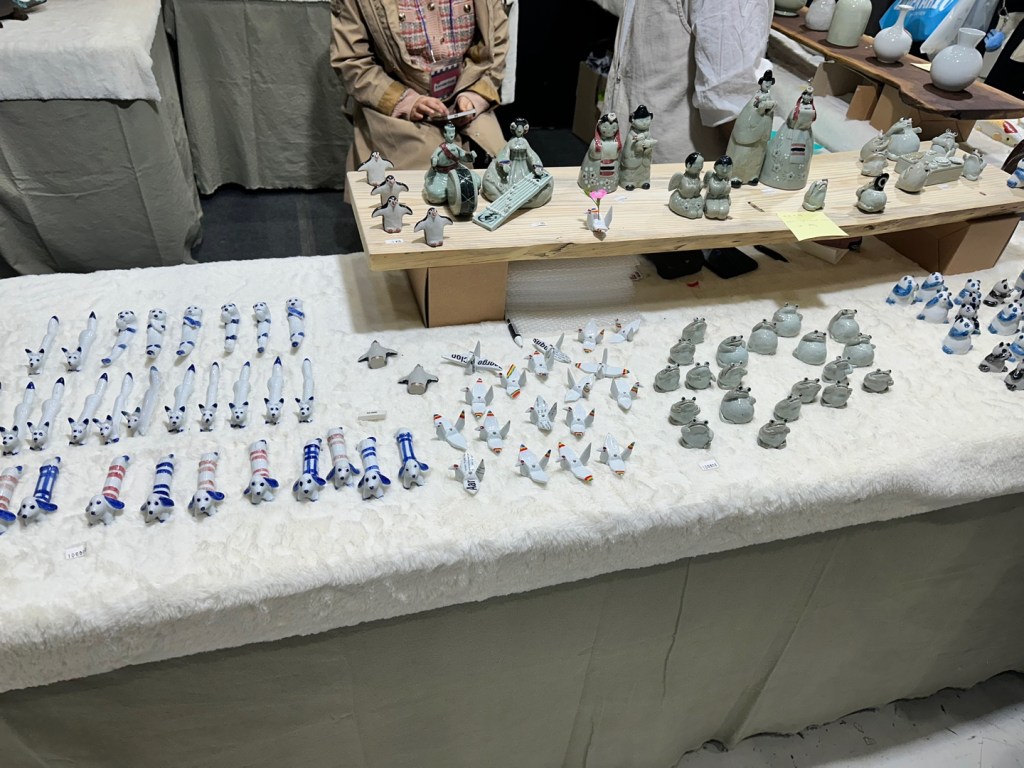
    Like last year, there was a mix of stalls with more traditional Korean art, art from Thailand, Japan, and India, and a lot of contemporary art that was geared at younger people.

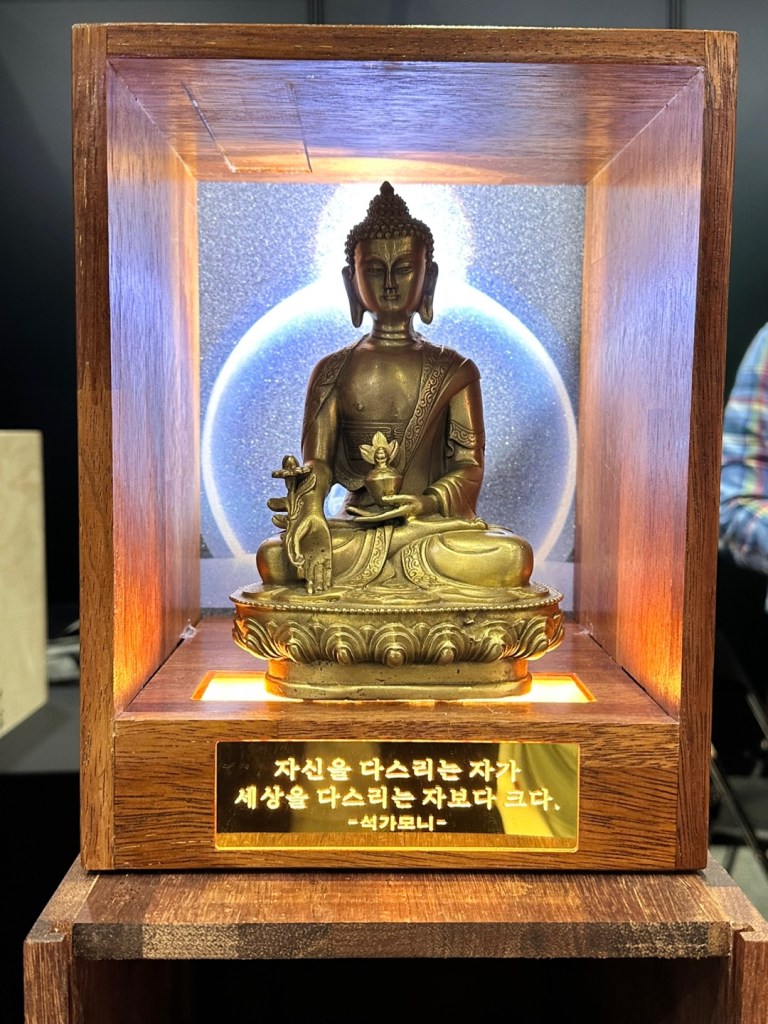
    You can tell where the art comes from based on its style. This one looks a lot like India or Nepal. I think the religious art from that region looks the most interesting.

    I also randomly met an older Korean lady working at a booth who claimed to have met Hillary Clinton, because she went to Yale at the same time as her. I found it kind of funny that that’s the first thing she said to me. I got a book for free from her about how to integrate Buddhism into your daily life.

    I stayed right up until the event closed, and before I went home I bought some prayer beads and a statue. But most of the things I really wanted were already sold out when I got there… So I will try again next time.

    If you’re interested in going, go to their website here. Actually, even though there are only a few foreigners, I don’t think you need much Korean to have fun! There are hundreds of booths to see. I think the Korean monks will be happy to see Buddhist culture reaching wider audiences, so you should definitely check it out if you are in Korea.